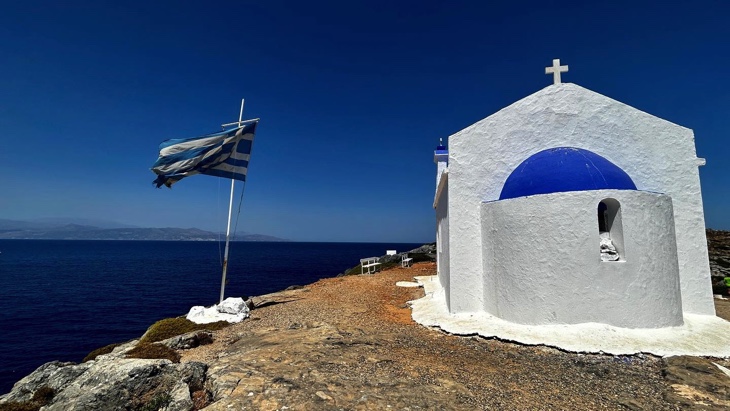




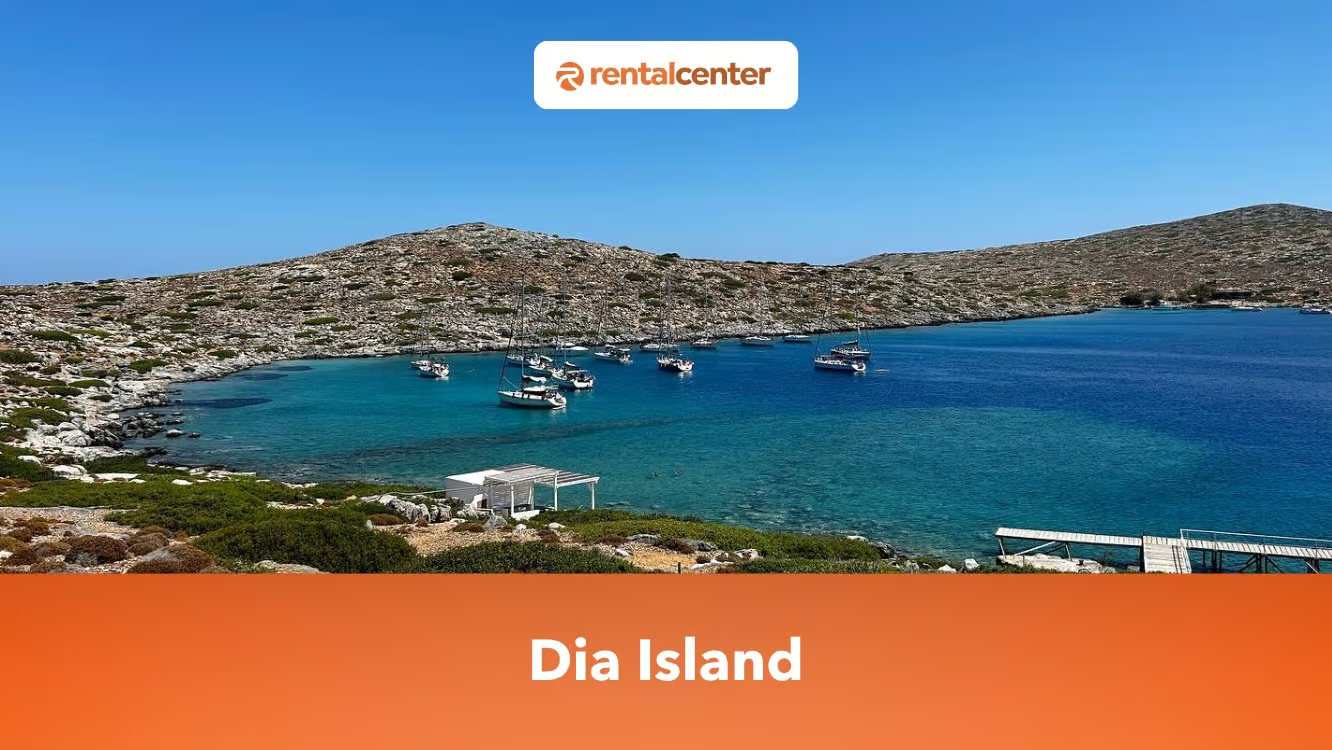
Dia Island is an uninhabited Natura 2000 protected island located 7 km (4.35 miles) north of Heraklion, Crete. Reachable by a 30-minute boat trip from Heraklion, Gouves, or Hersonissos, the island is open to day visitors for snorkelling, birdwatching and hiking – but no overnight stays, no camping, and no cars are permitted. Dia shelters the Kri-Kri wild goat and 300–400 pairs of Eleonora’s Falcon, and the seabed off its south coast holds the Cyclopean Walls – the remains of an ancient port discovered by Jacques Cousteau in 1976.
What Is Dia Island?
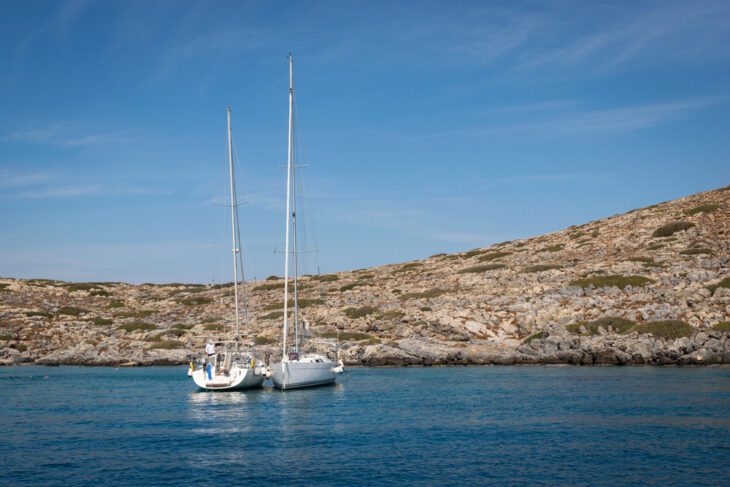
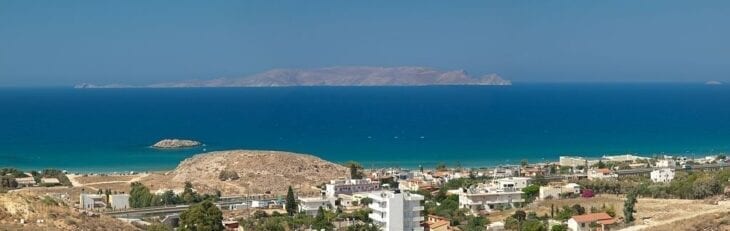
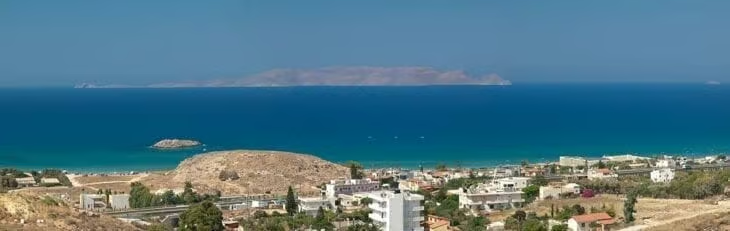
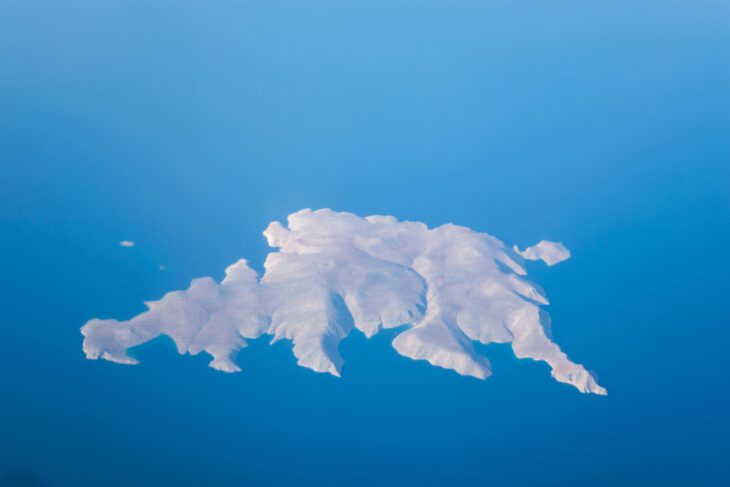
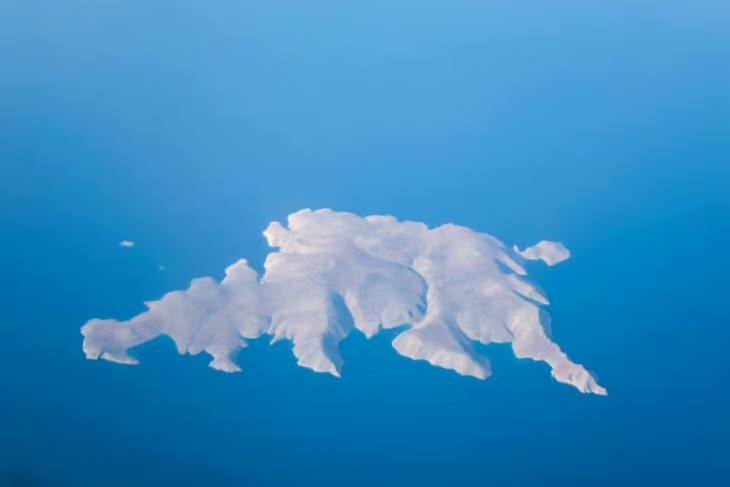
Dia Island is a small uninhabited island 7 km (4.35 miles) north of Heraklion, protected under the EU Natura 2000 programme, accessible only by boat and open to day visitors for snorkelling, birdwatching and hiking. It measures 5 km (3.11 miles) long by 3 km (1.86 miles) wide (~11.9 km²), with a peak at Vardia (220 m) and a coastline of cliffs reaching 60 m. Two small islets – Paximadi and Petalidi – sit nearby. Viewed from Heraklion, the island’s outline resembles a giant lizard, a shape that Greek mythology attributes to a petrified sea monster.
Why is Dia Island uninhabited?
Dia Island is uninhabited because it lacks the fresh water, agricultural land, electricity infrastructure and economic base needed to support permanent habitation. Springs dried up roughly 1,000 years ago when forests were cleared for shipbuilding. The island’s last regular human presence ended in 1937 when a small vine-growing community left. Today, Dia’s uninhabited status is preserved by law – as a Natura 2000 protected area, permanent settlement, infrastructure development and electricity connections would all violate EU environmental regulations.
Does anyone live on Dia today?
No – Dia carries three overlapping identities (a node of Greek mythology, a historical Minoan-era port, and a living wildlife sanctuary), but no permanent human residents.
What is Dia Island known for?
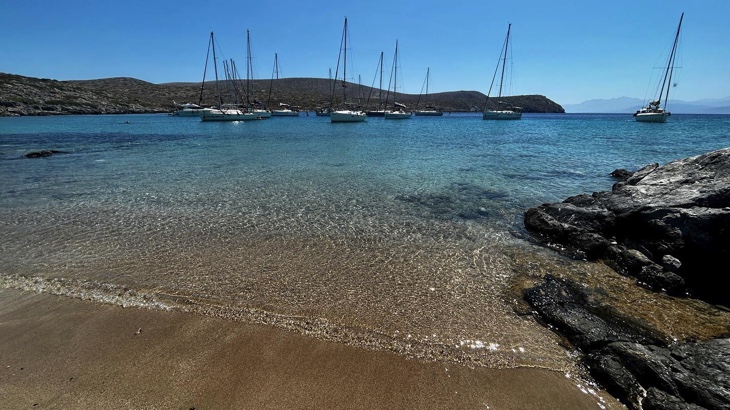
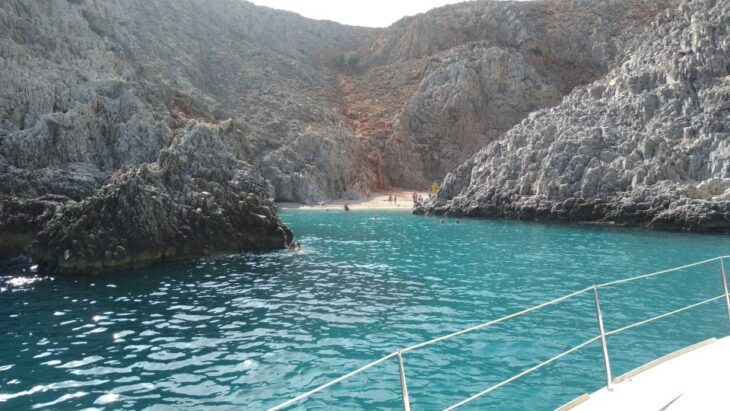
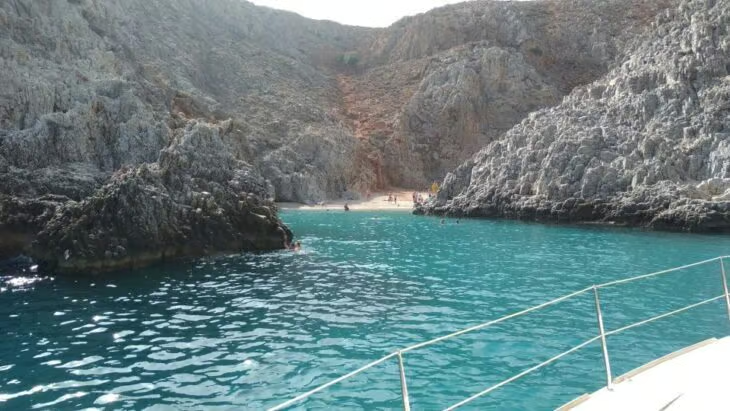
Dia Island holds Natura 2000 protected status and shelters the endangered Cretan wild goat (Kri-Kri, Capra aegagrus cretica), making it one of the most biodiverse small islands in the Aegean. The island offers rocky coves with exceptional snorkelling visibility rather than wide sandy beaches, with crystal-clear waters hosting diverse marine fauna across all five of its named bays. Cousteau’s seven shipwrecks and the Cyclopean Walls keep it on the radar of underwater archaeologists.
History of Dia Island
Dia Island served as the principal port of Crete during the Minoan period and is the site of seven ancient shipwrecks discovered by Jacques Cousteau in 1974–75, along with the remains of a submerged ancient port known as the Cyclopean Walls.
Minoan period: the ancient port of Crete
Dia’s strategic location and natural coves made it a Minoan-era anchorage from at least 3000 BCE. A harbour settlement once stood on the south coast near the present-day Bay of Agios Georgios – confirmed by the Cyclopean Walls now lying on the seabed. The island was already an important maritime marker for ancient navigators approaching Crete’s north coast.
Jacques Cousteau and the Cyclopean Walls
Jacques-Yves Cousteau explored the waters around Dia between 1974 and 1976 using a bathyscaphe, while searching for the lost city of Atlantis between Crete and Santorini. His 1974–75 expedition discovered seven ancient shipwrecks around the island. In 1976, Cousteau also identified submerged squared and rectangular rocks forming an artificial breakwater near the Bay of Agios Georgios – now called the Cyclopean Walls by researchers – which he believed to be the remains of one of Crete’s most important ancient ports. The harbour is thought to have been destroyed by the 1450 BC Santorini volcano eruption, whose tidal waves overwhelmed it and ended Dia’s role as a major port.
From Standia to Dia: Byzantine and Venetian era
Throughout the Byzantine and Venetian periods, the island was known as Standia – a name preserved on Venetian sea charts and used for centuries as a navigation marker for ships approaching Heraklion. The modern name “Dia” reflects an older Greek root meaning “through” or “across”, evoking the island’s role as a maritime gateway.
Sources: Jacques Cousteau’s 1976 exploration report; T.A.B. Spratt, Travels and Researches in Crete (1865); BirdLife International Dia Island Data Zone (2022); European Natura 2000 Protected Areas database.
Mythology of Dia Island
Greek mythology says Zeus created Dia by turning a sea monster into stone with a thunderbolt – the island’s lizard-like profile from Heraklion still echoes this legend.
Zeus and the dragon: the creation myth
According to the most widely repeated legend, a sea monster threatened Crete; Zeus hurled a thunderbolt and petrified it, leaving its body offshore as the island of Dia. The lizard-like outline visible from Heraklion is said to be the dragon’s fossilised form.
Artemis, Ariadne and Theseus: other mythological connections
A second tradition links the island’s name to Artemis, daughter of Zeus and goddess of wild animals – a fitting patron for what is now a wildlife reserve. A third legend connects Dia to Theseus: after slaying the Minotaur in the labyrinth at Knossos, Theseus is said to have stopped at Dia with Ariadne before sailing north – placing the island within one of the most famous myths of the ancient world.
Wildlife and Nature on Dia Island
Dia Island shelters two of Crete’s most iconic species: the Kri-Kri wild goat (Capra aegagrus cretica) and up to 400 pairs of Eleonora’s Falcon (Falco eleonorae) – one of the largest falcon colonies in Greece.
Kri-Kri: the Cretan wild goat
Dia Island shelters one of the last wild populations of the Kri-Kri (Capra aegagrus cretica) – listed by the IUCN as Near Threatened – within its Natura 2000 protected zone. Translocated to Dia in the 20th century as a refuge population, the goats roam the rocky slopes; visitors often spot them from the boat or along the path between Agios Georgios and the northern shelter.
Eleonora’s Falcon and birdwatching
Dia Island is home to one of Greece’s largest colonies of Eleonora’s Falcon (Falco eleonorae), with an estimated 300–400 nesting pairs. The Greek name for the bird is mavropetritis. The island is also visited by Purple Heron, Bee-eater, Little Egret, Peregrine Falcon and Blue Rock Thrush. The Eleonora’s Falcon colony on Dia is documented by the Greek Ornithological Society (BirdLife Greece) and BirdLife International’s Data Zone.
A wild subspecies of the European rabbit (Oryctolagus cuniculus cnossius) and several endemic snail species (including Albinaria retusa) and lizards round out the protected fauna.
Marine life and underwater landscapes
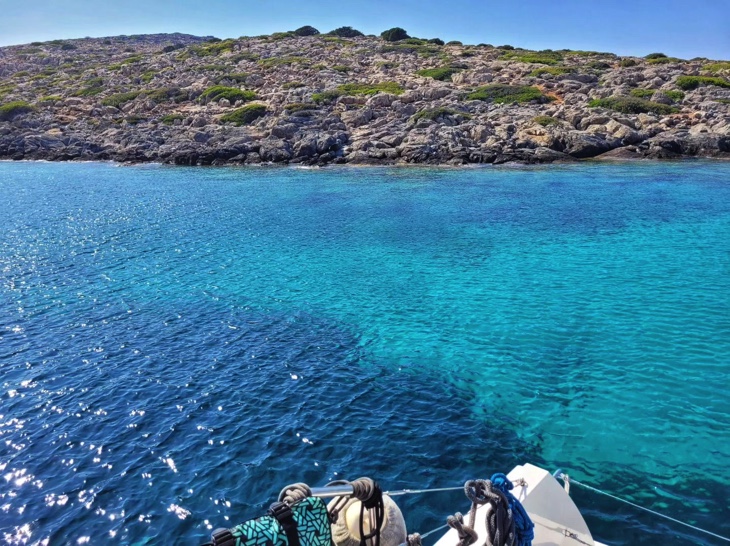
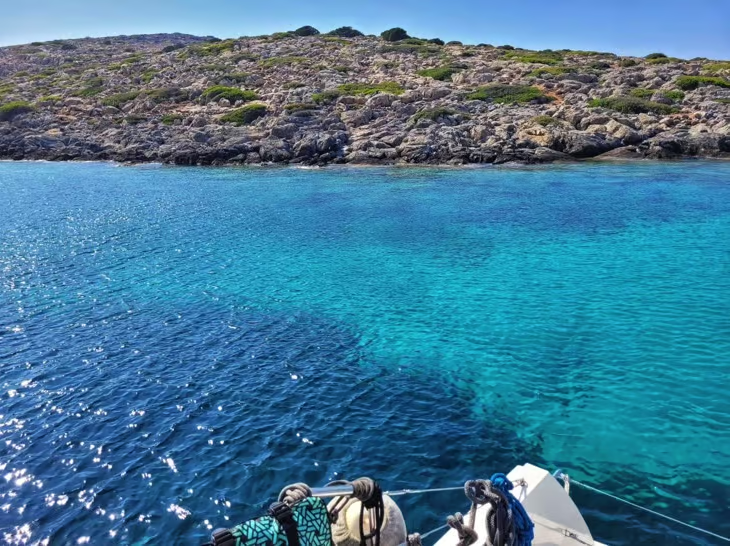
The waters around Dia are clear, sheltered and rich in fish – making them ideal for snorkelling. Boat trips from Heraklion typically anchor for two snorkelling stops in the southern coves, where coloured rock formations and seagrass meadows host bream, octopus and the occasional sea turtle.
Geography: Bays, Beaches and Landscape
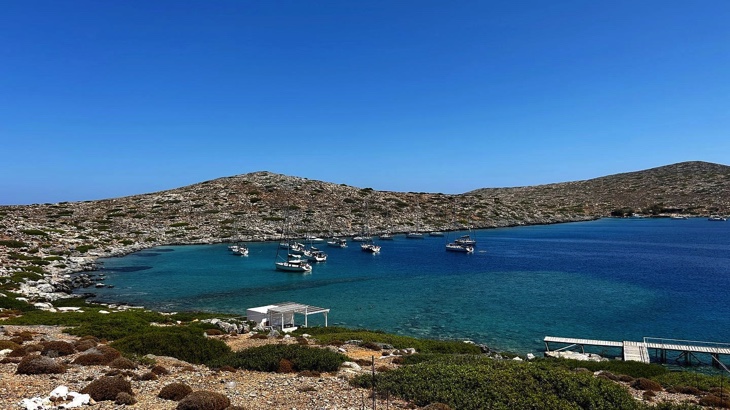
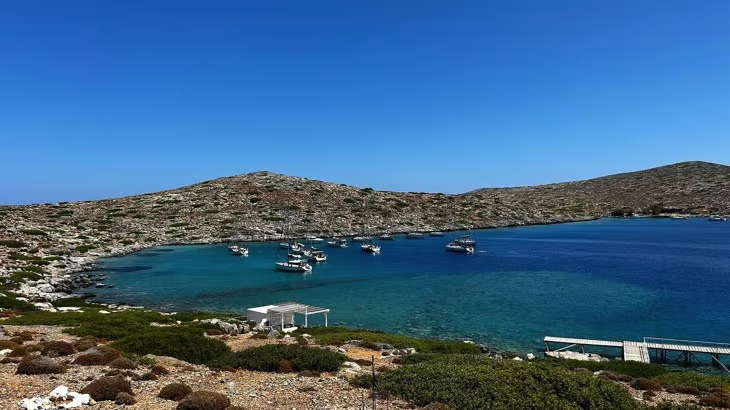
Dia Island extends 5 km (3.11 miles) long by 3 km (1.86 miles) wide (~11.9 km²) with a rocky peak at Vardia (220 m), and four sheltered coves on its southern coast plus a fifth, more exposed bay on its eastern side.
The southern coves
Find below a table describing the southern coves of Dia Island
| Cove | Position | Notable Feature |
|---|---|---|
| Agios Georgios | Westernmost south | Only port and landing point on the island |
| Kapari | Central-west south | Good anchorage; quiet snorkelling |
| Panagia | Central-east south | Most sheltered bay; main beach |
| Agrielia | Easternmost south | Wilder, less visited |
| Aginara | East coast | Exposed; for experienced swimmers |
Panagia Beach
Panagia sits in Dia’s most protected southern bay – calm waters, arid rocky slopes scented with Cretan oregano, and the occasional wild rabbit hopping among the shrubs. Distance from any landing point depends on where the boat anchors; allow 15–25 minutes on foot from Agios Georgios.
Beach Analipsi
Sandy stretch 240 m from Dia’s harbour – preferred by visitors who want quieter, less-crowded swimming.
Vardia peak and rocky cliffs
Vardia rises to 220 m at the island’s highest point. The northern coastline drops in unstable cliffs of up to 60 m to the Cretan Sea – stay well back from the edges; there are no railings and no rescue infrastructure.
How to Get to Dia Island?
The only way to reach Dia Island is by boat; most trips depart from Heraklion port (30 min), with additional departures from Gouves and Hersonissos along the northern Cretan coast.
Boat from Heraklion, Gouves and Hersonissos
| Departure | Boat type | Typical cost (per adult) | Notes |
|---|---|---|---|
| Heraklion old port | Half-day with snorkelling stop | €25 ($28.70, £21.19)–€45 ($51.66, £38.14) | 25–35 min crossing; daily May–October |
| Heraklion old port | Full-day sailing tour with lunch | €60 ($68.89, £50.85)–€90 ($103.33, £76.28) | The popular Crete sailing trip route |
| Gouves | Summer-season RIB | €30 ($34.44, £25.43)–€50 ($57.41, £42.38) | Faster, smaller groups |
| Hersonissos | Summer-season day cruise | €30 ($34.44, £25.43)–€50 ($57.41, £42.38) | Convenient for east-coast resort guests |
Practical note: Boat schedules, ticket prices and operator names change seasonally. Always verify departure times and book tickets directly with the port authority or operator before your trip. This guide reflects 2024–2025 data.
How long is the boat trip to Dia?
About 25–35 minutes from Heraklion’s old port. RIB boats from Gouves and Hersonissos can be slightly faster but more weather-dependent.
What to Do on Dia Island?
Dia Island’s main activities are snorkelling in crystal-clear coves, birdwatching for Eleonora’s Falcon and Kri-Kri spotting, with walking as the primary way to explore the island.
Snorkelling and diving
Dia’s primary activities are snorkelling, swimming and birdwatching. Panagia bay is the calmest for beginners; Agios Georgios offers the only harbour landing. Boat operators typically anchor for two snorkelling stops on a half-day trip.
Birdwatching
Dia hosts one of Greece’s most important Eleonora’s Falcon colonies (300–400 pairs of Falco eleonorae). Bring binoculars; the falcons are most active in late afternoon as they hunt migrating songbirds across the channel.
Hiking and walking trails
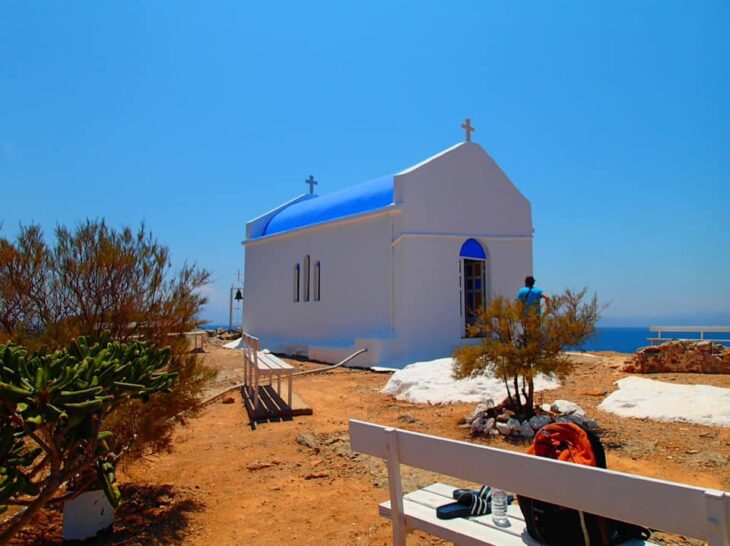
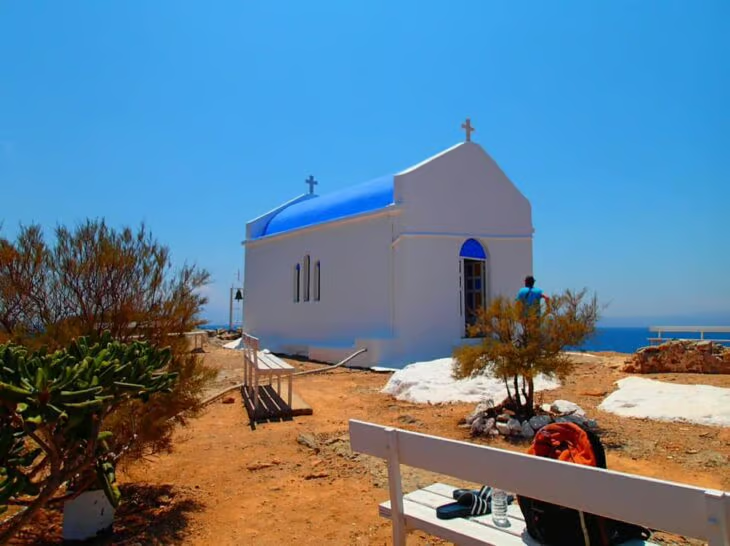
A stone-paved path runs from Agios Georgios harbour towards the northern shelter (~3 km (1.86 miles), ~1 hour each way). The trail to the chapel of Analipsis offers the best chance of Kri-Kri sightings.
Boat tours and sailing trips
Half-day boat trips from Heraklion typically include two anchor stops (Agios Georgios + one other cove) and a swim. Full-day sailing tours include a BBQ lunch onboard. Afternoon sailings are popular because they avoid the hottest hours and the strongest meltemi gusts.
Practical Information for Visiting Dia
Dia Island is open to day visitors only – no camping, no overnight stays and no cars are permitted; bring your own food and water as there are no facilities on the island.
Important: Dia Island is a strictly protected Natura 2000 nature reserve. Visitors must leave the island before nightfall. Camping, lighting fires, picking plants and disturbing wildlife are prohibited under Greek law and EU environmental regulations. Carry out all waste – there are no bins or waste collection facilities.
Is camping allowed on Dia Island?
No. Dia is a Natura 2000 reserve; camping and any overnight stays are prohibited. The island has no designated sites or facilities.
Can you stay overnight on Dia?
No – Dia Island remains uninhabited and operates under strict Natura 2000 regulations that prohibit permanent settlement, overnight stays and vehicle access. All visitors must leave the island before nightfall. For overnight accommodation, Heraklion offers a wide range of hotels within walking distance of the port – ideal for an early-morning departure to Dia. Hotels near the Old Town and Koules Fortress are popular choices.
What to eat on Dia?
Nothing is sold on Dia. Most boat trips include onboard BBQ, soft drinks and water. Bring extra snacks and at least 1.5 L of drinking water per person.
Is Dia safe for children and older visitors?
Yes. Dia Island poses no significant safety risks – the protected reserve status ensures regulated access and a well-maintained environment. Children love the boat ride and the easy-to-spot wildlife (goats, falcons, rabbits); supervise near cliff edges. Older visitors find the boat ride short and gentle; the southern coves are accessible without strenuous hiking, but bring good walking shoes for the harbour-to-coves path.
How to prepare for your Dia day trip
- Boat tickets – book in advance during July and August
- Walking shoes – paths are stone, rock and uneven dirt
- Sun protection – SPF 50+, wide-brim hat, UV sunglasses; minimal shade between coves
- Beach supplies – towels, swimwear, snorkelling gear
- Food and water – 1.5 L per person minimum; nothing is sold on the island
- Camera and binoculars – for falcons, Kri-Kri and the Heraklion skyline
- Cash – optional for onboard purchases; the island itself has no shops
Getting Around Crete to Reach Dia
Renting a car in Crete lets you reach all three Dia departure points (Heraklion, Gouves, Hersonissos) on your own schedule; note that rental cars cannot be taken by ferry to Dia itself.
To reach Dia’s departure ports independently, rent a car in Crete. Rental prices average €30 ($34.44, £25.43)–€40 ($45.92, £33.90)/day or ~€250 ($287.03, £211.88)/week. Key requirements: valid driving licence, credit card, minimum age 21–23. Note that rental vehicles cannot be ferried to Dia – park at Heraklion, Gouves or Hersonissos port and continue by boat.
Are cars allowed on Dia?
No. Cars and motorcycles are prohibited on the island. Visitors explore on foot or by ATV – and ATVs are limited to the dirt tracks outside the Natura 2000 protected zones.
Can you rent a car and take it to Dia?
No. Ferrying rental cars to Dia is prohibited under all standard rental contracts, and Dia has no road network to use them on. Rent a car to reach the port, then take a passenger boat.
Dia Island FAQ
Is Dia Island worth visiting?
Yes – Dia is worth a day trip if you want wildlife (Kri-Kri goats, Eleonora’s Falcons), archaeology (Cousteau’s Cyclopean Walls) and snorkelling in uncrowded coves, all within 30 minutes of Heraklion port. Skip Dia if you want sandy resort beaches, restaurants or built attractions – the island has none.
Is Dia open year-round?
Boat services run from approximately May to October. In winter, sea conditions and the meltemi-driven swells from the north make crossings rare and weather-dependent.
Are dogs allowed on Dia?
Generally no. As a Natura 2000 reserve protecting ground-nesting birds and small mammals, dogs are restricted; check with your boat operator before booking.
Is there mobile signal on Dia?
Limited. Greek mobile networks reach the southern coves intermittently from Heraklion-area towers, but the north coast is essentially without signal.
How big is Dia Island?
Dia covers approximately 11.9 km² (4.6 sq mi), measuring 5 km (3.11 miles) long by 3 km (1.86 miles) wide, with a peak elevation of 220 m at Vardia.
Can you rent a car and go to Dia?
No, renting a car and taking it to Dia Island is impossible. Ferrying the car is against the car rental terms and conditions. Rental car companies typically prohibit transporting their vehicles on ferries to islands for various reasons, such as potential damage to the vehicle during transportation or the limited infrastructure on the island itself. Therefore, visitors cannot rent or bring a car to Dia Island. Additionally, no local car rental companies are available on Dia Island. The island’s small size and restricted car access makes it unnecessary to have car rental services on-site. Visitors are encouraged to explore Dia on foot or utilise alternative modes of transportation like ATVs, which are better suited for navigating the island’s terrain and ensuring compliance with its transportation regulations.

What are the factors to consider before renting a car in Crete?
Listed below are factors to consider before renting a car in Crete:
- Insurance: It is crucial to have the right insurance coverage for the rental car. This typically includes a collision damage waiver (CDW), theft protection and third-party liability. Some rental companies may offer additional coverage options, such as personal accident insurance or personal effects coverage. It’s also advisable to check whether one’s travel insurance or credit card company provides any coverage for car rentals.
- Driver’s Age: Rental companies often impose age restrictions for safety and insurance reasons. The minimum age to rent a car is usually 21 or 23 years old and drivers under 25 may be subject to a young driver surcharge. Some companies also have a maximum age limit, so it’s important to check the specific age requirements of the rental company.
- Driver’s Gender: While the driver’s gender does not typically affect the ability to rent a car, all drivers must meet the rental company’s requirements. This includes having a valid driving licence and being included in the rental agreement. Regardless of gender, all potential drivers should be declared to the rental company to ensure the insurance policy covers them.
- Car Type: The type of car one chooses to rent can significantly impact the rental experience. Factors to consider include the size of the car, its fuel efficiency, whether it has a manual or automatic transmission and whether it is suitable for the terrain one plans to drive on. For instance, a robust vehicle with good ground clearance may be better if one plans to explore rural areas or mountainous terrain in Crete.
- Documents Needed for Renting a Car: Renting a car requires certain documents. Typically, one would need a valid driving licence and a credit card. If the driving licence is not in English or Greek, an international driving permit (IDP) may be required. Checking with the rental company for their requirements is important to avoid any last-minute surprises.
How much does a car rental in Crete cost?
The cost of renting a car in Crete can vary significantly based on several factors. The location of rental, whether it’s from a city centre, an airport or a smaller town, can influence the cost, with higher-demand areas typically being more expensive. The size of the car, determined by the number of passengers, also plays a role in the cost, with larger vehicles generally being more expensive. The planned itinerary can increase the cost, particularly if it involves long distances or toll roads. The type of car, whether it’s a luxury, specialty or standard vehicle, affects the rental price, with smaller cars usually being the most affordable option. Lastly, the duration of the rental period can impact the cost, with longer rental periods sometimes offering better value per day. On average, one can expect to pay around €30 ($34.44, £25.43) to €40 ($45.92, £33.90) per day for Crete car rental. A week-long rental averages approximately €250 ($287.03, £211.88), while a weekend rental averages around €78 ($89.55, £66.11). These are average prices and actual costs can vary.
How to prepare for a day trip to Dia?
Here is How to prepare for a day trip to Dia:
- Boat Tickets: Purchasing or reserving boat tickets in advance is essential. The departure times of the boats can vary, so checking these times and planning the trip accordingly can help avoid any last-minute rush or disappointment.
- Hiking/Walking Equipment: As walking is the primary mode of transportation on Dia Island, suitable footwear and comfortable clothing are recommended for exploring the island’s attractions, beaches and hiking trails. A daypack, water bottle and snacks could benefit the journey.
- Sun Protection: Dia Island is known for its abundant sunshine. To protect oneself from the sun’s rays, sun protection essentials such as sunblock with a high SPF, sunglasses, a hat and a light cover-up should be packed.
- Beach Supplies: If one plans to spend time on Dia’s beautiful beaches, essentials such as towels, swimwear, a beach mat and snorkelling gear might be needed. A reusable water bottle will ensure hydration throughout the day.
- Food and Water: While some food options are available on the island, bringing additional snacks and plenty of drinking water is always a good idea. This will ensure nourishment and hydration during the day trip, especially during the hotter months.
- Camera and Binoculars: Dia Island offers picturesque landscapes and natural beauty, making it a perfect place for photography. A camera would help capture these beautiful moments. Additionally, binoculars could be useful for birdwatching and observing the surrounding marine life.