






Crete is home to ten UNESCO-recognised sites: six Minoan palace centres officially inscribed on the World Heritage List in July 2025, plus four natural designations – Samaria Gorge (Biosphere Reserve, 1981), Psiloritis Global Geopark (2015), Sitia Global Geopark (2015), and Asterousia Biosphere Reserve (2020). Crete’s UNESCO sites collectively document 5,000 years of human achievement – from the Bronze Age Aegean Minoan palaces and the Venetian fortress of Spinalonga to the pristine White Mountain ecosystems.
This guide covers all ten sites, with practical information on visits, fees, transport, and the latest 2025 inscription details.
Editorial note: This article is produced by Rental Center Crete as an independent travel resource. All UNESCO status information has been verified against official UNESCO World Heritage Centre records (whc.unesco.org) as of April 2026.
The six Minoan Palatial Centres – UNESCO World Heritage Sites (2025)
In July 2025, at the 47th session of the UNESCO World Heritage Committee, the six Minoan Palatial Centres of Crete – Knossos, Phaistos, Malia, Zakros, Zominthos, and Kydonia – were unanimously inscribed on the UNESCO World Heritage List under criteria ii, iii, iv, and vi. This followed a decades-long nomination process and a 600-page dossier submitted by Greece. The inscription recognises the outstanding universal value of Europe’s first advanced civilisation: the Minoans, whose Bronze Age palatial culture flourished on Crete from roughly 1900 to 1450 BCE.
Quick reference – the six Minoan palaces
| # | Palace | Location | Size | Key highlight |
|---|---|---|---|---|
| 1 | Knossos | 5 kilometers (3.11 miles) from Heraklion | 20,000 sq m | Throne Room; Arthur Evans excavation; Linear A & B tablets |
| 2 | Phaistos | Mesara Plain, S. Crete | ~18 acres | Phaistos Disc; panoramic views |
| 3 | Malia | N. coast, E. of Heraklion | 7,500 sq m | Commercial hub; Kernos ritual table |
| 4 | Zakros | E. Crete, Kato Zakros | 8,000 sq m / 150 rooms | Trade artefacts (elephant tusks, Canaanite jars) |
| 5 | Zominthos | Psiloritis, 1,187 m altitude | n/a | Highest Minoan palace; ceremonial site |
| 6 | Kydonia | Beneath Chania Old Town | n/a | Urban excavation in progress |
Source: UNESCO World Heritage Centre, “Minoan Palatial Centres of Crete,” Dossier 1733, inscribed 17 July 2025. Available at: whc.unesco.org/en/list/1733/
1. Knossos Palace
Knossos is the largest Minoan palace on Crete (20,000 sq metres) and the political heart of the Minoan civilisation, located 5 kilometers (3.11 miles) from Heraklion. Knossos was occupied from approximately 7000 BCE, making it one of the oldest continuously inhabited sites in Europe.
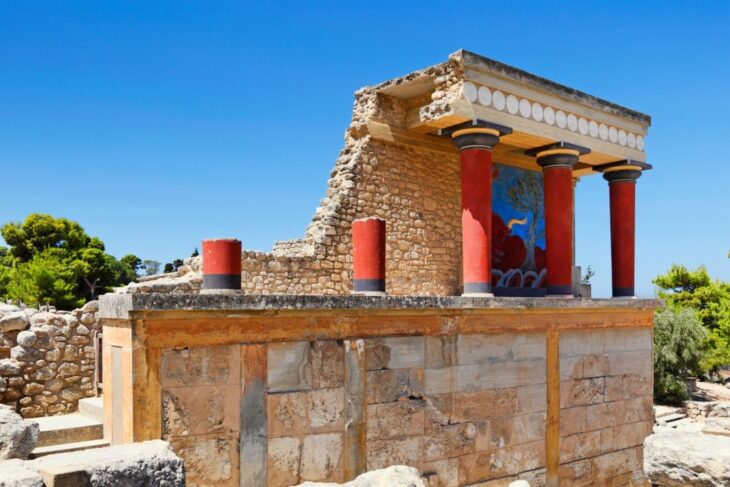
Knossos Palace defines the archaeological heritage of Greece – the largest Minoan palace and the political centre of Europe’s first advanced civilisation. At its peak (1700–1450 BCE), the palace housed around 1,000 people and administered a territory extending across much of Crete. The Knossos Palace advanced features – multi-storey construction, indoor plumbing, the earliest throne room in Europe (gypsum throne, still in situ), and vibrant frescoes in mineral pigments – demonstrate a technological sophistication unmatched in the contemporary Mediterranean world. Linear A script tablets found here remain undeciphered; Linear B tablets, in contrast, have been read since Michael Ventris’s 1952 decipherment.
British archaeologist Arthur Evans conducted the principal excavations from 1900 onward and reconstructed key sections of Knossos Palace based on his findings. Knossos was officially inscribed on the UNESCO World Heritage List in July 2025 as part of the Minoan Palatial Centres serial property (criteria ii, iii, iv, vi).
Top must-see attractions:
- The Throne Room – Europe’s earliest throne room, with the original gypsum throne still in situ
- The Grand Staircase – sweeping multi-storey staircase decorated with frescoes
- The Central Court – large open-air courtyard with central altar
- The Lustral Basin – circular pool used for religious rituals
- The North Entrance – frescoes depicting the bull-leaping ceremony
- Built: ~1900 BCE (peak 1700–1450 BCE); first occupied 7000 BCE
- Destroyed: ~1375 BCE
- Excavated by: Sir Arthur Evans (from 1900)
- Location: 5 kilometers (3.11 miles) west of Heraklion
- UNESCO status: Inscribed 2025 (Minoan Palatial Centres serial property)
2. Palace of Phaistos
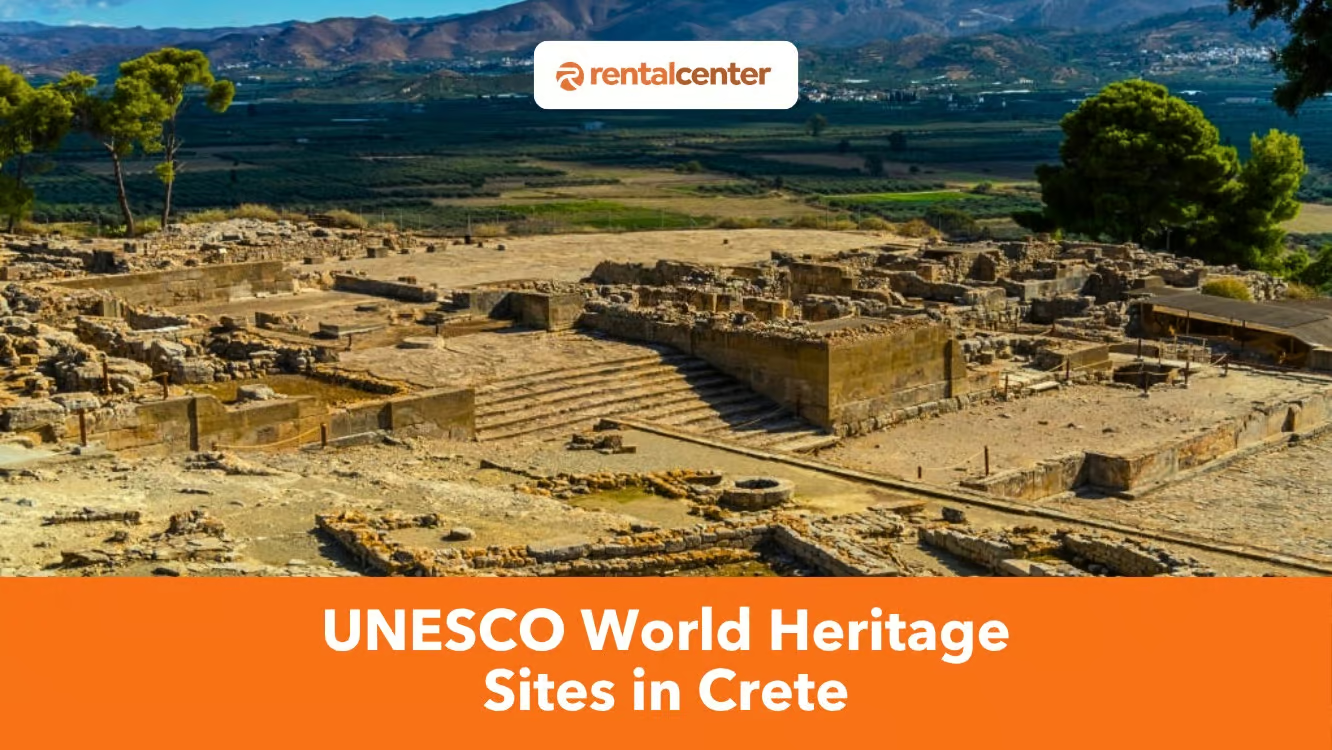
Phaistos, Crete’s second-largest Minoan palace, sits on a hilltop overlooking the Mesara Plain and is home to the famous Phaistos Disc – the world’s oldest undeciphered printed text. The palace covers approximately 18 acres on a hilltop 58 kilometers (36.04 miles) south of Heraklion.
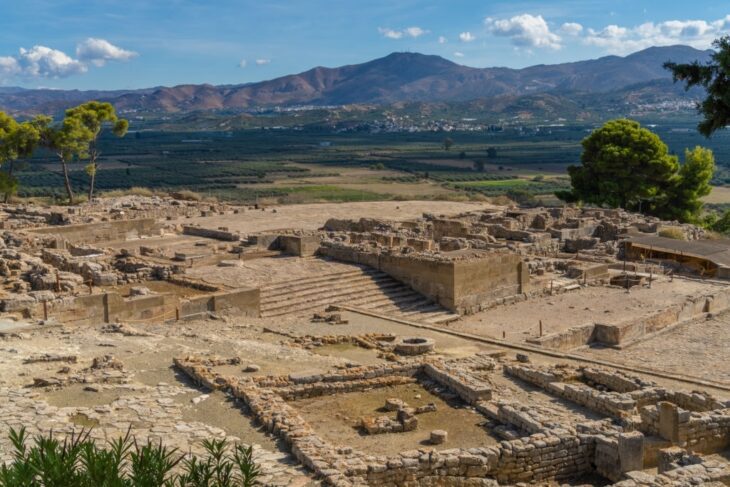
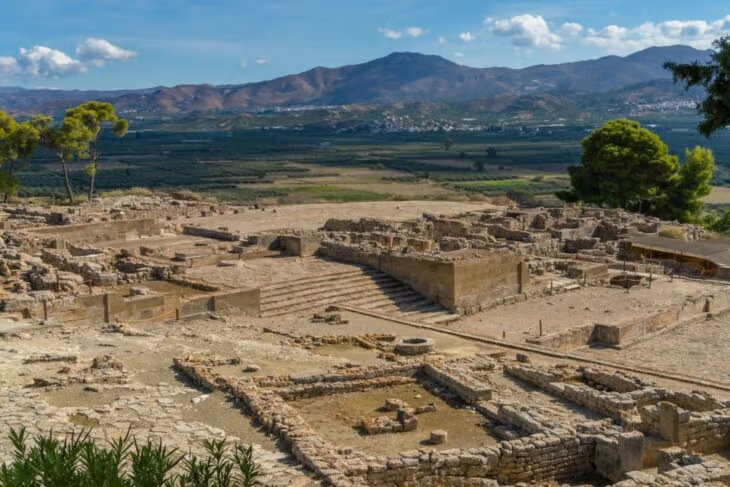
The Palace of Phaistos rose during the height of Minoan civilisation around 1900 BCE and dominated the Mesara Plain for 450 years before fire consumed it around 1450 BCE. It was rebuilt and destroyed again around 1200 BCE. The complex consists of a central courtyard, storerooms, workshops, and living quarters, notable for its monumental central staircase and an intricate system of drainage and plumbing.
The Phaistos Disc – a clay disc stamped with 241 symbols in 45 distinct characters – was discovered here in 1908 and remains the oldest undeciphered printed text in the world. It is now displayed at the Heraklion Archaeological Museum.
Phaistos is officially inscribed on the UNESCO World Heritage List as part of the Minoan Palatial Centres (2025).
Top must-see attractions:
- The Central Court – large open-air courtyard surrounded by columns
- The Propylon – monumental entranceway decorated with frescoes
- The Royal Chambers – living quarters of the ruling monarchs
- The Corridor of the Procession Fresco – long, narrow corridor with procession imagery
- The Archive Room – small room where Linear A clay tablets were discovered
- Built: ~1900 BCE
- Destroyed: ~1450 BCE (rebuilt; destroyed again ~1200 BCE)
- Location: Mesara Plain, southern Crete (58 kilometers (36.04 miles) S of Heraklion)
- Famous for: Phaistos Disc (1908 discovery)
- UNESCO status: Inscribed 2025 (Minoan Palatial Centres)
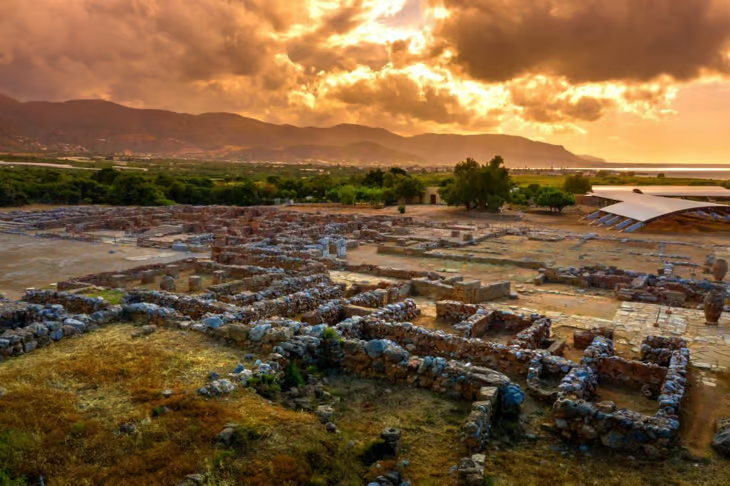
3. Palace of Malia
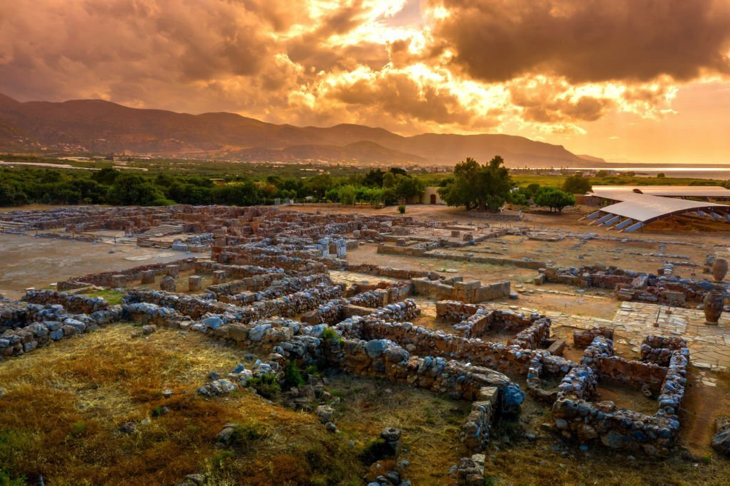
The Palace of Malia was the Minoan civilization’s major commercial hub on the northern coast, built around 1900 BCE and rebuilt after a destructive earthquake in 1700 BCE. It is the third-largest Minoan palace at 7,500 sq metres.
The Palace of Malia represents one of the Minoan civilisation’s greatest political and commercial centres, earning UNESCO World Heritage status in 2025 as part of the Minoan Palatial Centres serial inscription. The original palace was constructed around 1900 BCE on a Neolithic settlement (6000–2900 BCE); after an earthquake destroyed it in 1700 BCE, a new palace was built on the same site – and it is this structure that survives today.
Malia served as a governmental and cultural hub for the Minoans, with living quarters, storage rooms, workshops, and sacred spaces. Fortifications surrounded the palace, with a wide moat as an additional barrier. The walls at Palace of Malia bore frescoes depicting scenes from everyday life, religious ceremonies, and mythology.
Top must-see attractions:
- The Central Court – large circular hearth in the centre
- The North Entrance – monumental entrance with stunning frescoes
- The Royal Quarters – western side rooms used by the royal family
- The Hypostyle Crypt – basement room with column array, used for religious ceremonies
- The South Propylon – monumental southern entrance
- The east and west magazines – storage rooms for trade goods
- The Kernos – ritual stone table unique to Malia
- Built: ~1900 BCE; rebuilt after 1700 BCE earthquake
- Location: Northern coast, east of Heraklion
- Size: 7,500 sq metres
- UNESCO status: Inscribed 2025 (Minoan Palatial Centres)
4. Palace of Zakros
Palace of Zakros served as the Minoan gateway to the eastern Mediterranean, as confirmed by elephant tusks, Canaanite jars, and oxhide ingots found within its 150 chambers. It is the most remote of the Minoan palaces, situated south of Palaikastro on Crete’s eastern coast at Kato Zakros.
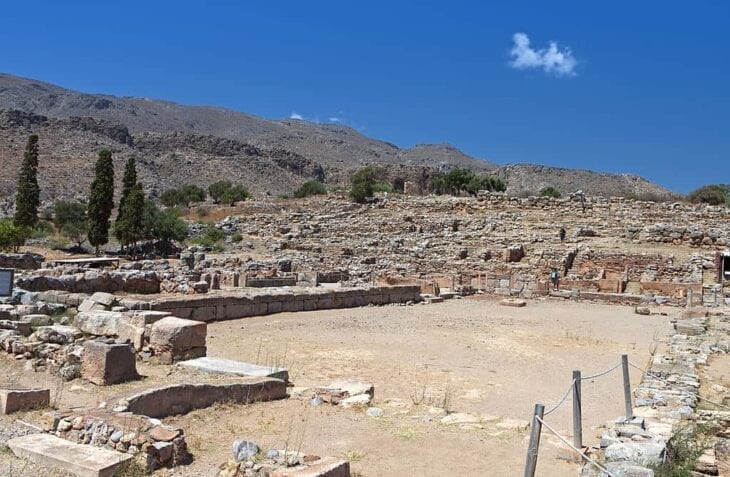
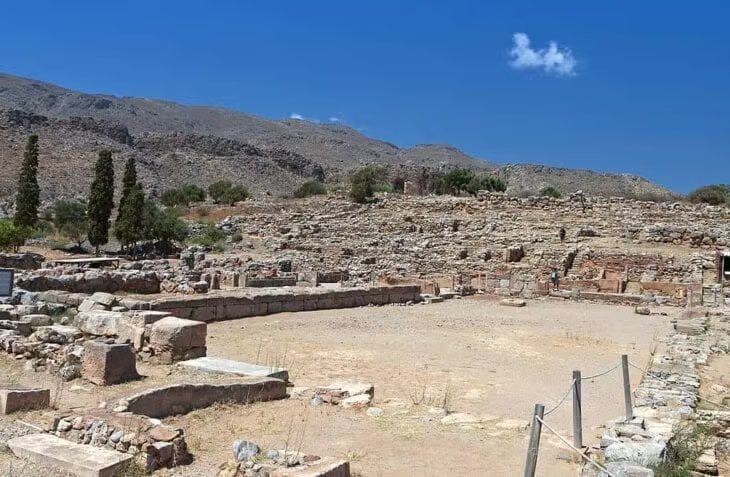
The Palace of Zakros was the smallest of the four major Minoan palaces (Knossos, Phaistos, Malia, Zakros) and the last to be discovered. Nikolaos Platon restarted excavations in 1961 and uncovered a palace that had not been robbed at the time of its destruction – making the site one of the most significant for Minoan archaeology since the Second World War. The Bronze Age Aegean trade artefacts (elephant tusks at the West Wing, Canaanite jars by the well, six oxhide ingots) confirm Zakros’s role as the Minoan port for trade with Egypt and the Levant.
The second palace (rebuilt after the previous earthquake) was constructed circa 1600 BCE and demolished around 1450 BCE. It comprised 8,000 sq metres, 150 chambers, and a Central Court of approximately 30 × 12 metres – substantially smaller than Knossos’s.
Zakros joined the other Minoan palaces on the UNESCO World Heritage List in July 2025.
Top must-see attractions:
- The Central Courtyard – heart of the palace, 30 × 12 m
- The Throne Room – where the ruler held court
- The residential quarters – rooms for the ruler, priests, and servants
- The storage rooms – pithoi for olive oil, wine, and grain
- The archaeological museum at Sitia – displays artefacts from the palace
- Built: ~1600 BCE (rebuilt); destroyed ~1450 BCE
- Excavated: since 1961 (Nikolaos Platon)
- Location: Kato Zakros, eastern Crete
- Size: 8,000 sq m, 150 rooms
- UNESCO status: Inscribed 2025 (Minoan Palatial Centres)
5. Kydonia Palace (Chania)
Kydonia Palace lies beneath the modern city of Chania – one of the few places on Earth where an entire Bronze Age palace complex is being excavated in real time beneath a living city.
Unlike the other five Minoan palaces that stand in open archaeological parks, Kydonia is being actively excavated in real time – with Minoan, Mycenaean, Roman, Byzantine, Venetian, and Ottoman layers stacked beneath the Old Town. The most significant finds come from Kastelli Hill behind the former Turkish mosque on the Chania waterfront. Inhabitation here dates from the earliest Minoan period through the Late Minoan IIIC and beyond.
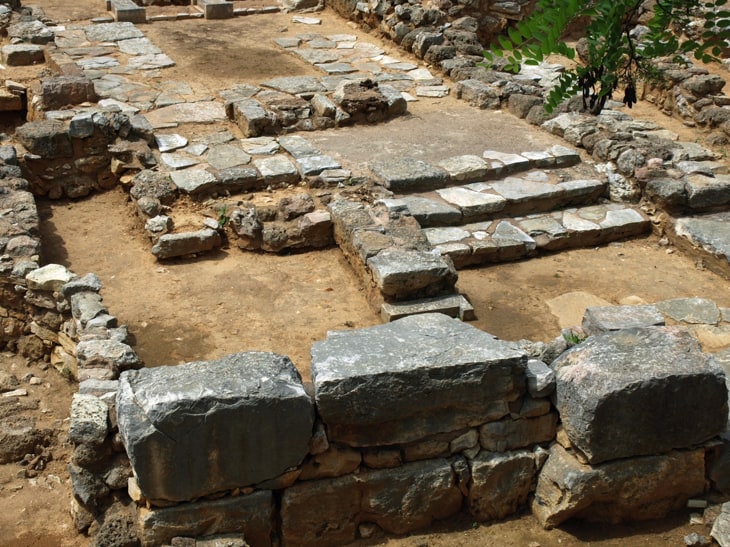
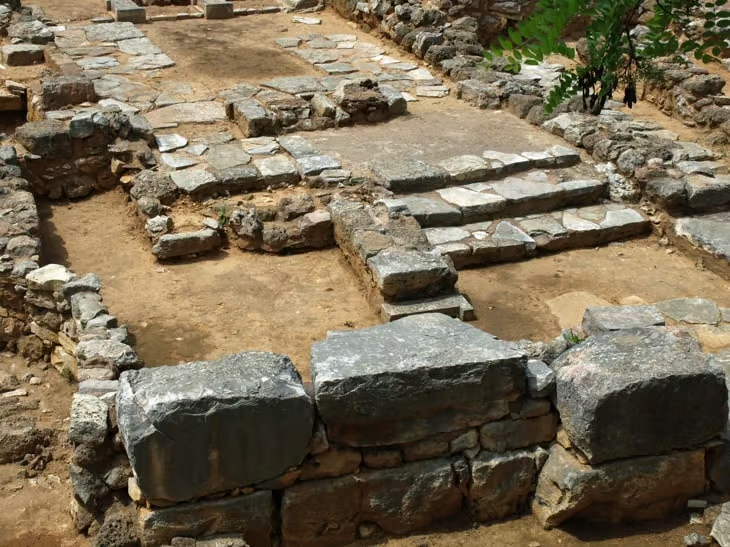
Archaeologists have uncovered high-calibre prepalatial buildings – particularly from the Early Middle (EM II–III) and Middle Minoan (MM IA) periods. Kamares pottery, eggshell ware, and stones with mason’s markings confirm a major Middle Minoan community at Kydonia, even where the neopalatial town was built directly over the protopalatial levels.
Kydonia Palace secured a place on Greece’s UNESCO tentative list in January 2014 – the last of the six Minoan centres to be identified – and was officially inscribed alongside Knossos, Phaistos, Malia, Zakros, and Zominthos in July 2025.
Top must-see attractions in the Kydonia area:
- Kastelli Hill – archaeological zone with active excavations
- The Old Venetian Harbour of Chania
- The Archaeological Museum of Chania – Kydonia artefacts
- Chania Old Town – Venetian streets layered over Minoan settlement
- Location: Beneath modern Chania (Kastelli Hill), NW Crete
- Status: Active urban excavation
- UNESCO status: Inscribed 2025 (Minoan Palatial Centres)
6. Zominthos Palace
Zominthos is Crete’s highest-altitude Minoan palace, situated at 1,187 metres in the Psiloritis Mountains – a mountain ceremonial and administrative centre that was only rediscovered in 1982.
Zominthos sits at 1,187 metres in the Ida mountain range (Psiloritis), making it the highest Minoan palace ever discovered. First identified in 1982 and excavated since 1983 (under Yannis Sakellarakis and continuing under Efi Sapouna-Sakellaraki), Zominthos served as a mountain ceremonial and administrative centre, likely controlling the trade routes across central Crete and supporting the seasonal movements of livestock between coastal and highland zones.
Unlike the coastal palaces, Zominthos reveals Minoan adaptation to alpine environments – with storage magazines, ritual spaces, ceramic workshops, and artefacts that link it directly to the palace of Knossos below. Its inclusion in the Minoan Palatial Centres serial inscription (UNESCO, 2025) acknowledges its role as a unique highland counterpart to the lowland palatial system.
What to see at Zominthos:
- The mountain palace structure – multi-room complex with storage and ritual areas
- The Psiloritis landscape – Crete’s highest peak (Mount Ida, 2,456 m)
- Nearby Idaean Cave – the mythological birthplace of Zeus, 6 kilometers (3.73 miles) from Zominthos
- The Nida Plateau – open meadows and traditional shepherds’ mitata
- Altitude: 1,187 m (highest Minoan palace)
- Discovered: 1982 (excavated from 1983)
- Location: Psiloritis Mountains, central Crete
- UNESCO status: Inscribed 2025 (Minoan Palatial Centres)
Crete’s four natural UNESCO sites
Beyond the six Minoan palaces, Crete holds four additional UNESCO-recognised natural areas, including two Global Geoparks and two Biosphere Reserves.
| Site | Designation | Year | Region |
|---|---|---|---|
| Samaria Gorge | Biosphere Reserve (UNESCO MAB) | 1981 | White Mountains, W. Crete |
| Psiloritis | UNESCO Global Geopark | 2015 | Central Crete |
| Sitia | UNESCO Global Geopark | 2015 | Eastern Crete |
| Asterousia | Biosphere Reserve (UNESCO MAB) | 2020 | Southern Crete |
1. Samaria Gorge – UNESCO Biosphere Reserve (1981)
The Gorge of Samaria became one of Europe’s first UNESCO-designated Biosphere Reserves in 1981, protecting a 13–16 kilometers (9.94 miles) corridor of White Mountain wilderness from Xyloskalo to Agia Roumeli on the Libyan Sea. The gorge runs from the Omalos Plateau through the White Mountains and ranks among the longest in Europe.
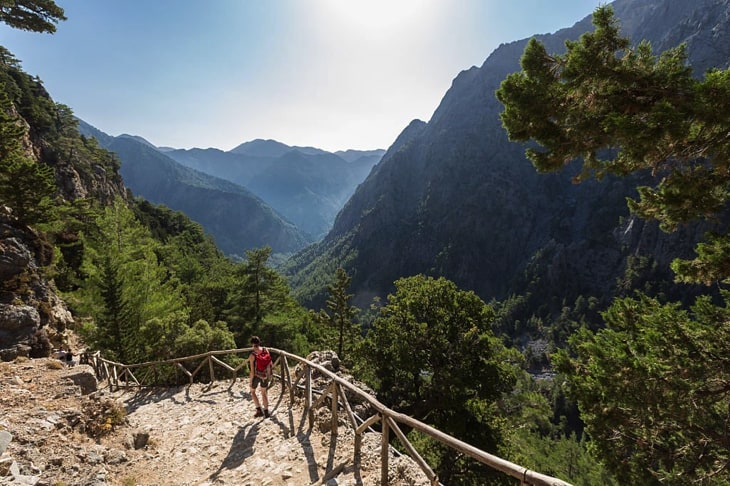
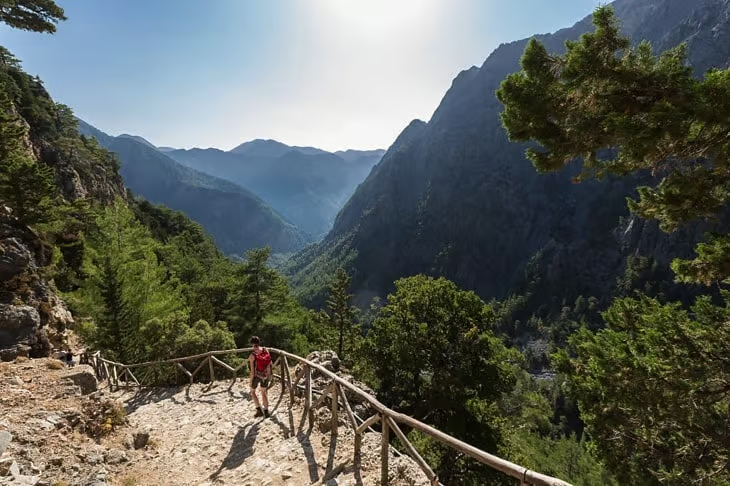
The site is home to the endemic kri-kri (Capra aegagrus cretica) – a wild goat found only in Crete – and 200+ bird species, alongside rare orchids and endemic wildflowers. Hikers walk the 13 kilometers (8.08 miles) route from May through October, typically in 5–7 hours. The narrowest section, the Iron Gates (Sideroportes), is just 4 metres wide between cliff walls 300 metres high. The abandoned village of Samaria, depopulated when the national park was established in 1962, is a midway Crete landmark.
Note: Samaria Gorge is a UNESCO Biosphere Reserve, not a UNESCO World Heritage Site. It is on Greece’s tentative list for World Heritage status (Ref. 5865, submitted January 2014).
2. Psiloritis – UNESCO Global Geopark (2015)
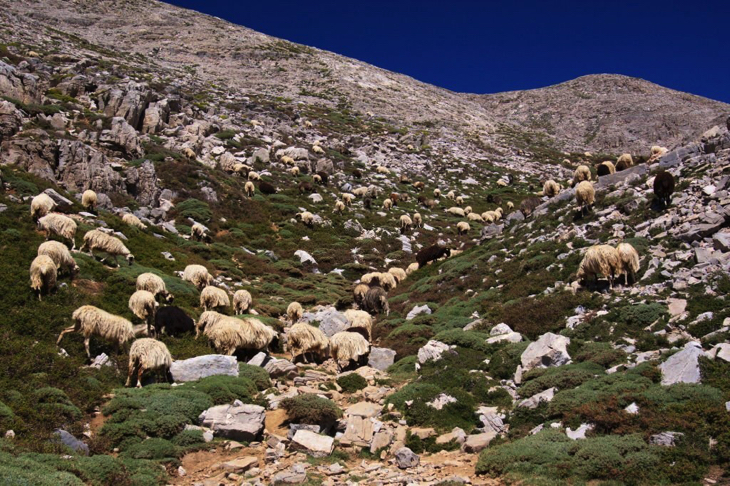
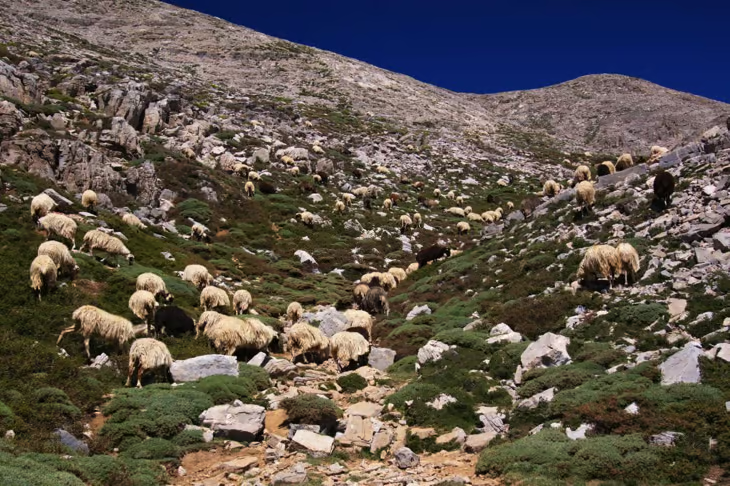
Psiloritis Geopark covers Crete’s highest mountain (2,456 m) with a 300-million-year geological history and the mythological birthplace of Zeus. Designated a UNESCO Global Geopark in 2015 – and an earlier European Geopark in 2001 – Psiloritis spans approximately 1,160 km² of central Crete, including the Idaean Cave (Zeus’s birthplace), the Nida Plateau, Anogia village, Zominthos Palace, and dozens of stone mitata (traditional shepherd huts).
3. Sitia – UNESCO Global Geopark (2015)
Sitia Geopark covers 517 km² of eastern Crete, featuring fossil sites, the Vai Palm Forest, and Toplou Monastery. Designated alongside Psiloritis in 2015, Sitia includes Crete’s only natural palm forest (Vai), Lasithian Mountains fossil sites, the historic Toplou Monastery, and the Zakros Gorge. It connects geologically with the Palace of Zakros.
4. Asterousia – UNESCO Biosphere Reserve (2020)
The Asterousia Mountains became a UNESCO Biosphere Reserve in 2020 – a rugged coastal range in southern Crete with traditional shepherding practices and dramatic cliffs facing the Libyan Sea. The reserve protects unspoiled coastal ecosystems, traditional Cretan agro-pastoralism, and pilgrimage trails to mountain monasteries.
Fortress of Spinalonga – on the tentative list
Spinalonga Fortress currently awaits UNESCO World Heritage designation, appearing on Greece’s official tentative list as a candidate for future inscription. It is a 16th-century Venetian sea fortress on a small island off the coast of Elounda in eastern Crete.
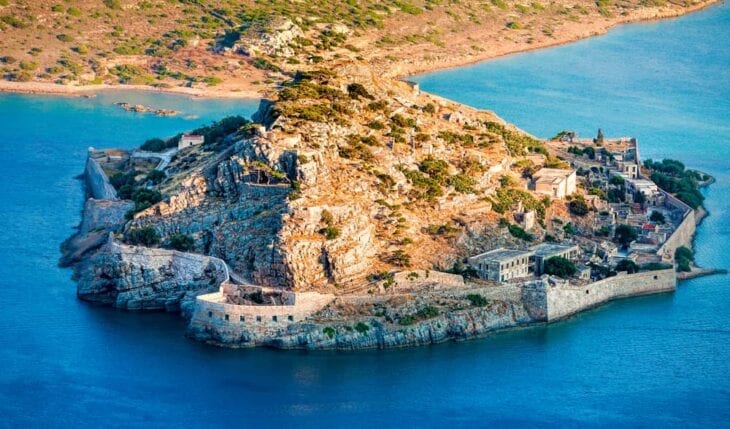
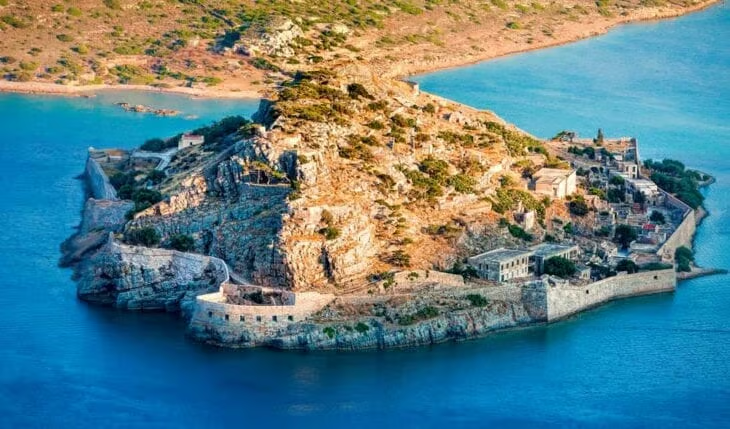
The Venetians constructed Spinalonga in the early 1600s to protect the eastern part of Crete from Ottoman invasion. Built on a rocky peninsula with high walls, bastions, towers, and turrets, the fortress played a critical role during the Venetian-Ottoman wars. After the Ottoman takeover, Hayreddin Barbarossa‘s successors built a mosque and Ottoman residences on the island during their 17th-century rule. Spinalonga later served as a leper colony from 1903 to 1957 – the last functioning leprosarium in Europe – when the final patient was moved to a mainland hospital.
Today, Spinalonga is reached by boat from Elounda or Plaka and is one of Crete’s most visited monuments.
- Built: Early 1600s (Venetian)
- Layered history: Venetian → Ottoman → Leper Colony (1903–1957)
- Location: Island off Elounda, eastern Crete
- UNESCO status: Tentative list (not yet inscribed)
- Access: Boat from Elounda or Plaka
Practical information: visiting UNESCO sites in Crete
Most of Crete’s UNESCO sites require a car to visit, particularly the remote Palace of Zakros in the east, Zominthos in the Psiloritis mountains, and the Samaria Gorge trailhead in the White Mountains.
When to visit?
The best time to visit Crete’s UNESCO sites is May–June or September–early October – pleasant temperatures (20–25°C), few crowds, and lower accommodation prices. Summer (July–August) brings heat above 30°C and peak crowds, especially at Knossos. Off-season (November–March) offers mild conditions and very few tourists, though Samaria Gorge is closed (typically open May–October only).
Admission fees (2024/2025)
| Site | Adult fee | Notes |
|---|---|---|
| Knossos Palace | €15 ($17.22, £12.71) | Free for under-18s and EU students |
| Phaistos | €8 ($9.18, £6.78) | Reductions for students, seniors, groups |
| Malia | €6 ($6.89, £5.09) | Includes site museum |
| Zakros | €6 ($6.89, £5.09) | Combined ticket with site museum possible |
| Samaria Gorge | ~€5 ($5.74, £4.24) | National park entry; check seasonal hours |
| Spinalonga | €8 ($9.18, £6.78) | Plus boat fare €10 ($11.48, £8.48)–€20 ($22.96, £16.95) from Elounda |
Fees verified via the Hellenic Ministry of Culture and Sports. Visitors are advised to confirm current prices at odysseus.culture.gr before travelling, as prices are subject to change.
Are there guided tours available?
Yes – Knossos, Phaistos, Malia, and Spinalonga all offer guided tours on site, bookable in advance or arranged on arrival. Numerous tour companies offer organised day tours combining multiple UNESCO sites with transportation and entry included. For Zominthos and the natural geoparks, specialist operators provide guided hikes and 4×4 tours.
Do you need a car to visit?
Yes – particularly for Zakros, Zominthos, the Asterousia Biosphere Reserve, and the Samaria Gorge trailhead. Knossos is reachable by city bus from Heraklion, but other sites require driving. A compact or midsize car (e.g. Volkswagen Polo) handles Knossos, Phaistos, Malia, and Spinalonga comfortably. For Samaria Gorge, Zominthos, and the Asterousia mountains, a midsize SUV (e.g. Nissan X-Trail) provides better clearance on rural mountain roads.
What documents do you need to rent a car?
- Valid driver’s licence (or International Driving Permit if your licence is not in Greek/English)
- Valid passport or ID card
- Credit or debit card in the renter’s name
- Signed rental agreement
Special driving laws to know
- Seat belts mandatory for driver and all passengers
- BAC limit: 0.05% (lower than many countries)
- Drive on the right; vehicles entering roundabouts have right of way
- Strict parking enforcement, especially in Heraklion and Chania
What is UNESCO?
The United Nations Educational, Scientific and Cultural Organization (UNESCO) is a UN agency established in 1945 to promote international cooperation in education, science, culture, and communication. It administers the World Heritage List, the Biosphere Reserve network, and the UNESCO Global Geoparks programme – three of which are represented on Crete.
Why were the Crete sites chosen?
The six Minoan Palatial Centres were inscribed under criteria ii, iii, iv, and vi for their outstanding universal value as the cradle of Europe’s first advanced civilisation. The Minoans pioneered urban planning, multi-storey architecture, indoor plumbing, and writing systems (Linear A and Linear B) that influenced subsequent Greek and Mediterranean civilisations. The natural sites (Samaria, Psiloritis, Sitia, Asterousia) were recognised for biodiversity, geological heritage, and traditional human–environment relationships.
How are the UNESCO sites in Crete protected?
The Greek government works closely with UNESCO and ICOMOS (International Council on Monuments and Sites) to protect Crete’s heritage. Greek Law 3028/2002 governs archaeological protection nationally, and Article 24 of the Greek Constitution establishes the state’s obligation to preserve cultural heritage. Greece is a signatory to the 1954 Hague Convention, the 1972 World Heritage Convention, and the 2003 Convention for the Safeguarding of Intangible Cultural Heritage.
Where can I rent a car in Crete to visit the Crete Unesco sites?
There are several car rental companies in Crete where people have plenty of options to rent a car, including international brands and local businesses. Some of the most famous options include Rental Center Crete, which has several locations throughout Crete, including at the airports and in major cities like Heraklion and Chania. The have has several locations in Crete, including at the airports and in major tourist areas like Rethymno and Agios Nikolaos. Car rental Crete is a popular and convenient option for navigating around the island, as it allows travellers to explore the island at their own pace and on their own schedule.

What documents do I need to rent a car in Crete?
Listed below are some documents needed to rent a car in Crete:
- A valid driver’s licence: Customers must have a valid driver’s license from their home country or an International Driving Permit (IDP) in order to rent a car in Crete. Their licence must be in English or Greek, or they need to provide an official translation.
- A valid passport or ID card: Customers need to provide a valid passport or ID card as proof of identity when renting a car in Crete.
- A credit or debit card: Customers need to have a debit or credit card in their name to cover the rental fees and any potential damages or fines. Debit cards are generally accepted.
- Rental agreement: Customers need to sign a rental agreement that outlines the terms and conditions of the rental, including the rental period, insurance coverage, and any additional fees.
Are there any special driving laws or regulations in Crete that I should be aware of?
Yes, there are some special driving laws and regulations in Crete that one must be aware of if they plan to drive on the beautiful island. For example, the use of seat belts is mandatory for both the driver and all passengers in the car, and failure to comply results in fines. Additionally, the legal blood alcohol limit is lower than in many other countries, at 0.05%, and the police conduct regular sobriety checks. It is important to note that some of the roads in Crete are narrow and winding, and there are often steep drops and sharp turns. It is recommended that drivers exercise caution and avoid excessive speed, especially when driving on unfamiliar roads.
The right side of the road is the preferred lane for drivers on the island of Crete (opposite to the UK, the same as the United States and most of Europe). Vehicles approaching a roundabout from the right have the right of way unless otherwise indicated by a sign. All other vehicles must yield to those entering a roundabout. Keep left to pass on the motorway. As a general rule, slower vehicles should move to the hard shoulder to allow faster vehicles to pass. Lastly, parking restrictions are strictly enforced in some areas, particularly in the larger cities, so it is important to pay attention to signage and parking regulations to avoid fines or having their vehicle towed.
This guide was originally published in May 2026 to reflect the official UNESCO World Heritage inscription of the Minoan Palatial Centres of Crete and current practical visitor information.