



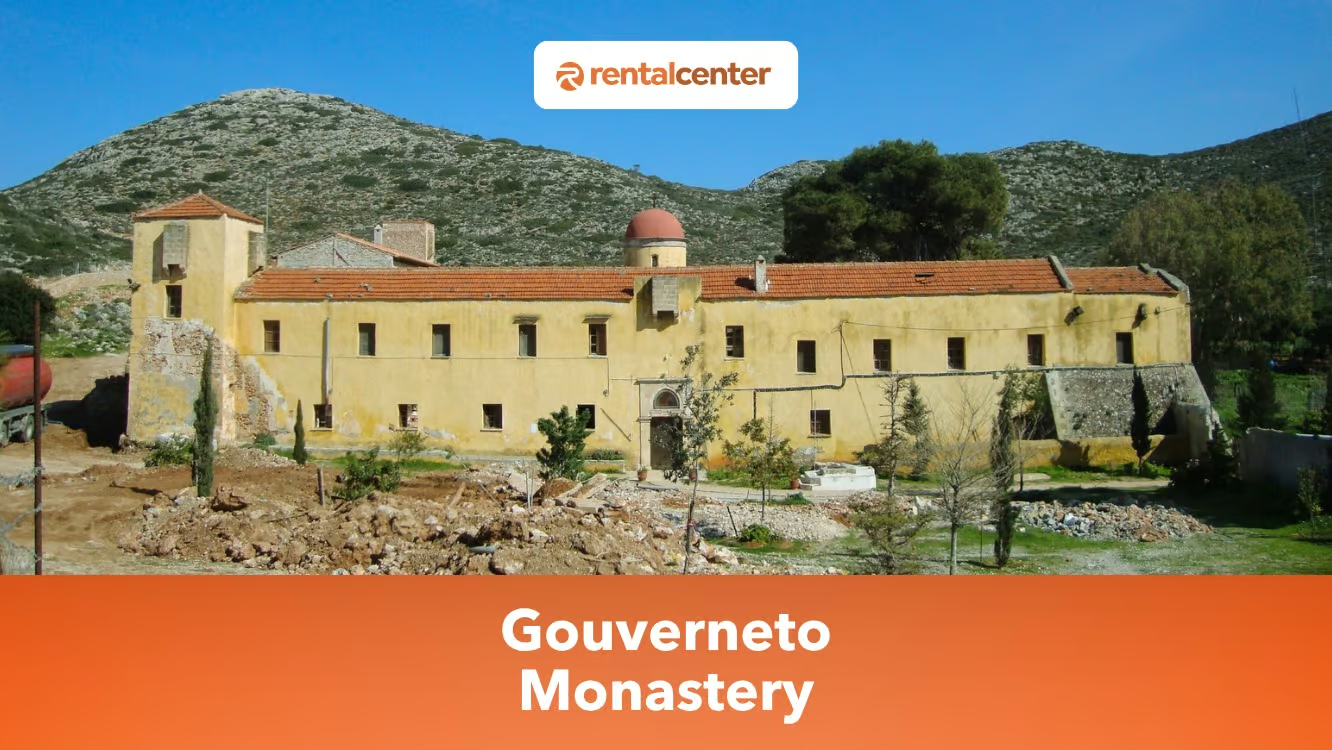
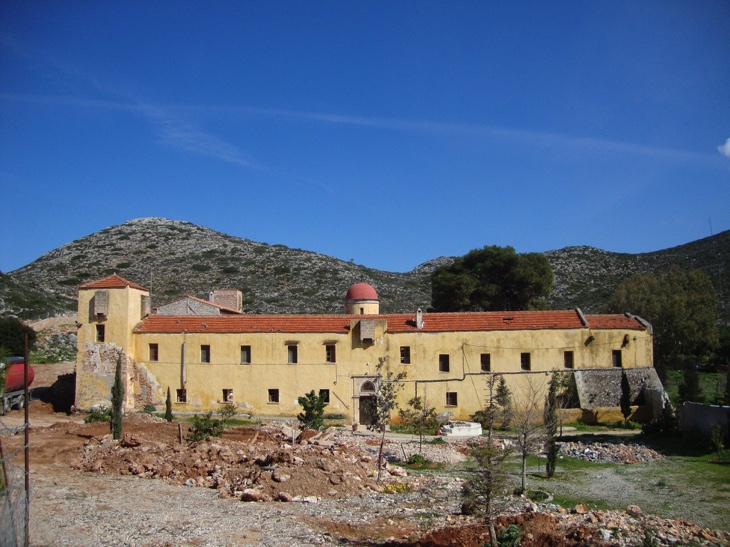
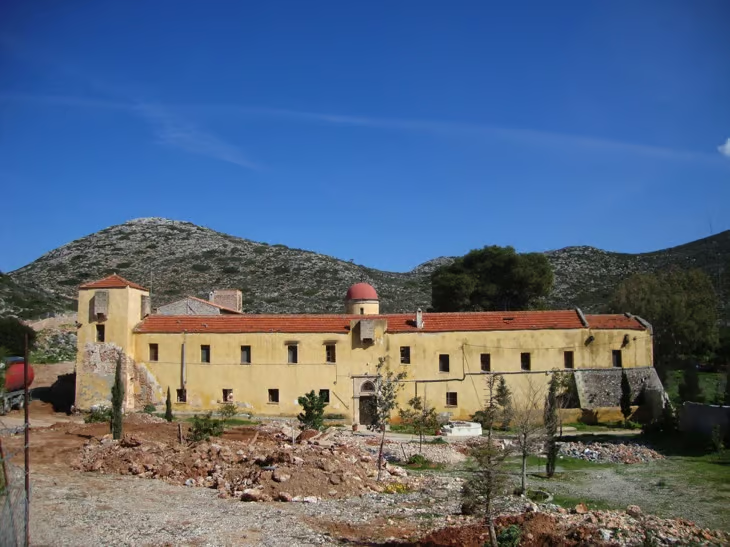
Gouverneto was founded in 1537 by Venetian Catholic monks, who built it in a defensible position within the gorge to withstand the pirate raids that plagued the region. The original building carried Gothic and Renaissance elements. The monastery grew wealthy and influential: a census in 1637, shortly before the Ottoman invasion, recorded 60 monks living there, making it one of the largest in Crete at the time. During World War II, German forces set up a guardhouse in the monastery to control the area. Since 2005, the resident monks have carried out ongoing restoration work to preserve the site.
What is Gouverneto Monastery?
Gouverneto Monastery is a historic Greek Orthodox monastery on the Akrotiri peninsula in the Chania region of Crete. It is dedicated to Our Lady of the Angels and remains an active place of worship. Built in 1537 during Venetian rule, it was established as a religious retreat by hermit monks who chose this rugged, remote setting for its ascetic solitude.
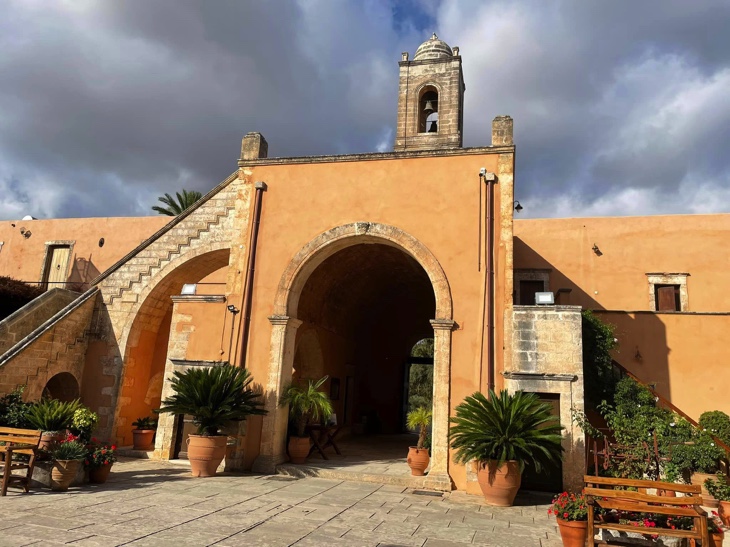
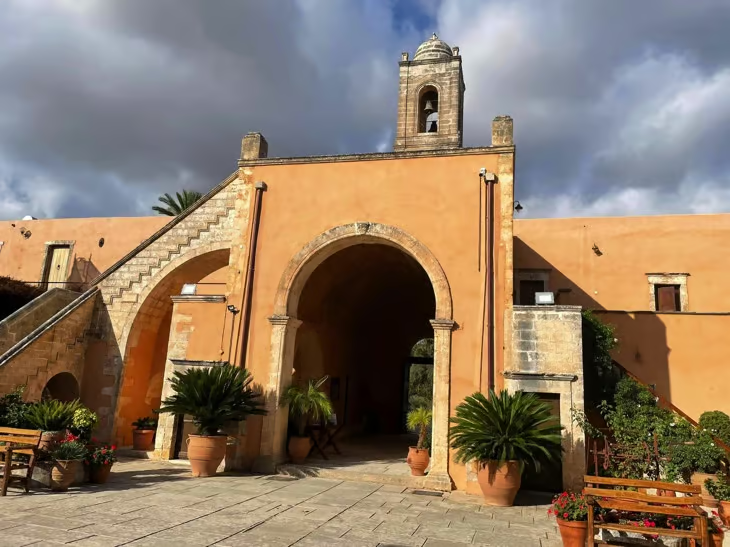
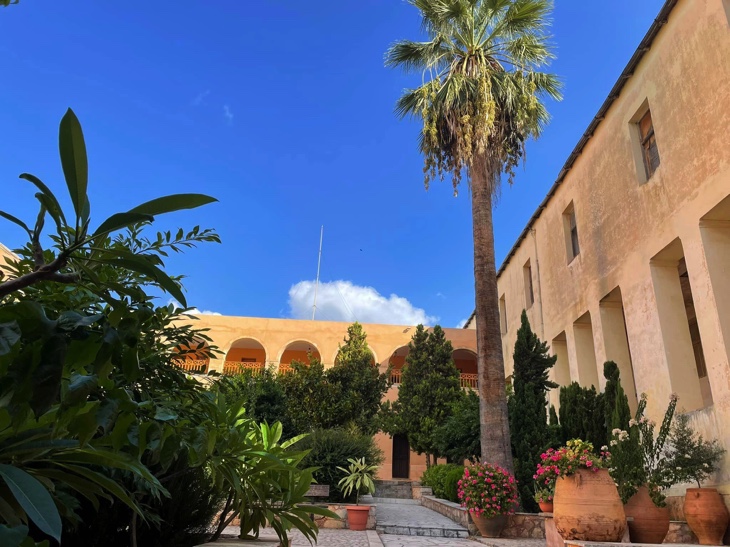
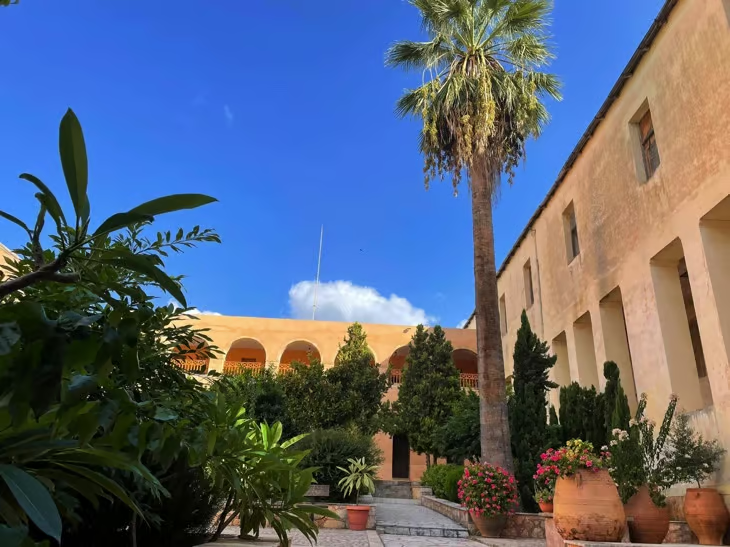
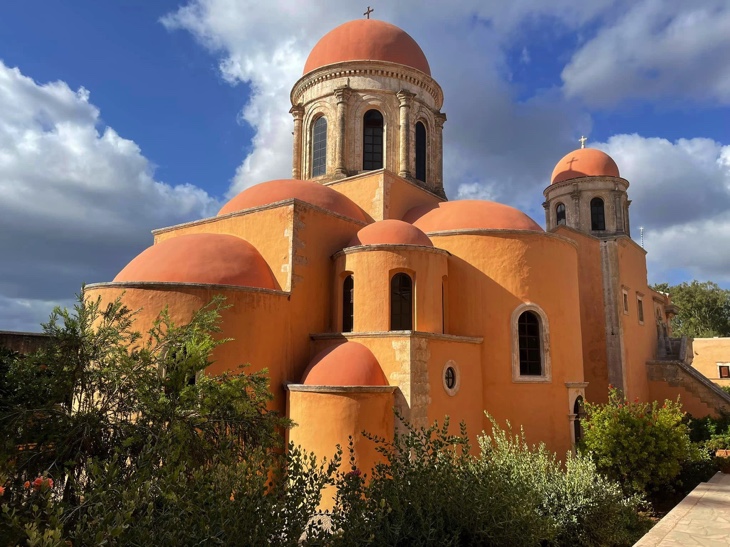
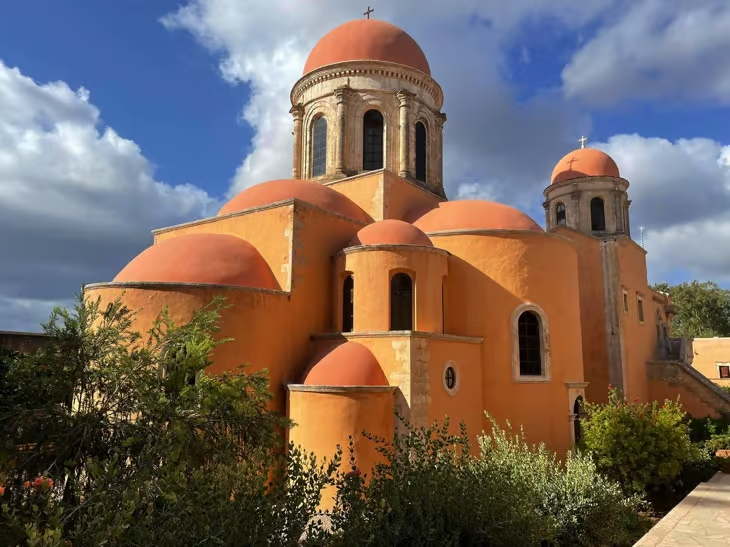
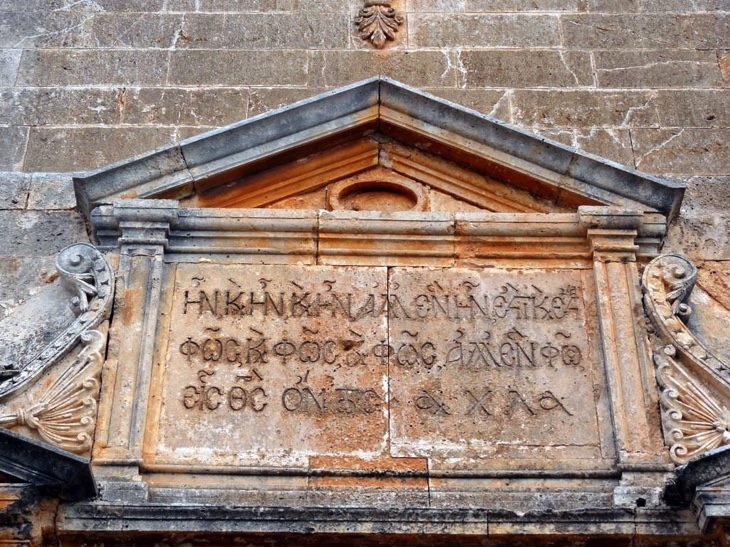
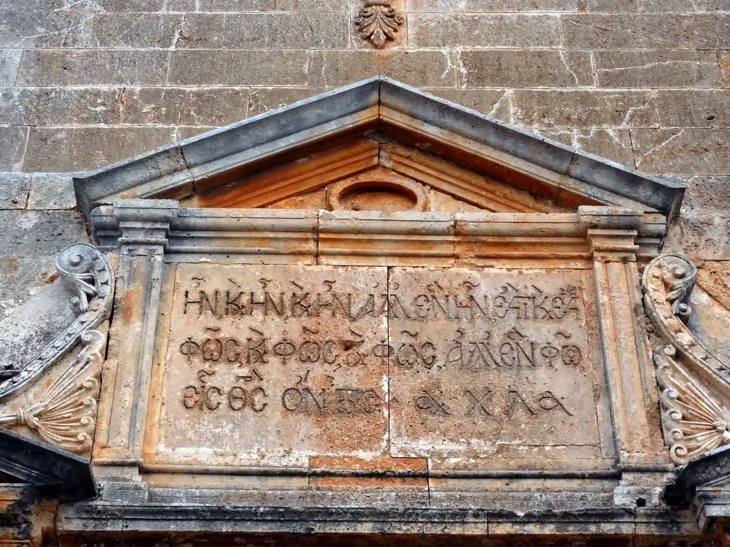
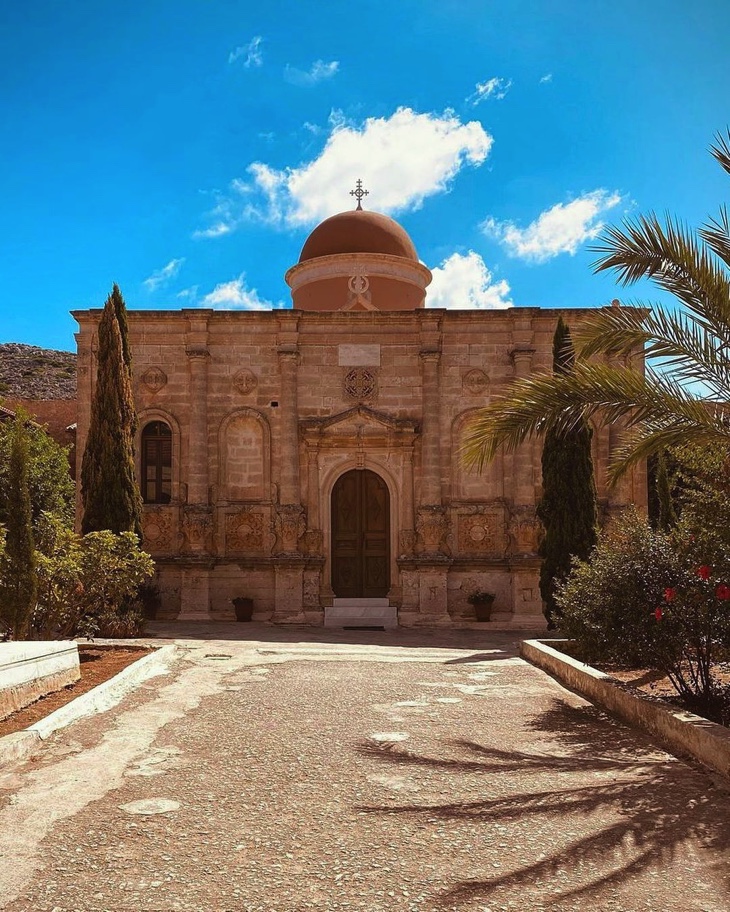
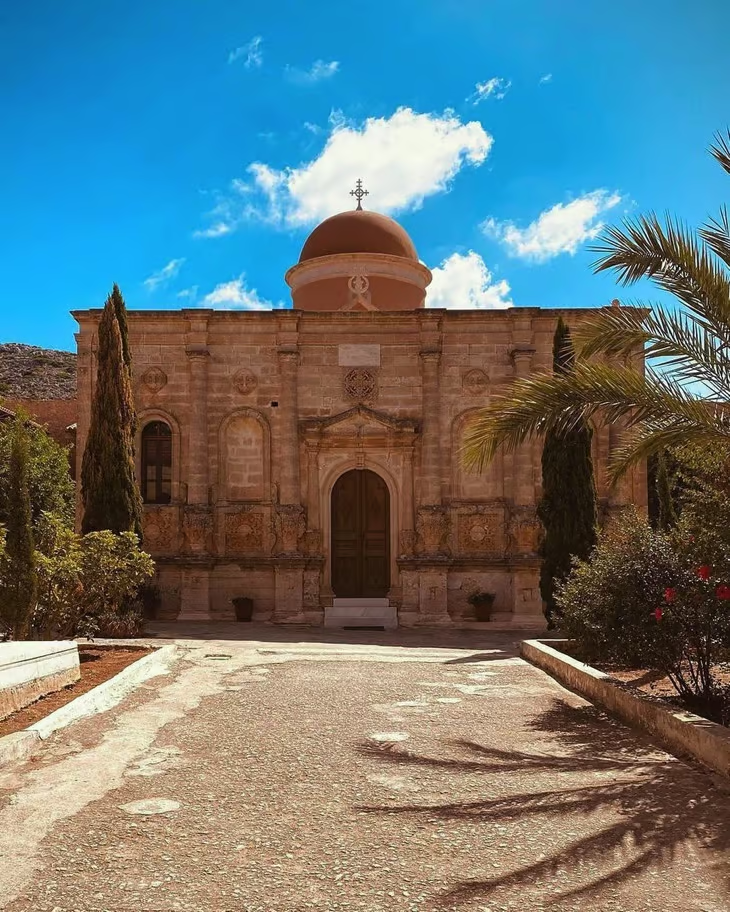
The monastery is built like a Venetian fortress. It measures roughly 40 by 50 metres, with towers at each corner, defensive embrasures in the walls, and about 50 monks’ cells arranged over two floors. The rectangular courtyard is dominated by a domed church with an ornate Venetian facade, and the courtyard chapel holds some of the oldest frescoes in Crete. To the west of the main church stand two chapels: one dedicated to St John the Hermit, the founder-saint of the site, and one to the Ten Holy Martyrs of Crete. A small museum on site displays ecclesiastical art and religious relics.
Where is Gouverneto Monastery located?
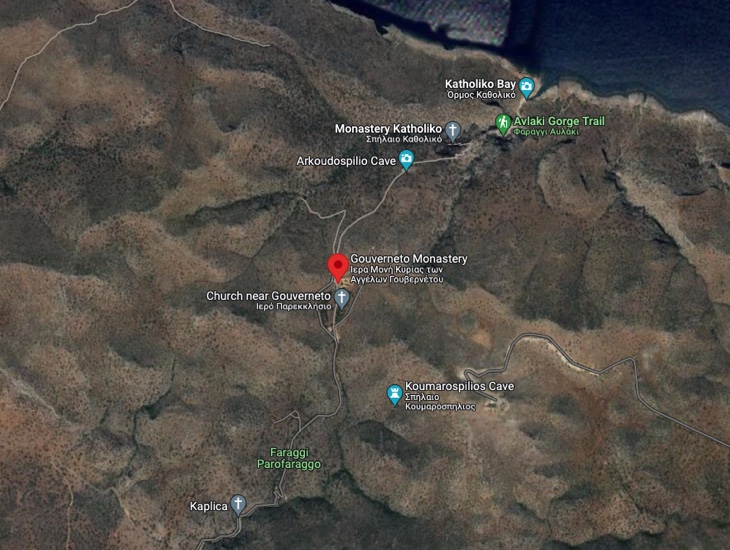
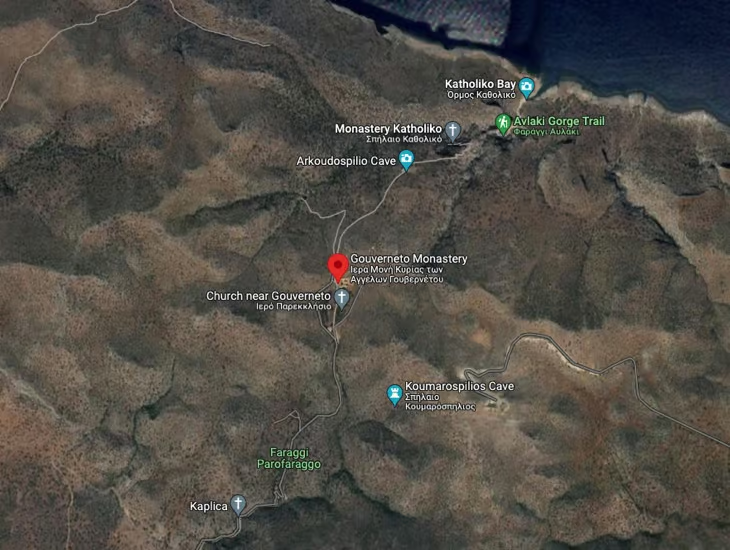
Gouverneto Monastery stands on the Akrotiri peninsula in the Chania region of Crete, Greece, at an altitude of about 260 metres. Its coordinates are 35.591336 latitude and 24.147736 longitude. The monastery lies roughly 20.7 kilometers (12.86 miles) by road from the city of Chania and about 4 kilometers (2.49 miles) from Agia Triada Monastery.
Is Gouverneto Monastery still inhabited?
Yes. Gouverneto Monastery is an active Orthodox monastery, home to a small brotherhood of monks who maintain daily worship and preserve the site’s Orthodox traditions. As one of the oldest monasteries in Crete, established in 1537, it remains both a working place of worship and a destination for tourists and pilgrims drawn to its history and tranquillity.
How do you visit Gouverneto Monastery?
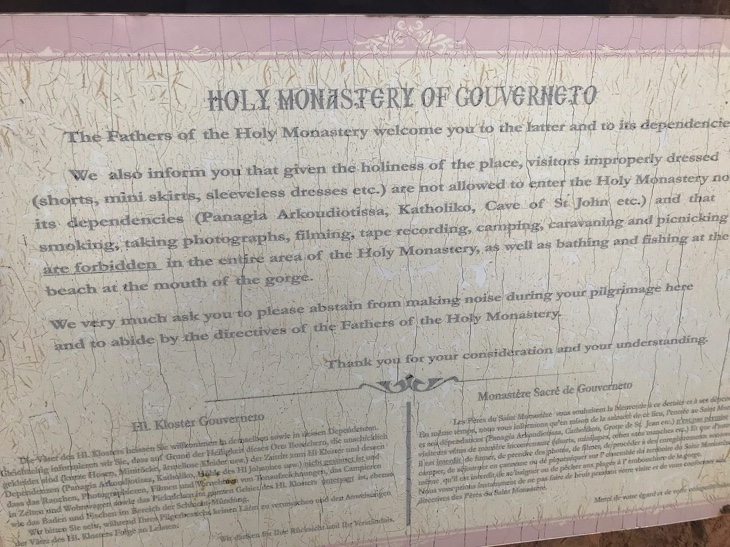
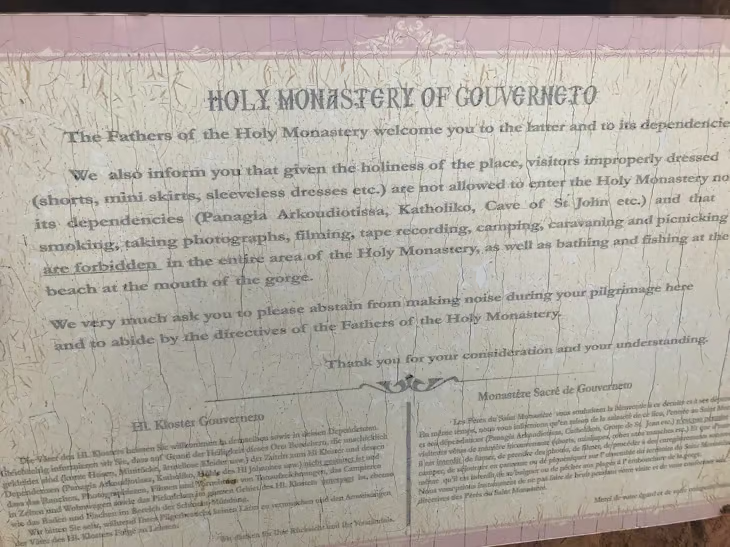
To visit Gouverneto Monastery, plan around its strict opening hours, because it closes on Wednesdays and Fridays. Entry costs €2.5 ($2.87, £2.12) per person, and donations to the brotherhood are welcome. Modest dress is required, and the monastery keeps shorter hours than most monasteries in Crete.
Opening hours
| Day | Morning | Evening |
|---|---|---|
| Monday, Tuesday, Thursday | 09:00–12:00 | 17:00–19:00 |
| Saturday, Sunday | 09:00–11:00 | 17:00–20:00 |
| Wednesday, Friday | Closed | Closed |
The weather at Gouverneto can be warm, especially in summer, so bring sun protection, a hat and plenty of water. Proper walking shoes help on the monastery grounds and the trails. A small cafeteria on site serves light refreshments. Photography is not permitted inside the historic Katholikon church.
Is there an etiquette to visit Gouverneto Monastery?
Yes. As an active Orthodox monastery, Gouverneto asks visitors to dress and behave respectfully. The monastery requires modest attire: shorts, swimwear, tank tops and sleeveless tops are not allowed, and both men and women should cover their shoulders and legs. Remove hats and sunglasses inside the churches and chapels. Smoking is forbidden on the grounds, and certain areas reserved for the monks are off-limits. Greet the monks politely and, if you wish, ask for their blessing; keep conversations short and quiet, and avoid interrupting the monks during prayer or work. Following this etiquette lets visitors experience the serene, spiritual atmosphere of the site.
What is the best season to visit Gouverneto Monastery?
The best time to visit Gouverneto Monastery is spring or autumn. From March to May and September to early November, warm, sunny days in the 20–25°C (68–77°F) range make hiking and sightseeing comfortable; wildflowers bloom in spring and the light turns golden in autumn. Summer, from June through August, can exceed 30°C (86°F), which makes the hike hard and the monastery offers little shade. Winter brings the most rainfall, muddy trails and, at higher elevations, cold and occasional snow that can hinder access along the mountain roads. The monastery stays open year-round, but spring and autumn offer the most favourable weather.
How do you get to Gouverneto Monastery?
You can drive and park at the monastery gate, or take the Chania–airport bus and a short taxi to the site. Either way, the final stretch down to Katholiko Monastery and the cove is on foot along marked trails.
By car from Chania
From Chania, head east on the EO Aerodromiou Soudas towards Souda and the airport. The route runs about 20.7 kilometers (12.86 miles) and takes roughly 36 minutes in normal traffic. You pass Souda, a naval and commercial port home to the Souda Bay War Cemetery, then the village of Kounoupidiana, which has cafes, restaurants and supermarkets for a quick stop. From there the road heads north into the Akrotiri interior, winding through olive groves and hills to the monastery car park. Some sections are narrow and uneven, so drive carefully.
By bus and taxi
Take the public bus from Chania’s central station to the airport, a ride of about half an hour. From the airport, a taxi to Gouverneto Monastery takes only a few minutes and costs around €15 ($17.22, £12.71). Calling a taxi back from the monastery can be difficult because mobile coverage is patchy, so plan your return in advance.
The hike: Arkoudospilio Cave, Katholiko Monastery and the cove
From the Gouverneto gate, a well-marked path descends into the gorge. After about 1 kilometers (0.62 miles) you reach Arkoudospilio, the Bear Cave, filled with stalactites and stalagmites; local legend says the Virgin Mary turned a water-stealing bear to stone here, and archaeologists believe the cave was a sacred site as early as Minoan times. A further 10 to 15 minutes down the gorge lie the ruins of Katholiko Monastery and the cave of St John the Hermit. Beyond Katholiko, a descent of about 20 minutes reaches a small sea cove that once served as a harbour; swimming there is prohibited by the monks. The trail is rocky and steep, and the return is all uphill, so carry good shoes and plenty of water. On the road down from Gouverneto stands a monument to the seven monks killed during the Ottoman invasion.
What type of rental car should you choose for Gouverneto Monastery?
A compact SUV is the best choice for visiting Gouverneto Monastery, because the Akrotiri roads are narrow and uneven in parts and higher ground clearance helps. Rental Center Crete offers several suitable options. The Peugeot 2008 is a compact SUV with an automatic gearbox that seats up to five and runs on unleaded petrol, easy to handle on Crete’s winding roads. The Nissan Qashqai is a larger SUV, also seating five, with a manual gearbox and spacious interior for luggage. The Toyota RAV4 is a full-size SUV with an automatic gearbox, reliable and comfortable, with generous boot space for larger groups. The right choice depends on the number of passengers, the amount of luggage and personal comfort.

Can you drive all the way to Gouverneto Monastery?
You can drive to the monastery car park, but not to the buildings deep in the gorge. Pick up your rental car in Chania or another town in western Crete, drive to the Gouverneto gate, and complete the final leg on foot along the marked trail. The walk down through the gorge to Katholiko Monastery is roughly 3 kilometers (1.86 miles) and is considered part of the experience.
Where can you rent a car in Crete?
Rental Center Crete is a local company that has served visitors to the island since 1975, with a diverse, well-maintained fleet ranging from economy cars to SUVs. Alongside local firms, several international companies such as Hertz, Avis and Europcar operate in Crete. It has rental locations at airports and in popular destinations including Heraklion, Chania, Rethymno and Agios Nikolaos, making pick-up and drop-off convenient. Rental Center Crete provides optional insurance coverage, flexible rental durations and 24/7 customer support.
What are the nearest attractions to Gouverneto Monastery?
The attractions near Gouverneto Monastery are listed below:
- Katholiko Monastery. The oldest intact monastery in Crete, with origins in the 11th century. Its Byzantine Katholikon features early frescoes and intricate stonework, about 1 kilometers (0.62 miles) from Gouverneto.
- Arkoudospilios Cave. Once inhabited by bears and now home to bats, this cave holds rare stalactite and stalagmite formations, about 850 metres from Gouverneto.
- Avlaki Gorge. A dramatic gorge with 100-metre cliffs and caves that once sheltered shepherds, about 750 metres south of Gouverneto.
- Agia Triada Monastery. A 17th-century monastery renowned for its timber-roofed Katholikon and Byzantine frescoes, set among olive groves about 4 kilometers (2.49 miles) from Gouverneto.
- Chania. The former Venetian port city on Crete’s northwest coast, about 21 kilometers (13.05 miles) away, with its iconic lighthouse, old harbour and Venetian mansions.
- Stavros Beach. A golden-sand beach near Kalives, a filming location for the 1964 film Zorba the Greek, about 12 kilometers (7.46 miles) from the monastery.
- Marathi Beach. A sandy, tamarisk-lined beach with sheltered turquoise water, about 27 kilometers (16.78 miles) along the coast.
What is the hiking route to Gouverneto Monastery?
Two hiking routes lead through the Gouverneto area. The first is the St John’s Monastery to St John’s Bay loop from Chordaki, an intermediate hike of about 4.32 kilometers (2.68 miles) that takes around 1 hour and 29 minutes and offers varied terrain and scenery. The second is the St John’s Monastery to Old Monastery Ruins loop from Stavros, a more demanding route of about 20.9 kilometers (12.99 miles) that takes around 5 hours and 58 minutes and is best suited to experienced hikers.
Is Gouverneto Monastery safe?
Yes, Gouverneto Monastery is generally safe for visitors. It is a well-maintained, active monastery, and the constant presence of the resident brotherhood keeps the site secure. Its thick historic walls, once a refuge from Ottoman raids, and its remote mountain location add natural protection. Visitors can walk the grounds, the Katholikon and the gardens freely. The main safety concern is the drive: the mountain roads leading to the monastery are narrow and winding, so drive carefully along the marked routes.
Is Gouverneto Monastery an archaeological site?
No, Gouverneto Monastery is not an archaeological site. It is a historic monastery built in 1537 and still in active religious use, so it does not consist of excavated ruins. Its Katholikon and other buildings remain in use by the monastic brotherhood, and its architecture, art and relics have been maintained by resident monks for centuries. Visitors come to admire its living Byzantine and Venetian heritage rather than excavated antiquities.
What is the oldest monastery in Crete?
The oldest monastery in Crete is Katholiko Monastery, an ancient Orthodox monastery set in the cliffs of Akrotiri in western Crete. First inhabited by ascetic hermits in the 11th century, it later became an important religious centre. Today the abandoned monastery remains remarkably intact, with medieval architecture and frescoes. To reach it, visitors hike up stone steps carved through Avlaki Gorge, with stunning sea views along the way.
What are the most beautiful monasteries of Crete?
The 3 most beautiful monasteries of Crete are Arkadi Monastery, Preveli Monastery and Gouverneto Monastery, listed below:
- Arkadi Monastery. Arkadi Monastery is known for its Renaissance architecture and massive defensive walls, with a hilltop setting overlooking olive groves and vineyards and a Venetian Baroque Katholikon holding relics and icons from the 16th century.
- Preveli Monastery. Preveli Monastery sits where the Kourtaliotiko gorge meets the sea on Crete’s south coast, backed by a rare palm grove, with a 17th-century Katholikon of frescoes and carved wood.
- Gouverneto Monastery. Gouverneto Monastery holds a 16th-century Katholikon that represents the pinnacle of Cretan monastic architecture, with Renaissance frescoes, ornate stone reliefs and Byzantine motifs.
What do visitors experience at Gouverneto Monastery?
Visitors to Gouverneto Monastery often describe the walk down to Katholiko Monastery and the sea as one of the finest hikes in the area, taking several hours round trip and best done with plenty of water and snacks, especially in hot weather. The remote setting among hills and forests creates a peaceful, retreat-like feel, with birdsong and views over the olive groves in the valley below. Inside, the 16th-century Katholikon impresses with its marble columns, chandeliers and vivid Byzantine frescoes, and the craftsmanship of its stone and wood reliefs. Many visitors also note the warm hospitality of the monks and their dedication to preserving the monastery’s heritage.