









Car hire excess insurance reimburses the excess – the first portion of any damage or theft cost – that your rental company charges before their own insurance pays. In Crete, the excess on a typical rental car ranges from €1000 ($1143.70, £850.70) to €2500 ($2859.25, £2126.75), sometimes up to the vehicle’s full replacement value on premium models. Rather than paying the rental desk’s standard excess waiver at €15 ($17.16, £12.76)–€25 ($28.59, £21.27) per day, third-party providers (iCarhireinsurance, Cover4Rentals, AIG, Questor) offer equivalent or broader excess cover for €2.74 ($3.13, £2.33)–€5 ($5.72, £4.25) per day – up to 8× cheaper for the same reimbursement.
This guide explains what car hire excess insurance is, what it covers, whether you need it in Crete, how third-party policies compare to rental-desk cover, and exactly how to file a successful claim – including the police report (astynomiki ekthesi) that Greek law requires.
Informational disclaimer: This article is general guidance on car hire excess insurance in Crete and does not constitute insurance advice. Policy terms, coverage limits, and excess amounts vary between providers and rental agreements. Always read your policy wording in full before declining cover at the rental desk. For personalised advice, consult your insurance provider directly. Rental Center Crete is a car hire company, not a regulated insurance intermediary.
Quick reference – Crete car hire excess insurance:
| Typical excess in Crete | €1000 ($1143.70, £850.70) – €2500 ($2859.25, £2126.75) (higher on SUVs / premium) |
| Rental desk waiver (CDW/FDW) | €15 ($17.16, £12.76) – €25 ($28.59, £21.27) per day |
| Third-party excess insurance | €2.74 ($3.13, £2.33) – €5 ($5.72, £4.25) per day (single trip) / from £41.99 per year (annual) |
| Mandatory by Greek law | Third-party liability + CDW only – excess insurance is optional |
| Claim window | Typically 17–30 days from incident |
| Required document | Police report (astynomiki ekthesi) – get one at the scene |
What is car hire excess insurance?
Car hire excess insurance is a separate policy that reimburses you for the excess (deductible) charge a rental company debits from your card if their hired car is damaged or stolen – even if the accident was not your fault. It does not replace the rental company’s mandatory CDW or third-party liability insurance; instead, it covers the part you would otherwise pay out of pocket.
Excess vs deductible – same thing, different name
The terms “excess” (UK / Greece / EU) and “deductible” (US) refer to the same concept: the maximum amount you are contractually liable to pay before your insurance covers the rest. In a Crete rental contract you will see “excess” or “liability” listed against each insurance level – typically €1000 ($1143.70, £850.70) for compact cars and €2 ($2.29, £1.70)–€2500 ($2859.25, £2126.75) for SUVs and premium vehicles. Some agreements list the full value of the vehicle as the excess unless additional cover is purchased.
Excess cover vs excess waiver – the key difference
| Product | What it does | Who provides it |
|---|---|---|
| Excess waiver (CDW / FDW / Super CDW) | Reduces or eliminates the excess on the rental contract itself. You never pay the excess in the first place. | Rental company, at the desk |
| Excess cover (Excess insurance / Excess reimbursement) | The excess remains on your rental contract. If charged, you claim reimbursement afterwards from the third-party insurer. | Third-party insurance providers (iCarhireinsurance, Cover4Rentals, AIG, Questor) |
Both protect your wallet, but they work in opposite directions – and the third-party route is typically far cheaper.
CDW, LDW, and how they relate to excess insurance
- Collision Damage Waiver (CDW) – Limits your financial liability for damage to the rental car. Mandatory in most Greek rental contracts. Leaves an excess of €1000 ($1143.70, £850.70)–€2500 ($2859.25, £2126.75) unless waived.
- Loss Damage Waiver (LDW) – A broader US-market term that combines CDW with theft protection. In Crete, the equivalent is CDW + Theft Waiver (TW) sold together.
- Full Damage Waiver (FDW) / Super CDW – Reduces or eliminates the excess. Sold at the desk for €15 ($17.16, £12.76)–€25 ($28.59, £21.27)/day.
- Car hire excess insurance – A separate policy bought independently (usually before you travel) that reimburses any excess the rental company charges, often with broader cover (tyres, windscreen, undercarriage, roof).
Do you need car hire excess insurance in Crete?
Greek law requires all rental cars to carry minimum third-party liability insurance and CDW, but car hire excess insurance is optional – and for most travellers, buying it from a third-party provider before you travel is both cheaper and broader in coverage than the rental company’s own waiver.
Is it mandatory? (Greek law)
Greek law requires every road vehicle – including rental cars – to carry minimum third-party liability insurance. Rental companies in Crete bundle this with basic CDW in every rental price. Car hire excess insurance, by contrast, is not mandatory. You can legally drive a rental car without it; you just remain personally liable for the excess if anything happens.
Is it worth getting? Cost vs risk analysis
Yes – for most travellers. The maths is straightforward:
- Average excess on a Crete rental: €1000 ($1143.70, £850.70) – €2500 ($2859.25, £2126.75)
- Third-party excess insurance: €2.74 ($3.13, £2.33) – €5 ($5.72, £4.25) per day
- Rental desk excess waiver: €15 ($17.16, £12.76) – €25 ($28.59, £21.27) per day
For a 7-day Crete hire, that is approximately €19 ($21.73, £16.16)–€35 ($40.03, £29.77) spent on third-party cover to protect yourself against a potential €2500 ($2859.25, £2126.75) liability. Even if you already hold travel insurance, check whether it explicitly covers rental-car excess – most standard travel policies do not. If you rent a car in Crete more than twice a year, an annual policy costs less than a single week of rental-desk excess cover. Picking the right category also matters – see our guide on how to choose the right car to rent in Crete, which affects both your premium and your potential excess liability.

Can you use your own car insurance or credit card?
In some cases, yes – but verify before you travel:
- Personal auto insurance – Some EU and UK policies extend rental-car cover within Europe, but limits and excess amounts vary widely. Confirm in writing with your insurer.
- Credit card rental cover – Premium credit cards (American Express Platinum, certain Visa/Mastercard issuers) include rental-car excess or CDW as a benefit. Coverage usually requires that you pay the rental in full with that card and decline the rental-desk waiver. Read the fine print – many cards exclude theft, third-party liability, or vehicles above a certain value.
- Travel insurance – Standard policies rarely include rental-car excess. Some “premier” policies do; always check the wording.
If any of these apply, you may not need a separate car hire excess insurance policy. If not, a third-party policy is the most cost-effective protection.
Car hire excess insurance coverage options in Crete
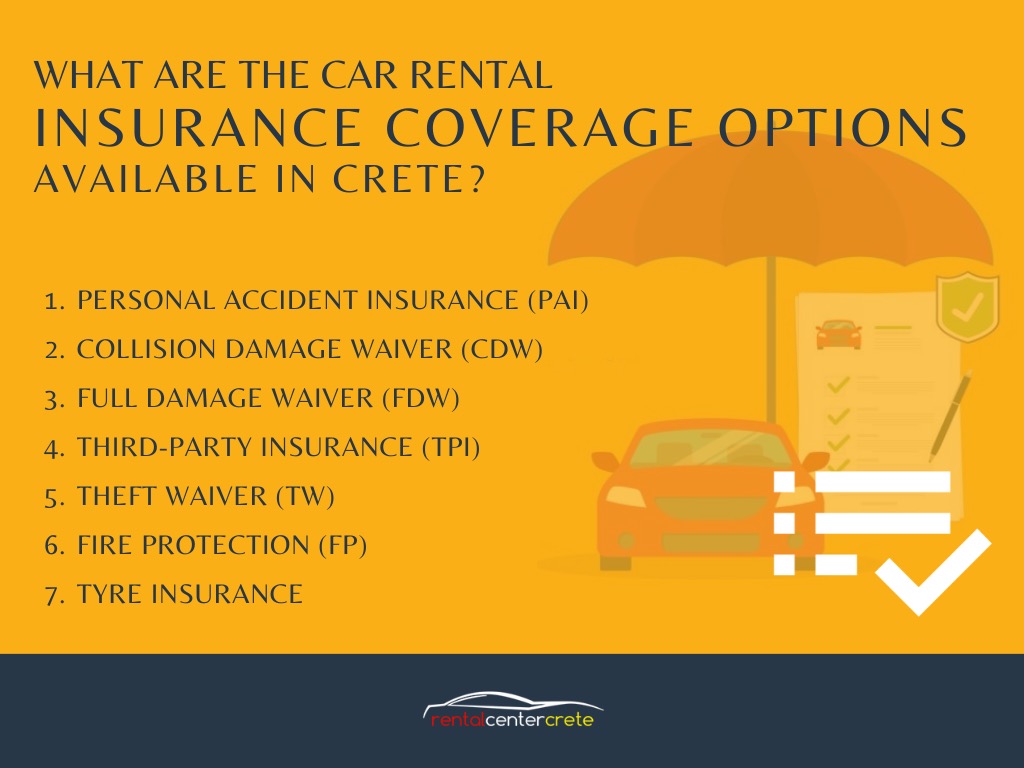
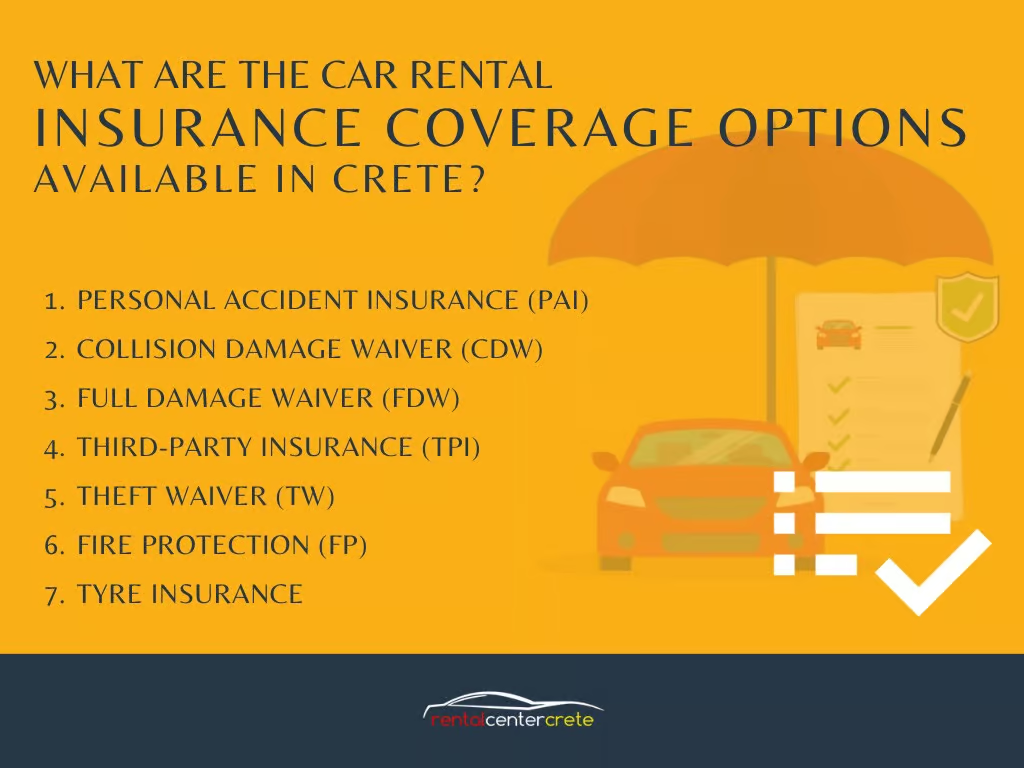
Third-party excess insurance typically covers damage to the car body, tyres, windscreen, undercarriage, roof, and loss from theft – parts often excluded from the rental company’s basic CDW. Below are the main coverage products available either at the Crete rental desk or from third-party providers.
What third-party excess policies cover (the third-party advantage)
Third-party policies often pay reimbursements for damage to vehicle parts that rental-desk CDWs commonly exclude:
- Tyres – punctures, blowouts, sidewall damage (common on Crete’s mountain and rural roads)
- Windscreen and auto glass – chips, cracks, full replacement
- Undercarriage – damage from speed bumps, kerbs, potholes
- Roof – branch strikes, hail
- Replacement keys – through optional key cover
- Misfuelling (petrol vs diesel) – through optional misfuelling cover
- Loss of use – the rental company’s lost-rental income while the car is repaired
- Admin / handling fees charged by the rental company
iCarhireinsurance and Cover4Rentals include tyre, windscreen, undercarriage, and roof cover as standard. Always verify that your policy includes these four parts before declining the desk’s waiver.
Collision Damage Waiver (CDW)
CDW covers damage to the rental vehicle in the event of a collision and is included in most Crete rental quotes. It leaves an excess of €1000 ($1143.70, £850.70)–€2500 ($2859.25, £2126.75) unless additionally waived. Excludes off-road driving, drink-driving, and damage caused while the car is being driven by an unauthorised driver.
Full Damage Waiver (FDW) / Super CDW
FDW reduces or eliminates the excess on the rental contract itself. Cost: €5 ($5.72, £4.25)–€15 ($17.16, £12.76) per day at the rental desk. Useful for travellers who prefer not to deal with reimbursement claims, but typically more expensive than equivalent third-party excess insurance.
Third-Party Insurance (TPI)
TPI covers damage to other vehicles or property caused by the rental car. Mandatory in every Crete rental – already included. Does not cover damage to the rental car itself. Cost (when sold as separate top-up): €5 ($5.72, £4.25)–€10 ($11.44, £8.51) per day.
Theft Waiver (TW)
TW covers the cost of replacing the rental car if it is stolen. Cost: €5 ($5.72, £4.25)–€15 ($17.16, £12.76) per day. Often bundled with CDW in Crete rentals. Requires a police report (astynomiki ekthesi) for any claim.
Personal Accident Insurance (PAI)
PAI provides medical compensation for the driver and passengers in the event of injuries during a rental period. Cost: €1.5 ($1.72, £1.28) per day at the rental desk. Rental Center Crete includes PAI in our Premium Insurance Package at no extra cost. Travellers with comprehensive private health or travel insurance often have overlapping cover – check before purchasing.
Tyre Insurance
Tyre Insurance pays for repair or replacement of damaged tyres (sidewall damage, blowouts, punctures, kerb damage). Particularly useful in Crete given the rural road network. Cost varies; typically a few euros per day. Already included in most third-party excess policies.
Fire Protection (FP)
FP covers fire damage to the rental car. Limited usefulness – Cretan rental fires are very rare – but worth checking whether your CDW already excludes fire.
Add-ons: key cover, misfuelling, loss of use
Optional extensions available with most third-party excess policies:
- Key cover – replacement keys / locksmith fees if keys are lost or locked in the car.
- Misfuelling cover – pump-out and engine-flush costs if you put petrol in a diesel car (or vice versa).
- Loss of use – the rental company’s lost-rental income while the car is being repaired (often charged back to renter even when the renter wasn’t at fault).
These are typically included free in premium third-party policies (Questor, iCarhireinsurance Premier) or available as small add-on fees.
Third-party vs rental desk: which to choose?
Buying car hire excess insurance from a specialist third-party provider before you travel is almost always cheaper than accepting the equivalent waiver at the rental desk in Crete – typically €2.74 ($3.13, £2.33)–€5 ($5.72, £4.25) per day against €15 ($17.16, £12.76)–€25 ($28.59, £21.27) per day at the desk, for the same level of reimbursement.
Price comparison table
| Provider | Type | Daily cost | Max cover | FCA / regulated |
|---|---|---|---|---|
| Rental desk (typical Crete) | CDW / Super CDW (waiver) | €15 ($17.16, £12.76) – €25 ($28.59, £21.27)/day | Excess → €0 ($0.00, £0.00) | N/A |
| iCarhireinsurance | Third-party excess | from £3.49/day | up to £7,500 | FCA reg. 312172 |
| Cover4Rentals | Third-party excess | from €2.74 ($3.13, £2.33)/day | up to €12000 ($13724.40, £10208.40) | FCA-authorised intermediary |
| AIG Ireland | Third-party annual | from €0.14 ($0.16, £0.12)/day equiv. | up to €40000 ($45748.00, £34028.00) PA | Central Bank of Ireland |
| Questor Insurance | Third-party excess | from £4/day | up to £6,000 | FCA-authorised |
| Leisure Guard | Third-party annual | from £56.87/year | up to £6,500 | FCA-authorised |
How third-party cover works (step by step)
- Buy the policy before you travel – online, takes 5 minutes, you receive a PDF certificate by email.
- Decline the rental company’s excess waiver at the desk. The rental company will pre-authorise your card for the full excess amount (typically €1000 ($1143.70, £850.70)–€2500 ($2859.25, £2126.75)) as security – this is normal.
- If damage or theft occurs, the rental company charges your card up to the excess. You pay them.
- Submit a claim to your third-party insurer with the police report, damage invoice, rental agreement, photos, and policy certificate.
- Receive reimbursement – typically within 17–30 days.
Annual vs single-trip policy – which should you choose?
| Policy | Best for | Cost | Hire-length limit |
|---|---|---|---|
| Single-trip excess insurance | One-off Crete holiday (1–180 days) | €2.74 ($3.13, £2.33) – £3.49 / day | Length of one rental |
| Annual multi-trip excess insurance | 2+ rentals per year (Europe-wide) | from £41.99 / £56.87 per year | Usually 31–65 days per hire |
If you rent a car twice or more per year – even once in Crete and once elsewhere – annual cover almost always works out cheaper. iCarhireinsurance, Questor, and Leisure Guard all offer annual policies starting between £41.99 and £56.87 / year.
How to buy before you travel
- Compare quotes on a comparison site or directly with iCarhireinsurance, Cover4Rentals, AIG, Questor, or Leisure Guard.
- Match the policy’s geographic cover to your destination (Crete = Europe).
- Check the per-claim limit matches your rental excess.
- Verify that tyres, windscreen, undercarriage, and roof are included as standard.
- Buy and download the certificate. Keep it on your phone and printed at the rental desk.
How to claim car hire excess insurance in Crete
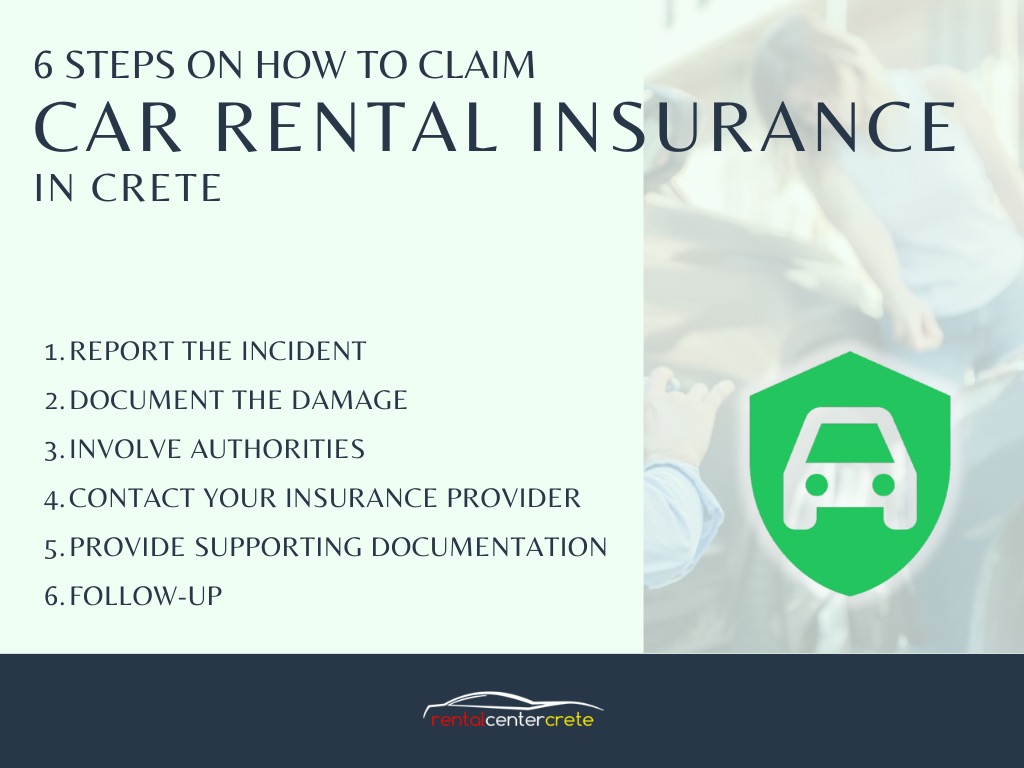
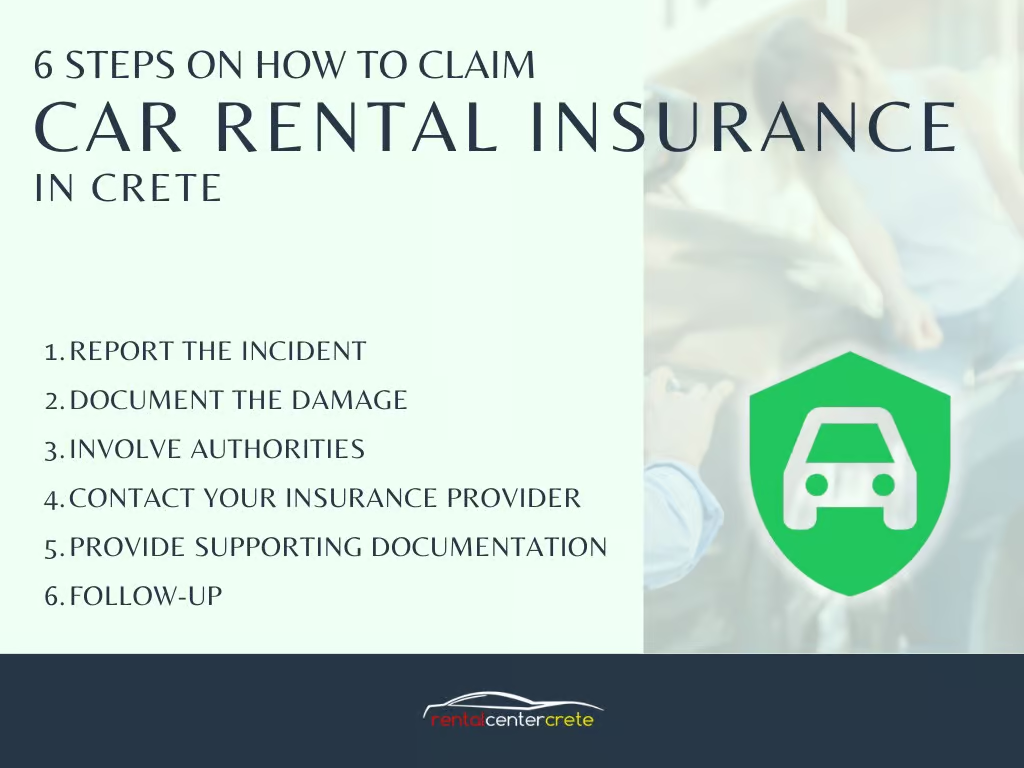
To successfully claim on a car hire excess policy in Crete, you must obtain a police report (astynomiki ekthesi) at the scene, photograph all damage, collect the rental company’s damage invoice, and submit everything to your third-party insurer within the claim window – typically 30 days.
Step 1: Report to police – get the astynomiki ekthesi
Call the police immediately on 100 (or 112 for general emergency). A police report (in Greek: αστυνομική έκθεση / astynomiki ekthesi) is the single most important document in any Crete excess insurance claim – without it, most insurers, including iCarhireinsurance, Cover4Rentals, AIG, and Questor, will decline a theft claim outright and will scrutinise damage claims much more strictly. Request a copy at the scene; if the police cannot issue one immediately, ask which police station you should visit to collect it.
Step 2: Document the damage (photos + video)
Photograph every scratch, dent, and scuff from at least four angles – wide shot and close-up – before you move the car or sign anything. Use your smartphone’s timestamp feature. Photograph the other vehicle(s), licence plates, road conditions, and any street signs that establish the location. Without timestamped photos you risk being billed for pre-existing damage – and your excess insurer can decline reimbursement if the damage isn’t clearly documented.
Step 3: Notify the rental company
Call your rental company (Rental Center Crete: +30 2810 240120) within 24 hours of the incident. Failure to notify on time is a contractual breach in nearly every Crete rental agreement and may void your CDW. Be ready to share: time and location of the incident, registration plates of all vehicles involved, the police-report reference number, and a brief factual description of what happened.
Step 4: Collect all required documents
To claim on a car hire excess policy after an incident in Crete, you will typically need all of the following:
- Police report (astynomiki ekthesi) – mandatory for theft; strongly recommended for any damage.
- Signed rental agreement showing your name, vehicle details, and excess liability amount.
- Damage assessment report issued by the rental company.
- Repair invoice or damage charge receipt from the rental company.
- Your excess insurance policy certificate (PDF/email from your third-party provider).
- Timestamped photographs and/or video of all visible damage.
- Bank or credit card statement showing the excess charge debited.
Rental Center Crete supplies items 2, 3, and 4 directly to the renter on request. Items 1 and 6 must be collected at the scene.
Step 5: Contact your excess insurance provider
Contact your excess insurance provider (not just any insurer) to start the reimbursement claim. Most third-party providers offer an online portal where you upload the documents. Submit promptly – most policies require notification within 30 days of the incident, even if the rental company hasn’t issued the final invoice yet.
Step 6: Submit the claim and follow up
Upload all seven documents to your insurer’s portal, complete the claim form, and submit. Reimbursement typically arrives within 17–30 days. Follow up if you haven’t heard back after 14 days – most claim delays are caused by missing documents or unanswered queries from the insurer’s adjuster.
What to do after an accident with a rental car in Crete
After any accident with a rental car in Crete: check for injuries first, call 112 (general emergency) or 100 (police), exchange information with all parties, then photograph the scene before moving vehicles.
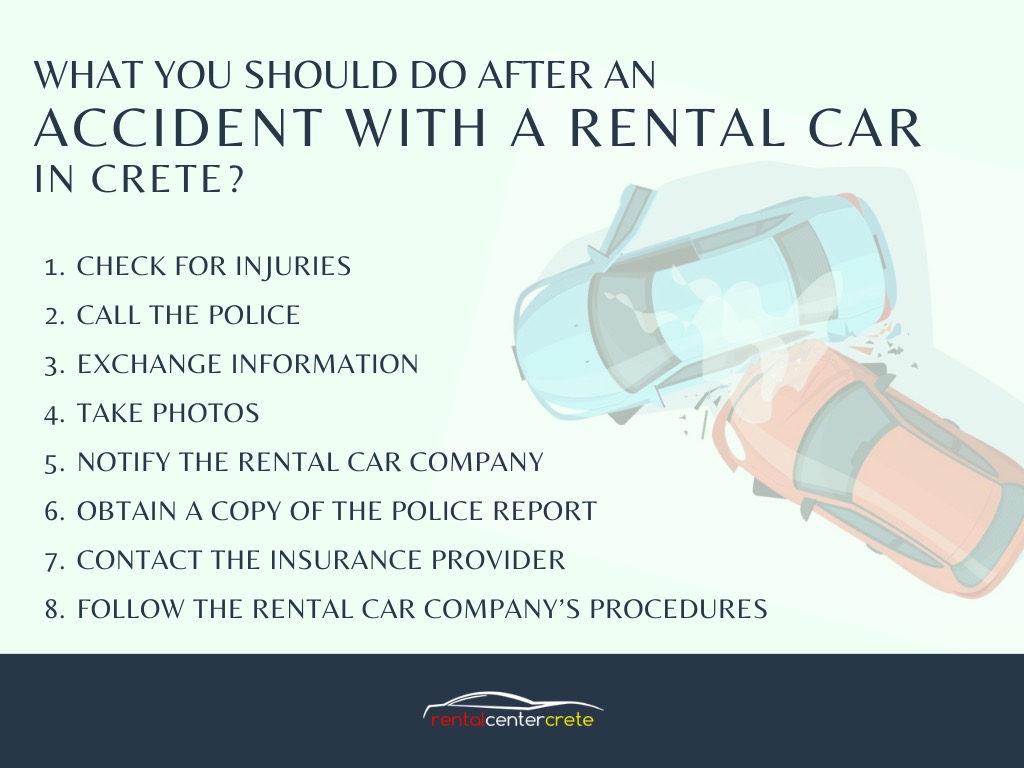
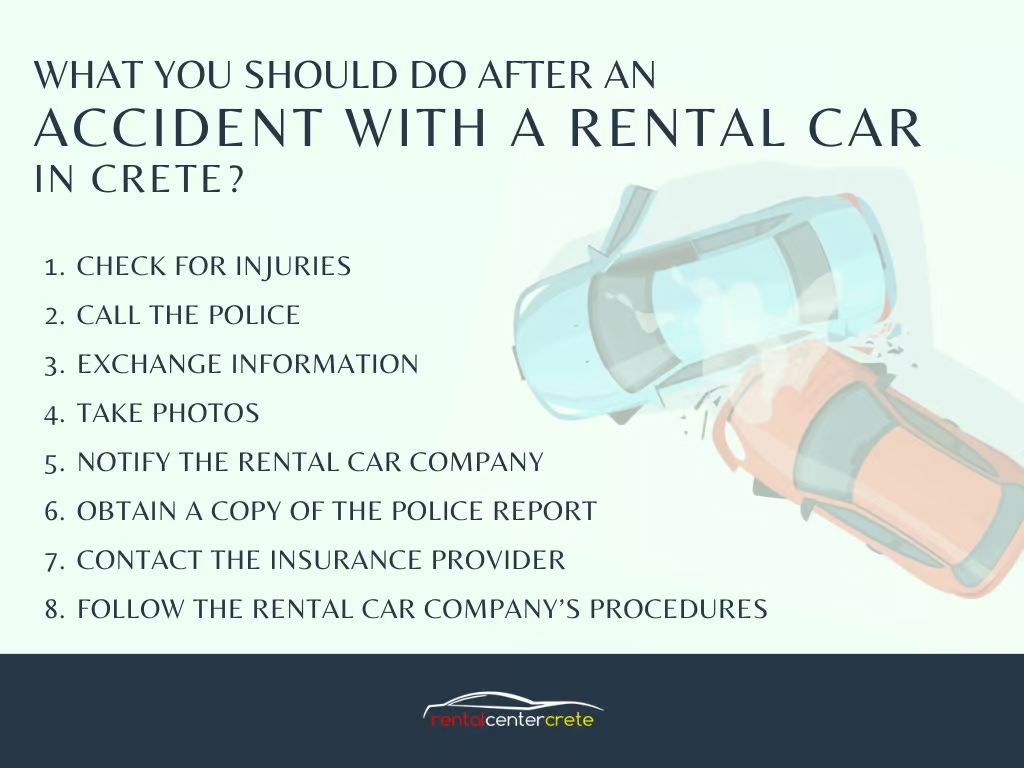
- Check for injuries – Call 112 for ambulance if anyone is hurt. Safety first; never move an injured person unless there is a fire or oncoming-traffic risk.
- Call the police on 100 – Required for the astynomiki ekthesi. Stay at the scene until officers arrive.
- Exchange information – Names, phone numbers, driving licence numbers, vehicle registration, insurance details for all drivers involved. Take pictures of the other party’s licence and the front of their car (registration visible).
- Photograph everything – All damage, all vehicles, road signs, road conditions, time-stamped on your phone.
- Notify the rental company within 24 hours – call +30 2810 240120 for Rental Center Crete.
- Obtain a copy of the police report – collect it at the police station if not issued at the scene. The reference number alone is not enough for most insurers.
- Contact your excess insurance provider – start the reimbursement claim as soon as you have a damage estimate.
- Follow the rental company’s procedures – return the car at the agreed location, complete the incident form, sign the damage assessment.
- Seek legal advice if anyone is injured – Greek personal injury claims operate under different time limits; consult a Greek lawyer if injuries are involved.
What car hire excess insurance does not cover
Even comprehensive excess insurance has exclusions. The most common across all third-party providers in Crete:
- Pre-existing damage – Always inspect and photograph the car before you drive away.
- Intentional damage or vandalism by the renter.
- Damage while driving under the influence of alcohol or drugs.
- Off-road driving – Most Crete rentals prohibit driving on dirt tracks or unpaved roads; coverage voids if you do.
- Unauthorised drivers – Only drivers named on the rental agreement are covered.
- Personal property stolen from the car – Use travel/home contents insurance instead.
- Racing or competitions of any kind.
- Unauthorised modifications to the rental car.
- Some natural disasters – Read the policy wording for floods, earthquakes, wildfires.
- Geographic restrictions – Most Crete rentals prohibit ferry transport off the island without written permission.
Frequently asked questions
Is car hire excess insurance worth it?
Yes, for most travellers. A single 7-day Crete hire faces a potential excess liability of €1000 ($1143.70, £850.70)–€2500 ($2859.25, £2126.75). Third-party excess insurance at €2.74 ($3.13, £2.33)–€5 ($5.72, £4.25)/day costs €19 ($21.73, £16.16)–€35 ($40.03, £29.77) for that week – about 1% of the worst-case liability. If you rent twice or more per year, an annual policy from £41.99 is even cheaper.
What does a car hire excess policy cover?
A typical third-party car hire excess policy covers reimbursement of the excess charged by the rental company for: collision damage, theft, vandalism, tyre and windscreen damage, undercarriage damage, roof damage, lost keys (with key cover), misfuelling (with misfuelling cover), and the rental company’s loss-of-use and admin fees. It does not cover: damage caused by drink/drug-impaired driving, off-road damage, personal property theft, or accidents involving unauthorised drivers.
What is the best way to cover rental car excess?
For most Crete travellers, the best value is to buy a third-party excess insurance policy before you travel and decline the rental desk’s waiver at pickup. Compare iCarhireinsurance, Cover4Rentals, AIG, Questor, and Leisure Guard for daily and annual rates. Pick a policy with a per-claim limit at least as high as your rental excess, and confirm tyres, windscreen, undercarriage, and roof are all included.
Can I use my own car insurance for rental cars in Crete?
Possibly – some EU and UK personal auto policies extend to rental cars within Europe, but the cover and excess vary widely. Confirm in writing with your insurer before relying on it. Premium credit cards (Amex Platinum, some premium Visa/Mastercard issuers) also include rental-car cover, but typically require that you pay the full rental on the card and decline the desk’s waiver. Always read the policy wording.
Are there restrictions for car rental insurance coverage in Crete?
Yes. Common restrictions on car rental insurance coverage in Crete include: geographic limits (often Crete-only, no ferry without written permission), prohibition on off-road driving, exclusion of drink/drug-impaired driving, exclusion of unauthorised drivers, and exclusions for racing or competition driving. Read both your rental agreement and your excess insurance policy carefully – restrictions in either document can void cover.
Is car rental insurance mandatory in Crete?
Yes – basic insurance is mandatory. Greek law requires all rental cars to carry third-party liability insurance and CDW; this is included in every rental quote. Excess insurance (the topic of this guide) is optional and not legally required, but strongly recommended given the typical €1000 ($1143.70, £850.70)–€2500 ($2859.25, £2126.75) excess on a Crete rental.
How much does car rental insurance cost in Crete?
The basic insurance bundled into every Crete rental costs roughly €10 ($11.44, £8.51)–€20 ($22.87, £17.01) per day (CDW + third-party liability). Comprehensive cover with reduced excess at the desk costs €30 ($34.31, £25.52)–€40 ($45.75, £34.03) per day. Third-party excess insurance bought before travel costs €2.74 ($3.13, £2.33)–€5 ($5.72, £4.25) per day for a single trip, for an annual multi-trip policy.
What happens if I don’t take any rental car insurance in Crete?
You cannot legally drive without basic third-party liability and CDW – every rental in Crete includes these. If you skip the optional excess insurance, you remain personally liable for the excess amount (€1000 ($1143.70, £850.70)–€2500 ($2859.25, £2126.75)) if the car is damaged or stolen, even if the accident wasn’t your fault.
Sources and further reading
- iCarhireinsurance.com – pricing and product data, April 2026
- Cover4Rentals – published rates and policy wording, April 2026
- AIG Ireland – Car Hire Excess product page, January 2026
- Questor Insurance – Car Hire Excess product page, March 2026
- Leisure Guard – annual excess insurance pricing, April 2026
- Which? – Best car hire excess insurance companies 2026, January 2026
- Greek National Tourism Organization (GNTO) – rental licensing
- Crete rental desk prices based on Rental Center Crete operational data, 2016–2026 seasons
Last updated: June 2026. Reviewed by Harry Anapliotis. If you spot outdated pricing or policy details, please contact info@rental-center-crete.com.