







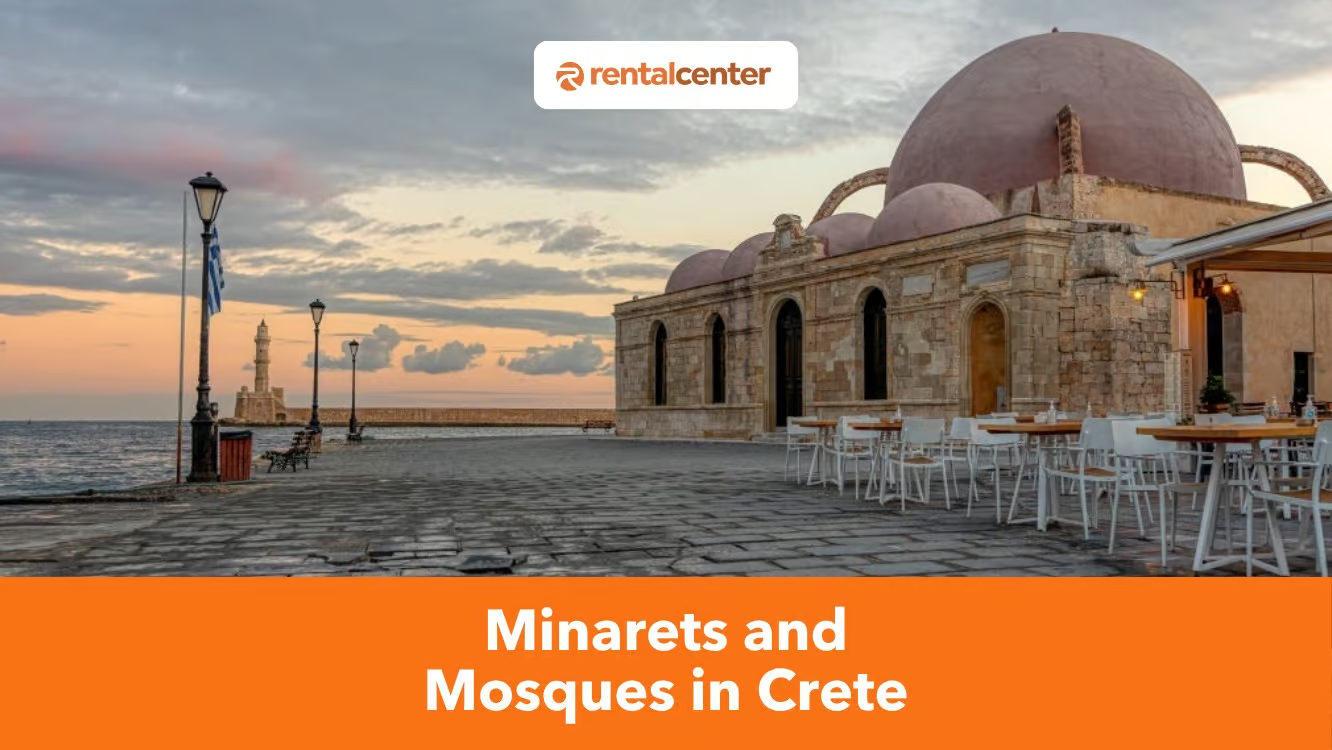
Crete preserves more than a dozen former Ottoman mosques, concentrated in the old towns of Chania and Rethymnon. The Ottoman Empire ruled the island for nearly 250 years – from 1646 until Crete gained autonomy in 1898 – during which the Turks converted most Venetian churches into mosques. When Ottoman rule ended, the buildings were repurposed again: as churches, museums, conservatories, and cultural centres. Today, these structures remain some of the most distinctive architectural landmarks on the island.
The six most significant mosques and minarets in Crete are.
- Küçük Hassan Mosque – Mosque of the Janissaries, Chania (1645)
- Minaret of Ahmet Aga – Splantzia quarter, Chania
- Neratze Mosque – Municipal Odeon, Rethymnon (33-metre minaret, 1890)
- Valide Sultana Mosque – Rethymnon (Porta Guora area)
- Veli Pasha Mosque – Mastaba district, Rethymnon (1789 minaret)
- Kara Musa Pasha Mosque – Rethymnon (with mihrab, mausoleum, and fountain)
Note: Many of Crete’s former Ottoman mosques are no longer active places of worship and function today as museums, cultural centres, or conservatories. Opening hours and access may vary by season – check with the local municipality before visiting. Historical facts verified against municipal records and published archaeological sources.
Ottoman history of mosques in Crete
The Ottoman Empire ruled Crete for nearly 250 years (1646–1897), during which most Venetian churches in Chania and Rethymnon were converted into mosques – buildings that still define the architectural character of both old towns.
When did the Ottomans arrive in Crete?
The Ottoman conquest of Crete began with the siege of Chania in 1645 and ended with the fall of Candia (Heraklion) in 1669 – the longest siege in modern military history. Rethymnon fell in 1646 and Chania in 1645, dates that explain why both old towns share the densest concentration of Ottoman religious architecture on the island. Throughout the 250 years of occupation, Ottoman authorities converted Venetian churches into mosques, added minarets to existing bell towers, and built new religious complexes complete with hammams (bath-houses), fountains, and madrasas (schools).
What happened to the mosques after Ottoman rule?
When Ottoman rule ended in 1898, the Greek population either reconverted mosques back into churches, demolished the minarets, or – most commonly – repurposed the buildings as exhibition spaces, museums, conservatories, and cultural centres. The Greek-Turkish population exchange of 1923 (Lausanne Treaty) ended the active Muslim community on the island; almost all of Crete’s Muslim residents were resettled in Turkey. Today there are very few Muslim residents on the island, and only a handful of buildings (such as the modern Al-Rahma Mosque in Heraklion) function as active places of worship – the historic Ottoman mosques are heritage sites, not living mosques.
1. Küçük Hassan Mosque – Mosque of the Janissaries (Chania)
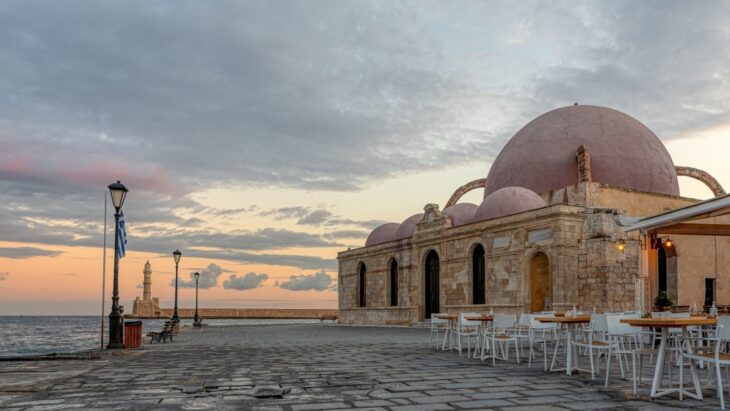
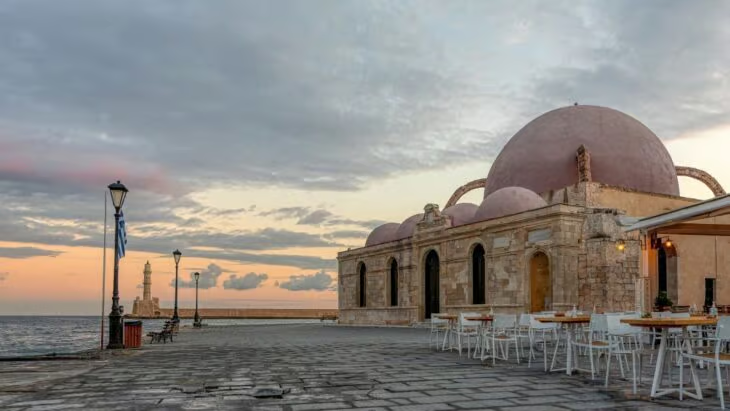
The Küçük Hassan Mosque, built in 1645 on the Old Venetian Harbour of Chania, is the oldest surviving Ottoman structure on Crete and today operates as an exhibition space for the municipality. It is also called the Mosque of the Janissaries (or Yiali Tzamisi – “seaside mosque”).
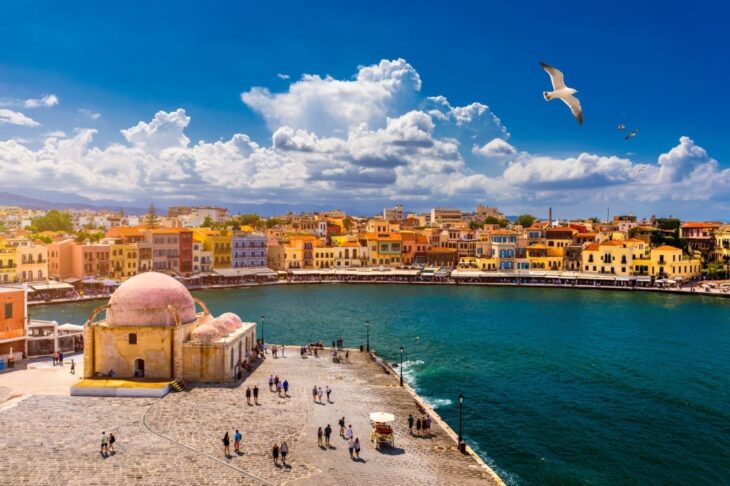
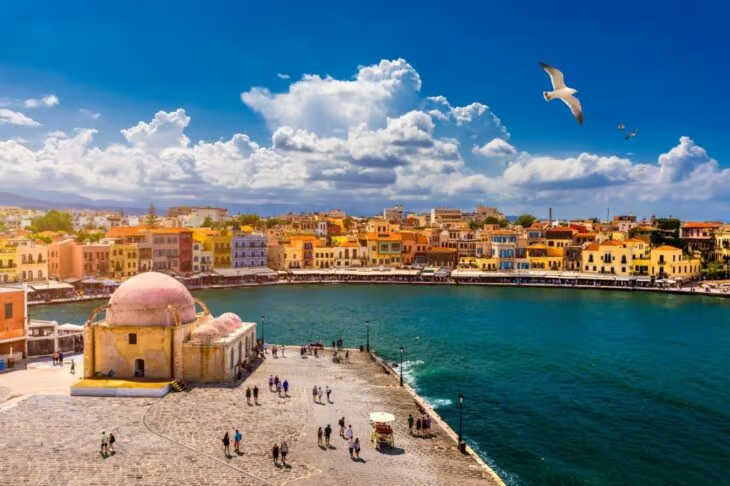
The Küçük Hassan Mosque was erected on the site of a former Venetian church in 1645 and served exclusively as the place of worship for the Janissaries – the Ottoman Empire’s elite infantry corps recruited from Christian boys converted to Islam. The mosque is easily recognised by its white-washed walls and distinctive hemispherical dome visible from across the harbour. The building stopped functioning as a mosque in 1923 following the population exchange, and its minaret was destroyed in 1939 during the Second World War. Today, the Municipality of Chania uses the mosque as an exhibition space hosting rotating cultural and historical displays. Restaurants, shops, and cafés line the surrounding harbour promenade.
The mosque is topped with a massive hemispherical dome framed by stone arches. A gallery on the north and west sides is crowned by six smaller domes – initially open, but walled off by arched openings in the late 19th century.
- Built: 1645 (oldest surviving Ottoman building in Crete)
- Location: Old Venetian Harbour, Chania
- Current use: Municipal exhibition space
- Free entry: Yes (during exhibitions)
2. Minaret of Ahmet Aga (Chania)
The Ahmet Aga Mosque no longer stands, but its minaret – one of the last Ottoman remains in Chania’s Splantzia quarter – survives on Chatzimichali Daliani Street.
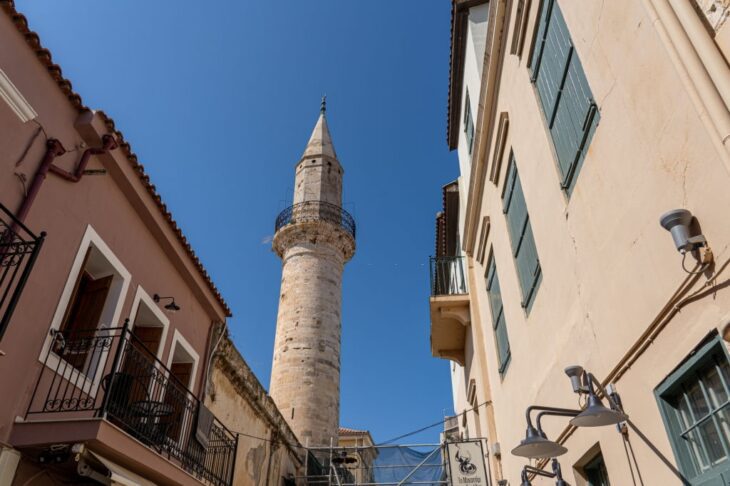
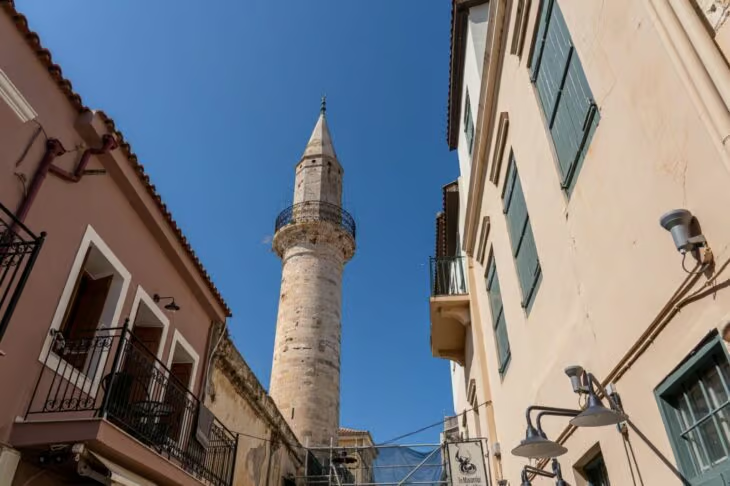
The Ahmet Aga Mosque originally stood on Chatzimichali Daliani Street in the Splantzia quarter, the historic Turkish district of Chania, where an old neighbourhood called Schinoplokadika was once home to rope and knit makers. Today, the mosque itself is gone – only the minaret survives, rising above the Splantzia rooftops. This minaret is considered the tallest remaining Ottoman minaret in Chania and stands close to the Church of Saint Nicholas, which itself bears an Ottoman minaret alongside its Byzantine bell tower – a visible reminder of the city’s layered history under Venetian, Ottoman, and Greek rule.
- Status: Mosque demolished; minaret survives
- Location: Chatzimichali Daliani Street, Splantzia quarter, Chania
- Notable for: Tallest surviving minaret in Chania
- Nearby: Church of Saint Nicholas (also retains an Ottoman minaret)
3. Neratze Mosque – Municipal Odeon (Rethymnon)
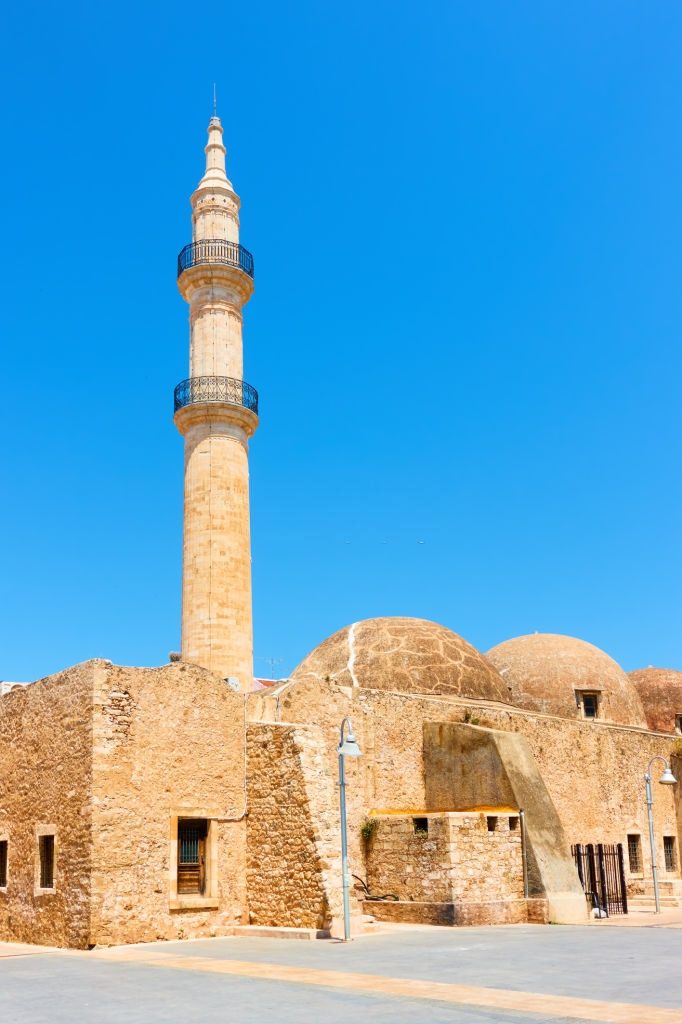
The Neratze Mosque in Rethymnon is home to the tallest minaret on the island at 33 metres, built in 1890, and the complex today houses the Municipal Odeon conservatory. It stands near Petichaki Square in the heart of Rethymnon’s old town.
The Neratze Mosque began as a Venetian church dedicated to Santa Maria, then served as an Augustinian Monastery before Gazi Hussein Pasha converted the complex into a mosque following the Ottoman capture of Rethymnon in 1657. Since 1957, the former mosque has housed the Municipal Odeon of Rethymnon – a conservatory and cultural centre that hosts concerts, exhibitions, and art events. The building retains three semi-circular domes and a prominent stone façade.
The mosque’s minaret, built in 1890 by engineer Georgios Daskalakis, stands 33 metres tall – the tallest minaret in Rethymnon and among the most impressive Ottoman structures on the island. Visitors who climb the minaret are rewarded with panoramic views over Rethymnon’s rooftops and the Cretan Sea.
- Originally built as: Venetian church (Santa Maria) → Augustinian monastery → mosque (1657)
- Minaret: 33 m, built 1890 by Georgios Daskalakis (tallest in Rethymnon)
- Current use: Municipal Odeon (conservatory & cultural centre, since 1957)
- Location: Near Petichaki Square, Rethymnon old town
4. Valide Sultana Mosque (Rethymnon)
The Valide Sultana Mosque was commissioned by Sultan Ibrahim in the late 17th century for his mother Turhan Hatice, and only its minaret remains visible today near the Porta Guora gate in Rethymnon’s old town.
The Valide Sultana Mosque was built in the late 17th century on the orders of Sultan Ibrahim, who dedicated it to his mother Turhan Hatice – then the most powerful woman in the Ottoman Empire and the holder of the title Valide Sultan (mother of the reigning sultan). The mosque stood at the intersection of the Ottoman city’s main streets near the Porta Guora, the principal gate of Rethymnon’s Venetian fortifications.
Today, the mosque preserves a section with two stone domes. The sanctuary’s nave is bordered by columns with inverted Corinthian capitals – a feature reused from the earlier Venetian or Byzantine structure. The mihrab (prayer niche oriented towards Mecca) is enclosed by a relief veneer inscribed with a passage from the Koran.
- Built: Late 17th century, commissioned by Sultan Ibrahim
- Dedicated to: Turhan Hatice (Valide Sultan, mother of the reigning sultan)
- Location: Near Porta Guora, Rethymnon old town
- Surviving features: Two domes, columns with inverted Corinthian capitals, mihrab with Koranic inscription
5. Veli Pasha Mosque (Rethymnon)
The Veli Pasha Mosque in Rethymnon’s Mastaba district features nine domes and the oldest surviving minaret in the city, dated by inscription to 1789, and now houses the city’s Paleontological Museum.
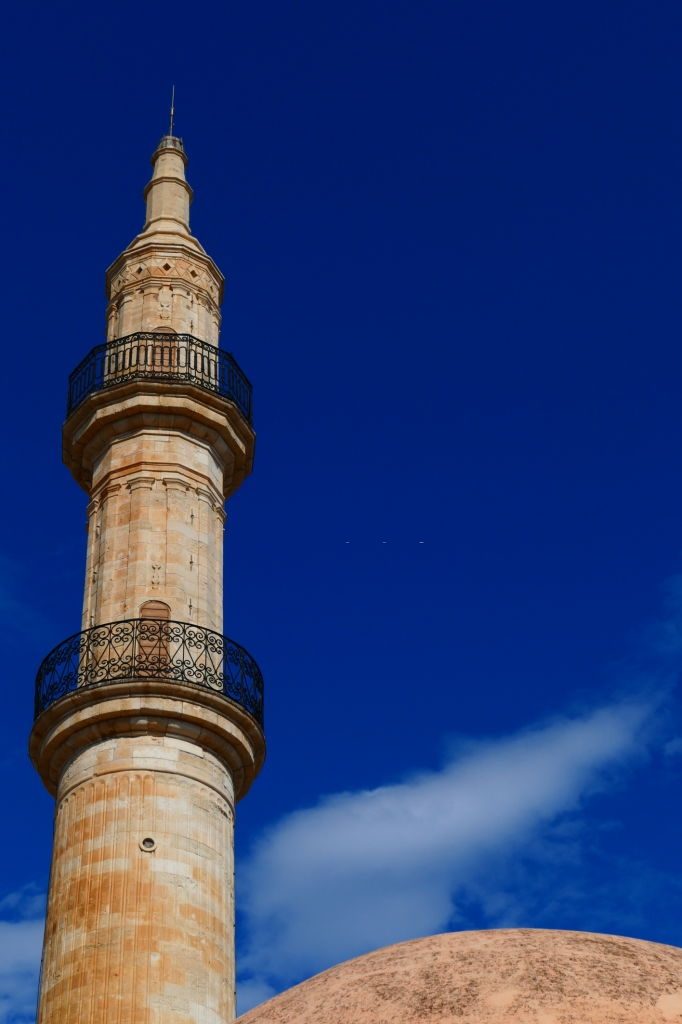
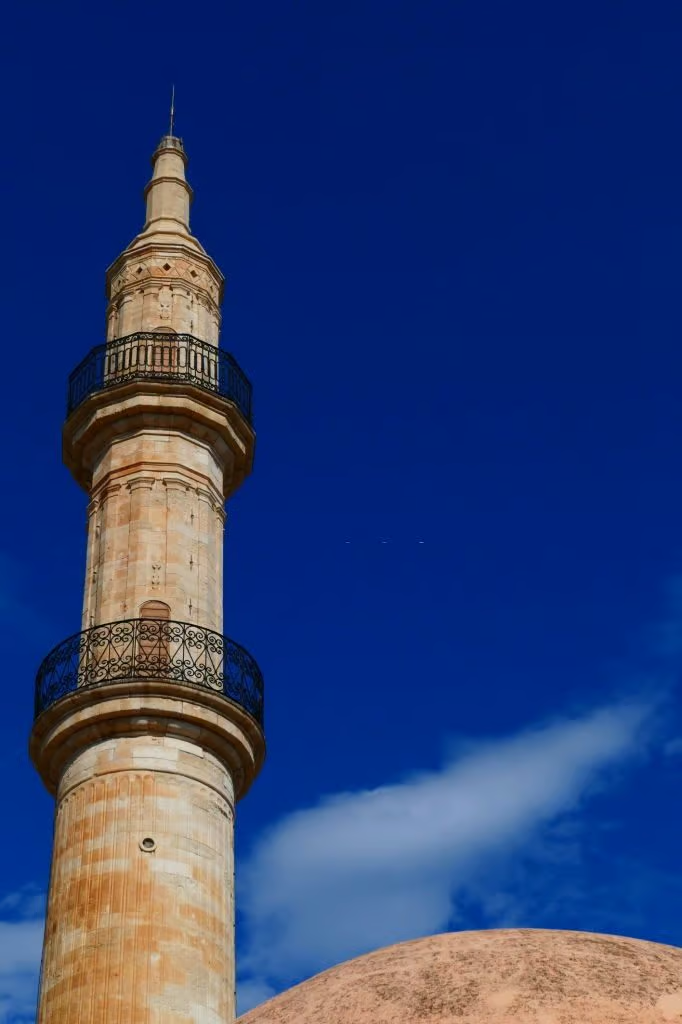
The Veli Pasha Mosque was built on the remains of the Saint Onuphrios temple during the 17th century in Rethymnon’s Mastaba district. The structure is topped by nine domes and includes a series of thirteen successive cells with a beautiful priory – the latter likely an integrated madrasa.
The Veli Pasha Mosque today houses the Rethymnon Paleontological Museum, having been restored after sustaining damage during the Second World War. The minaret carries a chronological inscription dating it to 1789 – the oldest surviving minaret in Rethymnon.
- Built: 17th century (mosque); minaret 1789
- Location: Mastaba district, Rethymnon
- Surviving features: Nine domes, thirteen cells with priory, oldest minaret in Rethymnon
- Current use: Paleontological Museum
6. Kara Musa Pasha Mosque (Rethymnon)
The Kara Musa Pasha Mosque in Rethymnon, built on the site of the Venetian-era Saint Barbara Monastery, preserves its mihrab oriented towards Mecca, a domed mausoleum with three vaults, and a courtyard fountain.
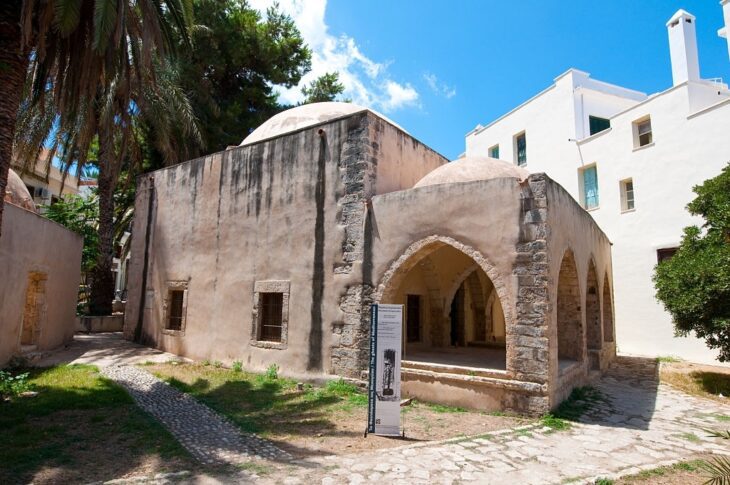
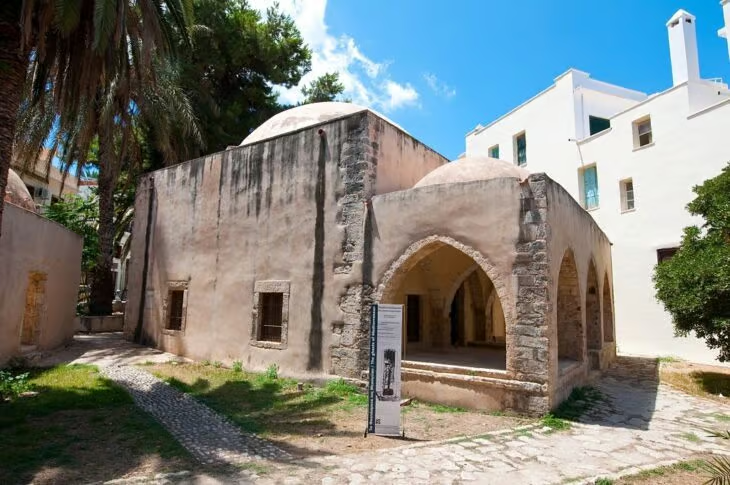
The Kara Musa Pasha Mosque was built on the grounds of the Venetian-era Saint Barbara Monastery during the 17th-century Ottoman occupation, and named after Kara Musa Pasha, the commander of Rethymnon’s Turkish occupation forces. With its four-sided domed tank and two main façades, the mosque is considered an Ottoman architectural treasure.
The mosque preserves its mihrab oriented towards Mecca – the original prayer niche used by worshippers – alongside a domed mausoleum with three vaults containing the graves of Ottoman dignitaries. The Kara Musa Pasha Mosque keeps its minaret and courtyard fountain as separate structures – the fountain once served the ritual purification (wudu) needs of Muslim worshippers before prayer. Lavish gardens and trees surround the complex.
- Built: 17th century, on Saint Barbara Monastery grounds
- Named after: Kara Musa Pasha (commander of Ottoman forces in Rethymnon)
- Surviving features: Mihrab, domed mausoleum (3 vaults), separate minaret, courtyard fountain
- Setting: Surrounded by gardens
Other notable mosques in Crete
Beyond the six main mosques, Crete preserves additional Ottoman religious structures including the Sultan Ibrahim Han Mosque inside Rethymnon’s Fortezza, the Kucuk Haci Ibrahim Aga Mosque (the converted Venetian Loggia), and the Ierapetra Mosque in eastern Crete.
- Sultan Ibrahim Han Mosque (Fortezza, Rethymnon) – Built inside the Venetian Fortezza fortress on the site of the cathedral of San Nicolò, it remains one of the best-preserved mosque interiors on Crete. Open to visitors as part of the Fortezza tour.
- Kucuk Haci Ibrahim Aga Mosque (Heraklion Loggia) – The Venetian Loggia in Heraklion was converted into a mosque during Ottoman rule. The minaret has been removed but the converted structure remains a cornerstone of the city’s central architecture.
- Ierapetra Mosque (eastern Crete) – A small Ottoman mosque overlooking the Libyan Sea in Ierapetra; one of the few surviving Ottoman religious structures outside Chania and Rethymnon.
Visiting mosques in Crete: practical tips
Most former mosques in Crete are located in the old towns of Chania and Rethymnon, accessible on foot, with several repurposed as museums or cultural centres that welcome visitors year-round.
- Chania cluster: The Küçük Hassan Mosque and the Minaret of Ahmet Aga are within a 10-minute walk of each other – pair them with a stroll along the Venetian harbour.
- Rethymnon cluster: The Neratze Mosque (Municipal Odeon), Valide Sultana, Veli Pasha, and Kara Musa mosques are all concentrated in the old town and can be visited on a single half-day walk. Add the Sultan Ibrahim Han Mosque inside the Fortezza for a full day.
- Entry: Several buildings operate as museums or cultural centres with free or low-cost entry. The Veli Pasha (Paleontological Museum) and Sultan Ibrahim Han (Fortezza) charge nominal entry fees.
- Active worship: Most former Ottoman mosques in Crete are no longer active places of worship. Visitors should still treat them as heritage sites of religious significance.
- Best time to visit: Similar to monasteries in Crete, Mosques, should be visited in April–June and September–October – pleasant temperatures, fewer crowds, and most museums open year-round.
- Getting there: Both Chania and Rethymnon old towns are pedestrian-friendly. A Crete car rental is the easiest way to combine sites across both cities; the drive between Chania and Rethymnon is approximately one hour via the E75.
© Rental Center Crete – licensed by the Greek National Tourism Organization (Reg. N° 1039E00810009100). Main office: Nidas 1, Heraklion, Crete, Greece 71307 – +30 2810 240120.