


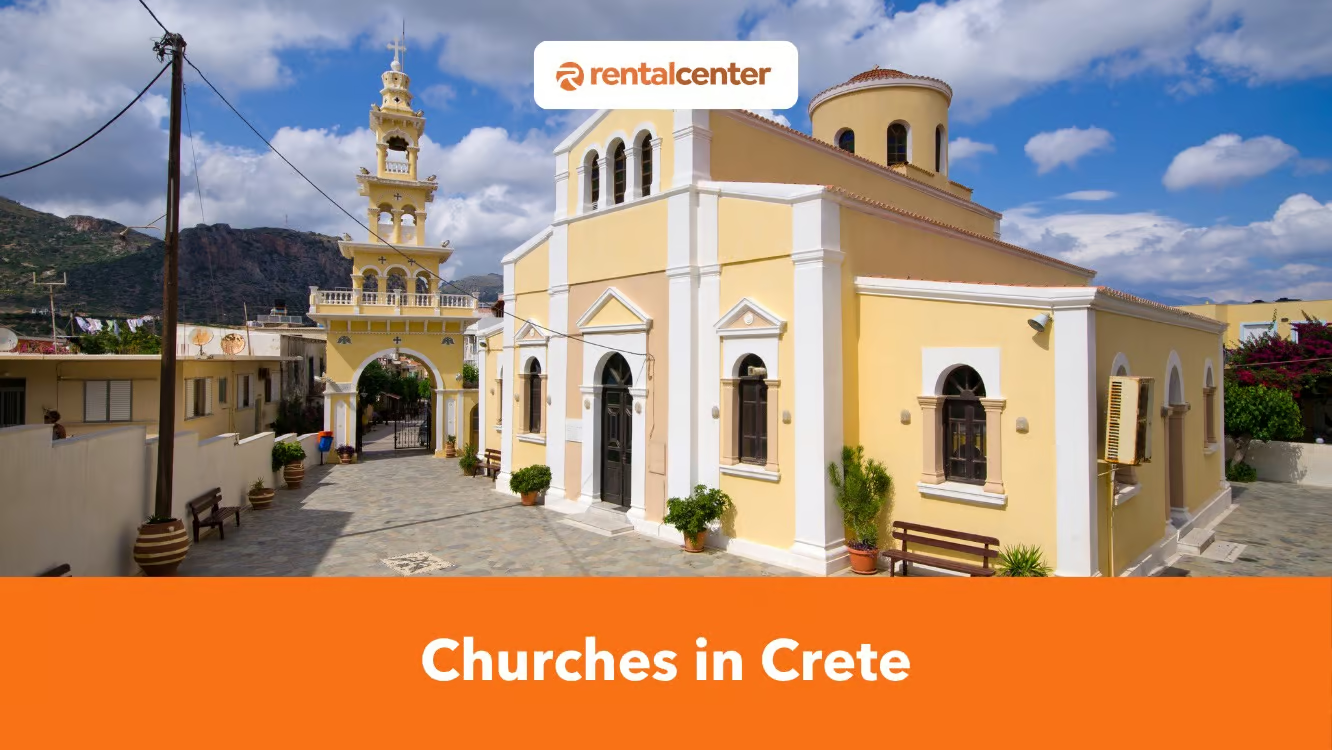
Crete has more than 5,000 churches, chapels, and monasteries – a density shaped by 1,600 years of Greek Orthodox faith, Byzantine imperial rule, Venetian occupation (1211–1647), and Ottoman domination. Among them, six stand out for their historical significance, Byzantine frescoes, and unique locations: from Panagia Kera near Kritsa – widely considered the oldest church in Crete still preserving its original Byzantine fabric – to the Agios Nikolaos chapel in Georgioupoli, which rises from the sea at the end of a stone pier.
What Is the Oldest Church in Crete?
The Church of Panagia Kera near Kritsa (Lassithi Prefecture) is widely identified as the oldest Byzantine church in Crete still standing with its original frescoes intact, with its central nave and vaulted dome dating to the 13th century. A rival claim belongs to the Cathedral of Agios Titos at Gortyn, whose original basilica dates to the 6th century AD. Below are the two main contenders.
Panagia Kera – The 13th-Century Byzantine Masterpiece
Panagia Kera holds the finest-preserved Byzantine frescoes in Crete – painted across three naves between the 13th and 14th centuries in vivid tempera that has survived more than 700 years. The central nave and vaulted dome were constructed in the 13th century, making the structure over 700 years old. The frescoes were painted in two distinct phases: the first layer in the mid-13th century, and the second during the first two decades of the 14th century, in the Palaiologan style.
The church is dedicated to the Assumption of the Virgin Mary and comprises three naves: the central nave (Virgin Mary), the south nave (Saint Anne), and the north nave (Saint Anthony). It stands roughly 1 kilometers (0.62 miles) south of Kritsa village at an altitude of 375 m – easily reached on a 10-minute drive from Agios Nikolaos town.
Other Contenders: Agios Titos and Agios Ioannis Antzoussis
The Cathedral of Agios Titos at Gortyn, in southern Heraklion Prefecture, traces its original basilica to the 6th century AD – from the First Byzantine Period on Crete (330–824 AD). The church was dedicated to Titus, the Greek Christian missionary appointed by the Apostle Paul as the first bishop of Crete. The current Cathedral of Agios Titos in Heraklion city was first erected in the 10th century and has cycled through Byzantine, Venetian Catholic, and Ottoman mosque phases before its restoration as a Greek Orthodox church in 1925. A third claimant, Agios Ioannis Antzoussis in the Rethymno region, is occasionally cited locally but lacks the documented dating of the other two.
Panagia Kera in Kritsa, Lassithi
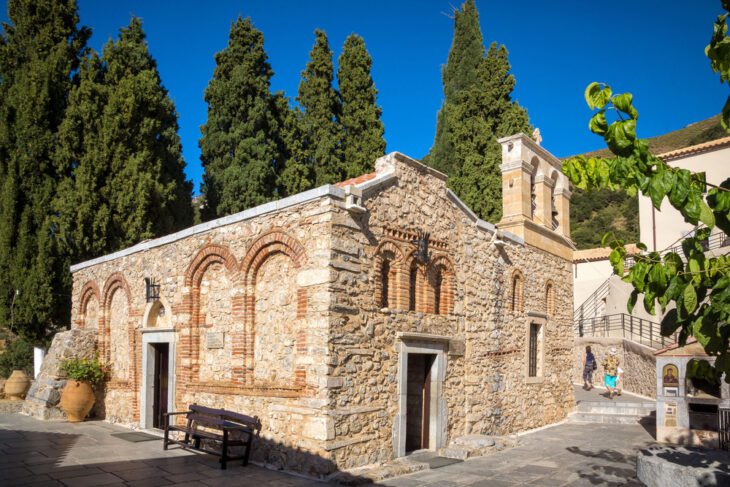
Panagia Kera near Kritsa holds the finest-preserved Byzantine frescoes on the island and is the most widely cited candidate for the oldest Byzantine church in Crete. The structure carries distinct buttresses supporting the entire building and a small, refined belfry, while the interior presents floor-to-ceiling Byzantine frescoes covering every wall.
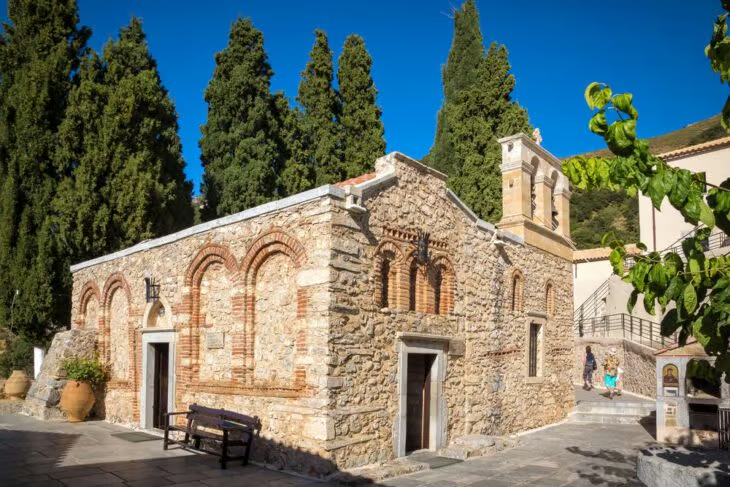
The Byzantine Frescoes
The central nave frescoes depict scenes from the New Testament – the Presentation, the Baptism of Christ, the Raising of Lazarus, and the Entry into Jerusalem – while the western wall shows the Crucifixion and the Punishment of the Damned, with Michael the Archangel announcing the Second Coming. The south nave is devoted to Saint Anne, and the north nave to Saint Anthony, with vivid Judgement Day scenes.
Panagia Kera commemorates the Assumption of the Virgin Mary and has attracted pilgrims for centuries. Local tradition attributes miraculous healings to the church’s icon of the Virgin Mary, which was transported to Constantinople during the Byzantine Iconoclasm and later returned to Crete.
Church of Agios Pavlos, Agia Roumeli (Chania)
The Church of Agios Pavlos sits directly on the beach of Agia Roumeli in southern Chania, built in the 10th century on the site where, according to tradition, Saint Paul baptised the first Christians of Crete during his journey to Rome.
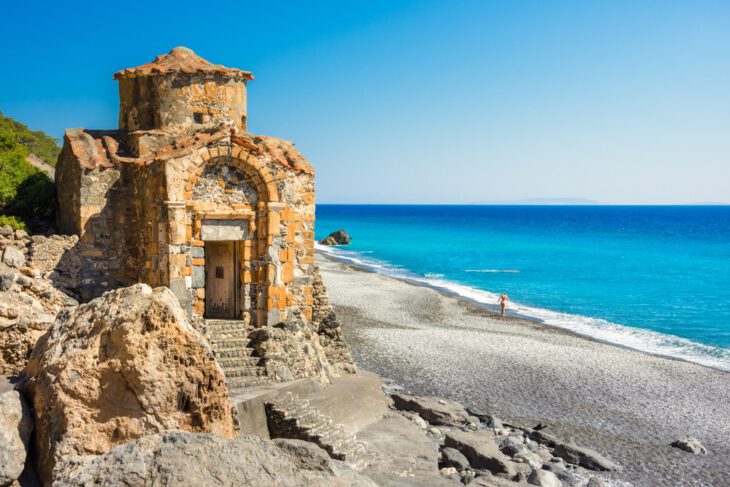
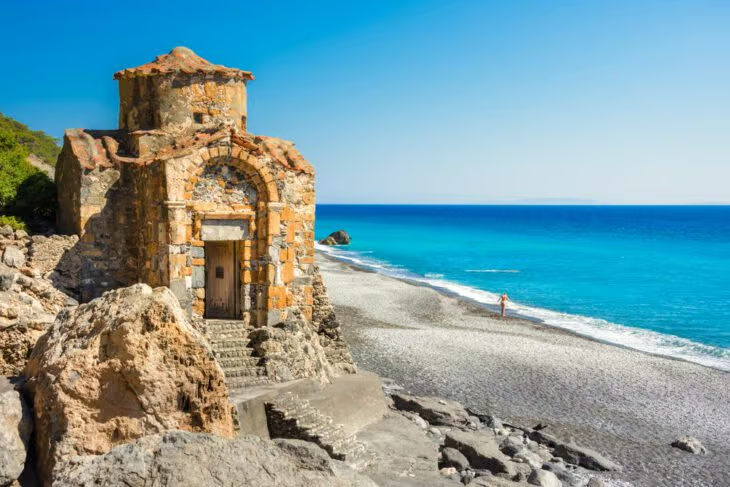
To reach the church, walk the path along the sea from the village’s main beach – about a 20-minute trek along the Cretan coast. The structure was built from dark stones quarried at the very beach of Agios Pavlos, stands a few metres above the sea, and is crowned with a white cross on its dome. Its 13th-century frescoes and stone facade reward the walk regardless of religious interest.
Agios Nikolaos Church in Chania’s Splantzia District
The church of Agios Nikolaos in Chania’s Splantzia district functioned as the city’s principal mosque during the Ottoman occupation – retaining its towering minaret as the tallest structure in the historic quarter today. Constructed in 1320 as the centrepiece of the Dominican convent of Saint Nicholas, the church bears architectural traces of every power that ruled Chania: Dominican, Venetian, and Ottoman.
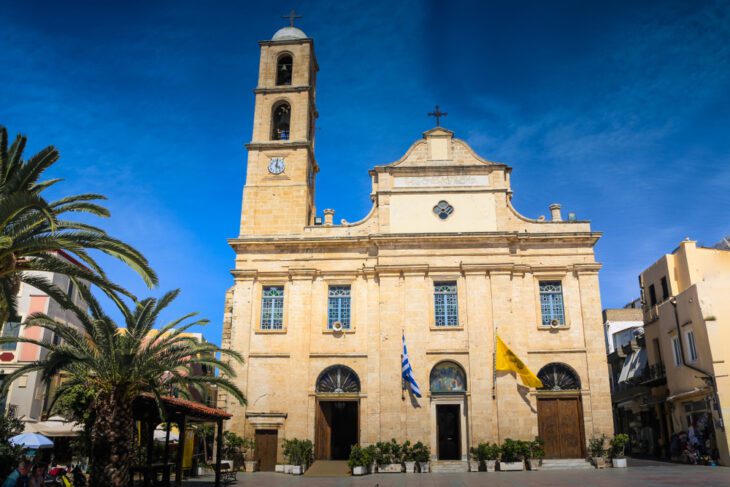
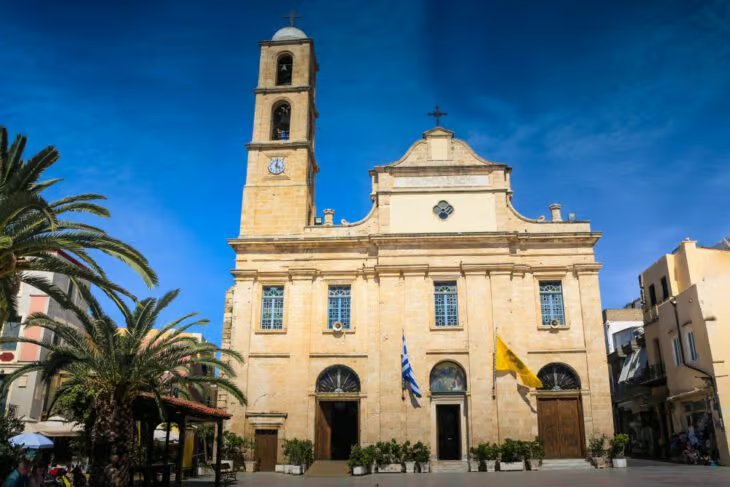
Its most distinguishing feature is the dual silhouette of an Ottoman minaret on its south corner and a Venetian bell tower on its north side – a single building marked by both the Christian West and the Islamic East. Inside, visitors can examine the remnants of the convent and its former mediaeval portal.
Church of the Panagia, Fodele (Near Heraklion)
The Church of the Panagia in Fodele – 3 kilometers (18.64 miles) west of Heraklion – occupies the central aisle of a 6th-century three-aisled Early Christian basilica, whose original baptistery and two pillars remain partially visible today. The church preserves frescoes from the 12th and 13th centuries depicting the Virgin Mary, Christ Pantocrator, John the Baptist, the Twelve Apostles, and other Biblical figures painted directly on the walls.
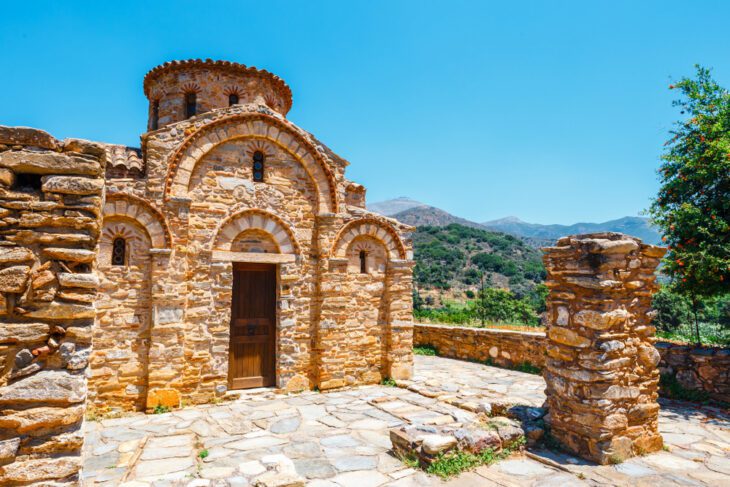
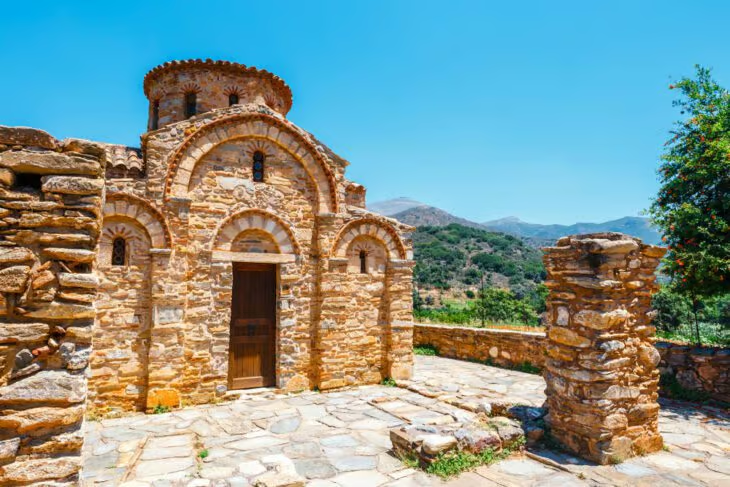
The temple sits among a grove of orange trees directly across from the El Greco Museum, making it a natural stop on any route between Heraklion and Rethymno.
Church of the Panagia, Thronos (Amari Valley, Rethymno)
The Panagia Chapel in Thronos village, at the heart of the Amari Valley in Rethymno region, shelters rare Byzantine paintings and a 1491 inscription. The chapel stands over the mosaic-floored ruins of a 4th-century early Christian basilica – among the earliest Christian structures in Crete – with sections of the original foundations visible to visitors.
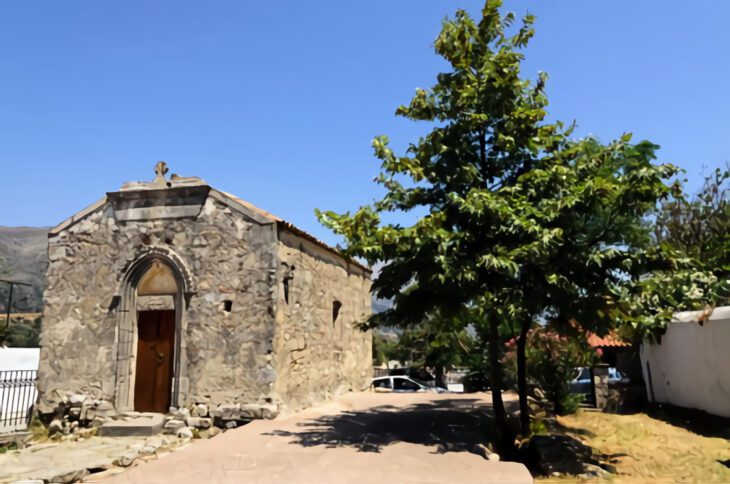
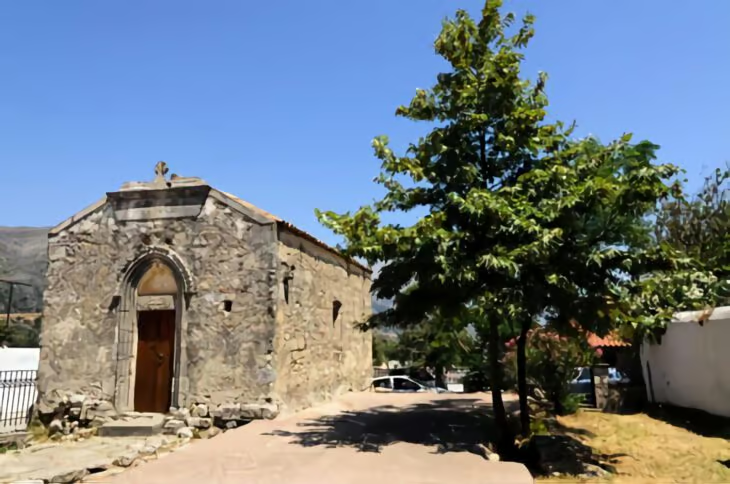
The vaulted single-nave interior is austere, but the walls carry rare Byzantine paintings rooted in the late Venetian period. To enter, head to the local cafe first and ask for the key.
Agios Nikolaos Chapel, Georgioupolis
The Agios Nikolaos chapel in Georgioupolis extends from the shoreline along a long pier directly into the Aegean Sea, creating the illusion that the chapel rises from the water. The pier ends at Georgioupoli’s city beach, around 27 kilometers (16.78 miles) from Chania, in a small seaside village.
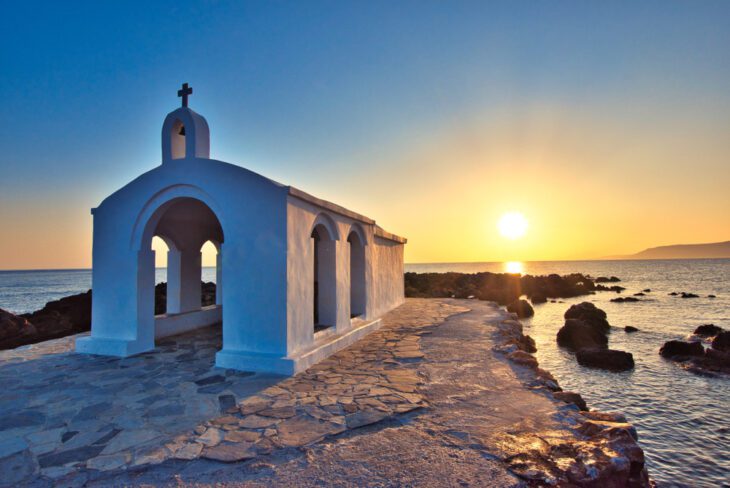
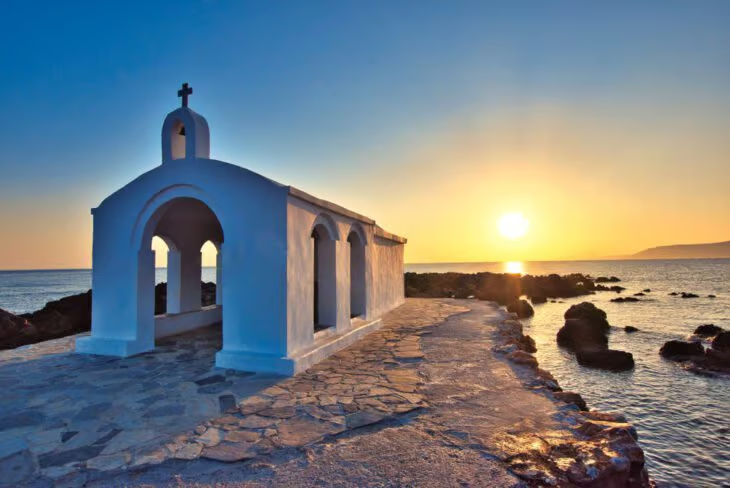
The white chapel ranks among Crete’s most-photographed wedding venues, with couples choosing it for both Greek Orthodox rites and post-ceremony portraits. The interior is plain – only a few icons, candles, and the patron image of Saint Nicholas, patron saint of fishermen and sailors.
Practical Information for Visiting Churches in Crete
Most Byzantine churches in Crete require modest dress (covered shoulders and knees), prohibit flash photography to protect ancient frescoes, and can be visited daily from approximately 9:00 to 18:00 in summer, most of them for free.
| Church | Entrance | Hours (Summer) | Tip |
|---|---|---|---|
| Panagia Kera (Kritsa) | €3 ($3.43, £2.55) | 9:00–17:00 daily | No flash photography; modest dress required |
| Church of Agios Pavlos (Agia Roumeli) | Free | Open access | 20-min walk from village beach |
| Agios Nikolaos (Chania) | Free | Open during services | Visit between morning liturgy and evening |
| Panagia (Fodele) | Free | Daylight hours | Park near El Greco Museum |
| Panagia (Thronos) | Free | Daylight hours | Ask at local cafe for key |
| Agios Nikolaos (Georgioupoli) | Free | Always open | Wedding bookings require advance contact |
Dress Code and Photography Rules
When visiting churches and monasteries in Crete, dress modestly: covered shoulders and knees are required at all sites. Flash photography is prohibited inside Byzantine churches to protect ancient frescoes – some of which are 700 years old. Many smaller churches are kept locked; the key is usually held at the nearest kafeneion (café) or by a local resident living next door.
Why Are There So Many Churches in Crete?
About 97% of Cretans practice Greek Orthodoxy – one of the highest rates of religious observance in Europe. Crete’s Byzantine heritage spans from 330 AD, and churches served not only as places of worship but as centres of cultural resistance under Ottoman rule (1645–1898).
A second, equally important factor is a tradition of personal piety: Cretans build small private chapels in thanks for answered prayers, in memory of loved ones, or following survival from accidents. This explains the thousands of tiny chapels found along roads, on clifftops, and in remote mountain pastures across the island. The most famous monastery on the island, Arkadi Monastery in Rethymno region, has become a national symbol of Cretan resistance against Ottoman rule following the 1866 explosion that killed hundreds of besieged civilians.
Last reviewed: May 2026. Opening hours and entrance fees are subject to seasonal change – verify with the local municipality or church authority before visiting.