






The cities are organized chronologically by their period of dominance: Minoan Bronze Age (c. 2700–1450 BCE), Dorian and Archaic (c. 1100–500 BCE), Hellenistic and Roman (c. 67 BCE–330 CE), and Late Antique and Byzantine (after 330 CE).
The Minoan Legacy: Crete’s Bronze Age Cities
The Minoan civilization, which flourished from c. 2700 to 1450 BCE, built the earliest urban centers in Europe, and Crete preserves more Minoan palace sites than any other location on earth. Excavations across the island, beginning with Sir Arthur Evans at Knossos in 1900, have revealed multi-story palatial complexes, sophisticated drainage systems, the Linear A writing system, and an artistic tradition that produced the famous frescoes of bull-leaping, saffron gatherers, and the Prince of the Lilies.
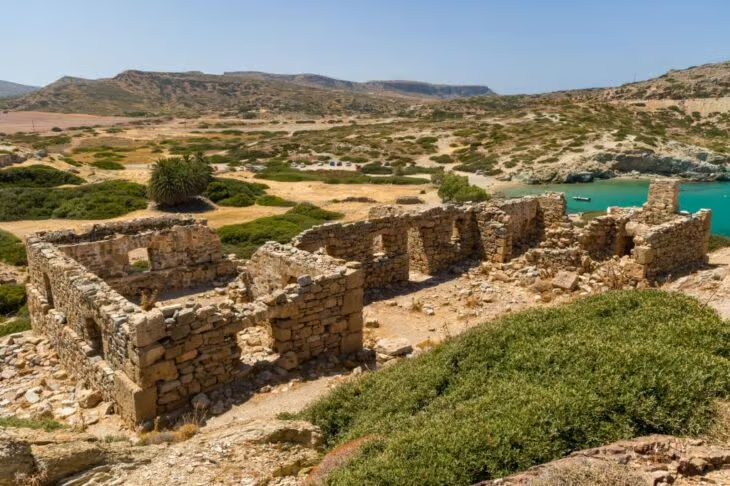
1. Knossos, Europe’s Oldest City and Capital of the Minoan World
Location: 5 km (3.11 miles) south of Heraklion | GPS: 35.2980° N, 25.1635° E Period: Continuously inhabited c. 7000 BCE – Roman era Entry: €15 ($17.22, £12.71) (combined ticket with Heraklion Archaeological Museum: €20 ($22.96, £16.95)) | Hours: Daily 8:00–20:00 (Apr–Oct), reduced winter hours
Knossos is Crete’s most visited archaeological site and the largest Bronze Age palace complex in the Aegean, with an estimated peak population of ~100,000 around 1600 BCE. Inhabited continuously since approximately 7000 BCE, Knossos holds the title of Europe’s oldest city.
The Palace of Knossos, excavated by Sir Arthur Evans beginning in 1900, features the Throne Room, the Grand Staircase, and the iconic Bull-Leaping Fresco. The site is the legendary home of King Minos, the mythical Labyrinth, and the Minotaur. Linear A and Linear B tablets recovered here are central to scholarship on Aegean writing systems. Source: Evans, A.J., The Palace of Minos, Macmillan, 1921–1935.
2. Phaistos, Palace of the Southern Plain
Location: Messara plain, 62 km (38.53 miles) south of Heraklion | GPS: 35.0517° N, 24.8137° E Period: c. 2000–1450 BCE (Minoan palatial era) Entry: €8 ($9.18, £6.78) | Hours: Daily 8:30–15:30
Phaistos is the second-largest Minoan palace after Knossos and is famed for the Phaistos Disk (c. 1700 BCE), a clay disc bearing 241 stamped symbols whose script remains undeciphered. The palace controlled the fertile Messara plain and traded extensively across the Aegean. Excavated by Federico Halbherr (1900) and continued by the Italian Archaeological School. The neighboring royal villa of Agia Triada is included in this archaeological complex.
3. Agia Triada, Royal Minoan Villa
Location: 3 km (1.86 miles) west of Phaistos | GPS: 35.0567° N, 24.7892° E Period: c. 1700–1450 BCE Entry: Combined with Phaistos site
A Minoan villa and ritual center adjacent to Phaistos, occupied for almost 400 years during the Neopalatial period. Agia Triada served as a Cretan royal residence and produced the Hagia Triada Sarcophagus, a painted limestone sarcophagus showing detailed Minoan funerary rites, now in the Heraklion Archaeological Museum. The site preserves storerooms, a megaron-style hall, and frescoes. A 39-minute walk from Phaistos, or 6 minutes by car.
4. Amnisos, Harbor of Knossos
Location: Northern coast, 7 km (4.35 miles) east of Heraklion | GPS: 35.3306° N, 25.1844° E Period: Bronze Age (Minoan harbor)
Amnisos served as the principal harbor for the palace city of Knossos during the Bronze Age. The site preserves the House of the Frescoes, where the famous Lily Fresco (now in Heraklion Archaeological Museum) was discovered, and the Eileithyia Cave, a sacred cave dedicated to the Minoan goddess of childbirth, mentioned in the Odyssey. Nearby beaches: Amnissos Beach, Karteros Beach. Visit in May–June for warm weather and quieter crowds. Reachable from Heraklion in 15 minutes by car.
5. Malia, Third-Largest Minoan Palace
Location: Northern coast, 37 km (22.99 miles) east of Heraklion | GPS: 35.2920° N, 25.4925° E Period: c. 1900–1450 BCE Entry: €6 ($6.89, £5.09) | Hours: Daily 8:30–15:30
Ancient Malia (Mallia) was the third-largest Minoan palace complex after Knossos and Phaistos, built around 1900 BCE. The site features a large central courtyard, granaries, and the famous Minoan kernos, a circular ritual offering table, plus elite “houses” surrounding the palace core. The Malia Pendant (a gold bee jewellery piece, 1700 BCE) is one of the finest surviving examples of Minoan goldwork. Excavated by the French School at Athens since 1915.
Dorian and Archaic City-States
After the Minoan collapse around 1200 BCE, Dorian Greeks established a network of independent city-states (poleis) across Crete, many of which survived until the Roman conquest in 67 BCE. Ancient sources count as many as a hundred poleis on the island during this period.
6. Aptera, City Without Wings
Location: Western Crete, 13 km (8.08 miles) east of Chania, 1 km (0.62 miles) inland from southern shore of Souda Bay | GPS: 35.4604° N, 24.1427° E Period: Minoan – 365 CE (Hellenistic/Roman peak) Entry: ~€2 ($2.30, £1.70) | Hours: Daily 8:00–14:30 (closed Mondays)
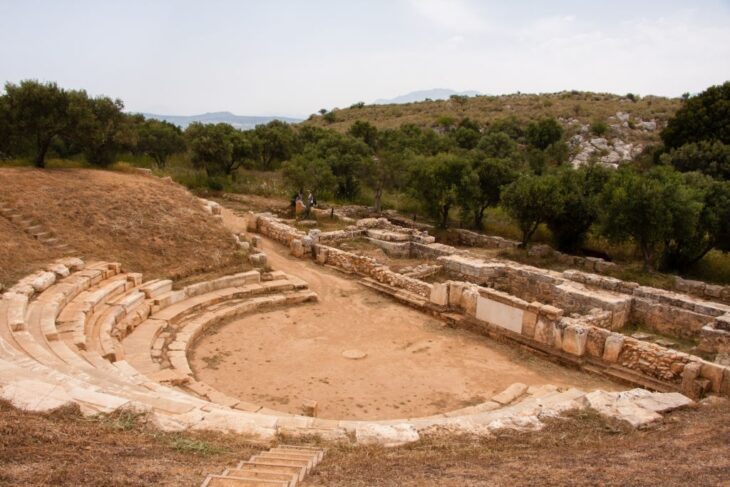
Aptera held political control over western Crete from the Minoan period through the late Roman era, commanding the strategic southern shore of Souda Bay. The city met its end in the catastrophic earthquake of 365 CE, one of the largest seismic events in Mediterranean history, which raised parts of western Crete by as much as 9 metres and sent a tsunami devastating Alexandria and other coastal cities (documented by Ammianus Marcellinus, Res Gestae 26.10). The earthquake ended Aptera’s urban life, though a Byzantine monastery dedicated to St. John the Theologian occupied the site intermittently until the 10th century.
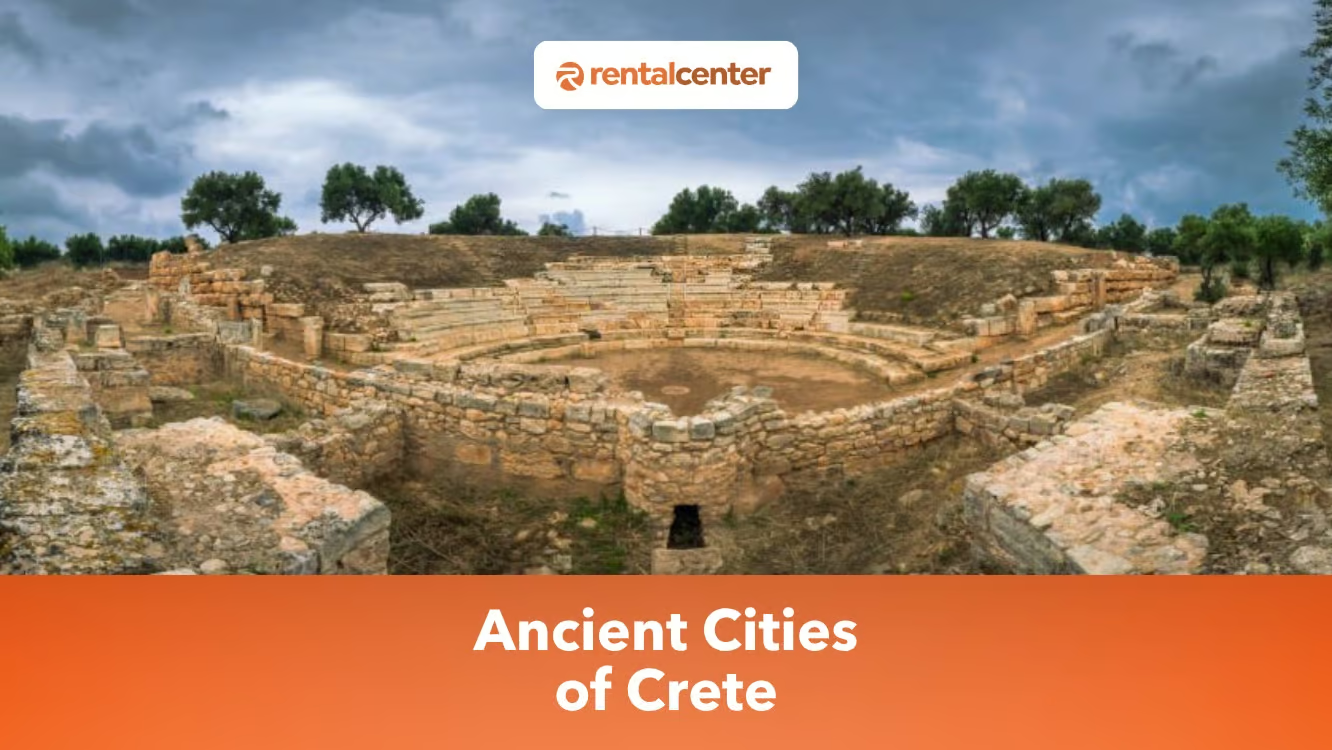
The site preserves an ancient theatre, Roman cisterns, and the ruins of Roman bath houses. The name Aptera means “without wings”, Greek mythology placed here the legendary contest between the Sirens and the Muses: the Muses won, the Sirens cast off their wing feathers and threw themselves into the sea, where they became the white islets named Leucae (modern Lefkes islands). Wear comfortable shoes for the uphill walk.
7. Eleftherna (Eleutherna), City of Freedom
Location: 30 km (18.64 miles) southeast of Rethymno, on Mount Psiloritis | GPS: 35.3241° N, 24.6770° E Period: 9th century BCE – Byzantine era Entry: Eleftherna Archaeological Museum: €4 ($4.59, £3.39) | Site free
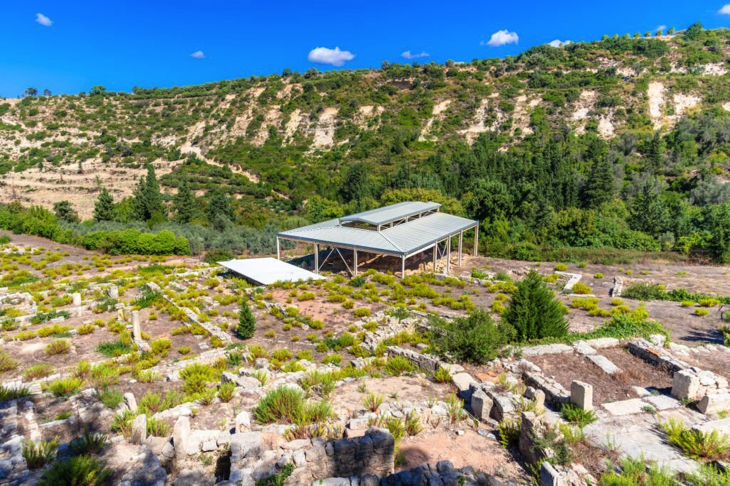
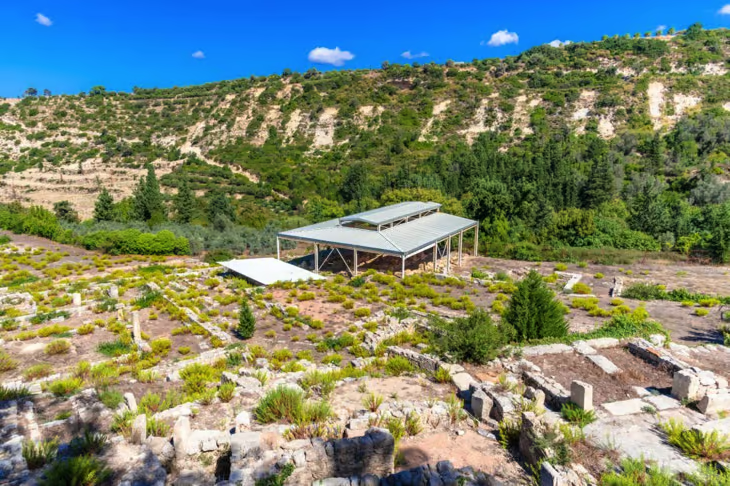
Eleftherna thrived in ancient Greece’s Geometric and Archaic eras as a major Dorian-built city-state on a narrow spur of Mount Psiloritis. The name derives from the Greek Eleftheria, “freedom.” A hub for pottery manufacturing and Mediterranean trade, the city’s wealth is preserved in its necropolis, where Geometric-period burials yielded gold jewellery, weapons, and a Phoenician-style alphabet inscription dated c. 800 BCE, among the earliest evidence of the Greek alphabet.
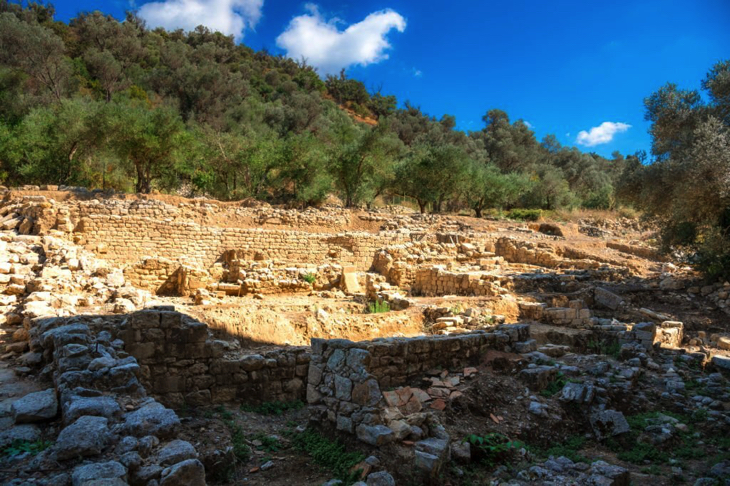
Athenian forces conquered Eleftherna in the 5th century BCE; the city later joined the Roman Empire and survived through the Byzantine era before slowly falling into ruin. Eleftherna reclaimed its place in history when the University of Crete launched systematic excavations in 1985 under Professor Nicholas Stampolidis, revealing a city-state of unexpected wealth and artistic sophistication. Source: Stampolidis, N. Ch. (ed.), Eleutherna: Polis, Acropolis, Necropolis, Athens: University of Crete Press, 2004.
Important monuments at Eleftherna:
- Necropolis, Geometric and Archaic period burials with rich funerary goods
- Eleftherna Archaeological Museum, opened 2016, houses key finds in situ
- Acropolis of Eleftherna, fortified core with defensive walls
- Temple of Artemis Orthia, religious center
- Orthi Petra (“standing stone”), ritual marker tied to ancient religious practice
8. Kamara (Lato pros Kamara), The Sunken City
Location: Elounda Bay, eastern Crete | GPS: 35.2587° N, 25.7428° E Period: 3rd–2nd centuries BCE (Hellenistic Dorian) Access: Free; visible by snorkeling at 1–2 m depth
Kamara is a submerged Dorian harbor settlement in modern Elounda Bay, the only underwater ancient city accessible to snorkelers in Crete. Founded after Dorian settlers from inland Lato chose this sheltered coastal location for its natural harbor (the city served as Lato’s port, Lato pros Kamara, “Lato by the arch”), Kamara gradually subsided into the sea following tectonic movement, leaving its street grid and building foundations visible at 1–2 metres depth.
The submerged ruins lie at the northern end of the Kolokytha peninsula in Elounda Bay. Reaching the site takes 13 minutes by car from Elounda village or a 90-minute coastal walk via Kolokytha beach. Clearest water: June–September.
9. Itanos, Eastern Trading Hub
Location: Northeastern Crete, between Sitia and Vai | GPS: 35.2731° N, 26.2683° E Period: Late Minoan – Byzantine
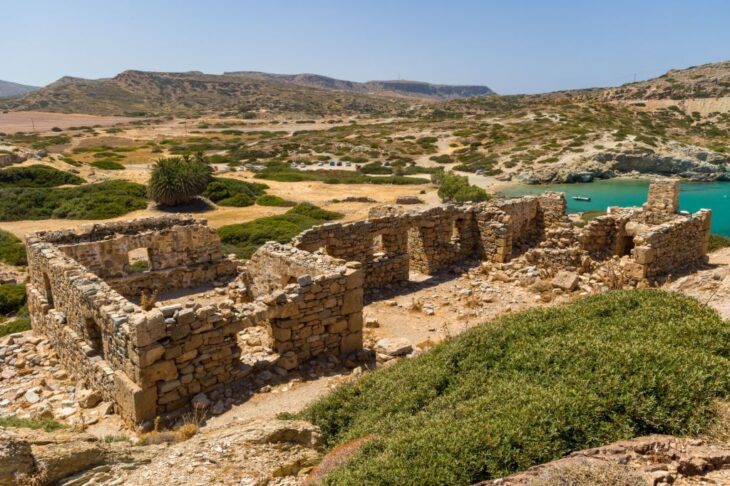
Itanos prospered as a Hellenistic and Roman trading hub with networks reaching Libya, Palestine, and Syria. The city minted its own currency and constructed marble-clad public buildings. Adjacent to the Vai Palm Forest (Europe’s largest natural palm grove) and Toplou Monastery. Mythology associates the nearby Lake Voulismeni (in Agios Nikolaos) with the bathing of two goddesses. Reachable from Sitia in 16 minutes by car.
Hellenistic and Roman Cities
Rome’s conquest of Crete in 67 BCE under Quintus Caecilius Metellus reshaped the island’s urban hierarchy: Gortyn replaced Knossos as the leading city and became the capital of the Roman province of Creta et Cyrenaica (Crete and Libya combined).
10. Gortyn (Gortyna), Roman Capital of Crete
Location: Messara plain, 45 km (27.96 miles) south of Heraklion | GPS: 35.0606° N, 24.9489° E Period: Bronze Age – 824 CE (Roman capital from 67 BCE) Entry: €6 ($6.89, £5.09) | Hours: Daily 8:00–20:00 (summer)
Gortyn served as the capital of the Roman province of Creta et Cyrenaica from 67 BCE until the Arab conquest in 824 CE, nearly 900 years as the island’s leading city. The site is known chiefly for the Law Code of Gortyn, a 5th-century BCE inscription on twelve stone columns that represents the most complete surviving example of ancient Greek law, covering marriage, divorce, property rights, slavery, and adoption. The code is displayed in situ at the Odeon of Gortyn.
Other key features: the Praetorium (Roman governor’s residence), the Temple of Apollo Pythios, the early Christian Basilica of Saint Titus (4th century CE, Titus was Crete’s first bishop, ordained by St. Paul), and a Roman amphitheatre. The site is dispersed across olive groves over several square kilometres, allow at least 2 hours.
11. Cydonia, Ancient Chania
Location: Modern Chania, northwestern Crete | GPS: 35.5138° N, 24.0180° E Period: Minoan – present (continuously inhabited)
Cydonia evolved continuously from a Minoan port into the Hellenistic capital of western Crete, then into the Byzantine city of Chania, making it one of the few ancient cities whose urban fabric has never been interrupted. Linear B tablets discovered in the city’s ancient workshops confirm its Minoan identity. Homer described western Crete as “the home of the Kydonians.” The city’s name derives from its legendary founder Kydon, variously described as the son or grandson of King Minos.
Modern excavations have uncovered Minoan houses beneath the Old Town’s Kasteli hill, including Kydonia tablets dating to the Late Minoan IIIB period. Above-ground today: the Venetian Old Port, Maritime Museum of Crete, the Egyptian-style Lighthouse of Chania, and the Archaeological Museum of Chania, itself housed in a former Venetian church above ancient Cydonian foundations.
12. Lebena, Sanctuary of Asklepios
Location: Southern coast, near modern Lentas village, at the southern foot of the Asterousia mountains | GPS: 34.9341° N, 24.9117° E Period: Final Neolithic – mid-1st century CE
Lebena flourished as one of the ancient Mediterranean’s premier healing centers, anchored by the Asklepieion (Sanctuary of Asklepios, Greek god of medicine) and a famous thermal spring used for hydrotherapy. The site was a regional dependency of Gortyn. Its name derives from the lion-shaped peninsula to the west (Greek leon = lion). A devastating earthquake in the mid-1st century CE destroyed the sanctuary and most of the town. Proto-Minoan tholos tombs and Hellenistic-Roman ruins survive. Reachable by hiking trail or by public bus; check timetables.
Late Antique and Byzantine Sites
13. Heraklion, From Roman Heracleum to Byzantine Chandax
Location: Central north coast | GPS: 35.3387° N, 25.1442° E Period: Late Roman – present
Modern Heraklion sits on the site of ancient Heracleum and the Arab city of Chandax (Rabd al-Khandaq), founded by Andalusian Arabs in 824 CE after they conquered Byzantine Crete. The Byzantine general, later emperor, Nikephoros Phokas reconquered the city in 961 CE. Under Venetian rule (1205–1669), the city became known as Candia and served as Venice’s most important overseas possession. It became Crete’s capital in 1971.
Key heritage attractions: Heraklion Archaeological Museum (the world’s largest Minoan collection), the Venetian Koules Fortress, the Morosini Fountain, the city walls, and the Historical Museum of Crete. Ideal visit window: spring or late autumn (March–May, September–November).
14. Archanes, Minoan Royal Necropolis
Location: 15 km (9.32 miles) south of Heraklion | GPS: 35.2386° N, 25.1633° E Period: Minoan – present
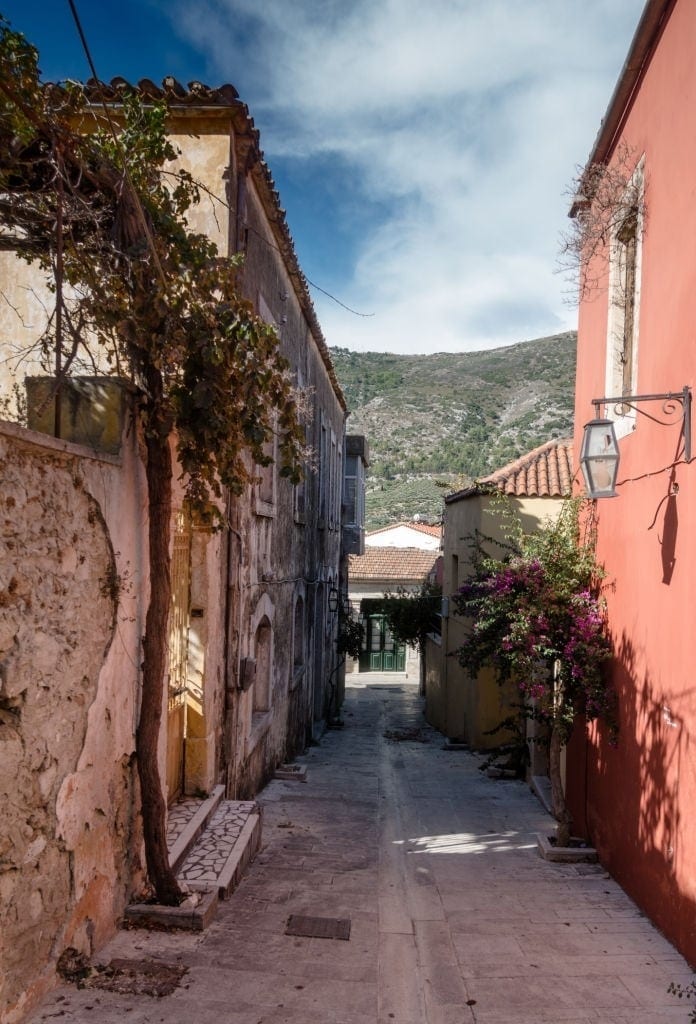
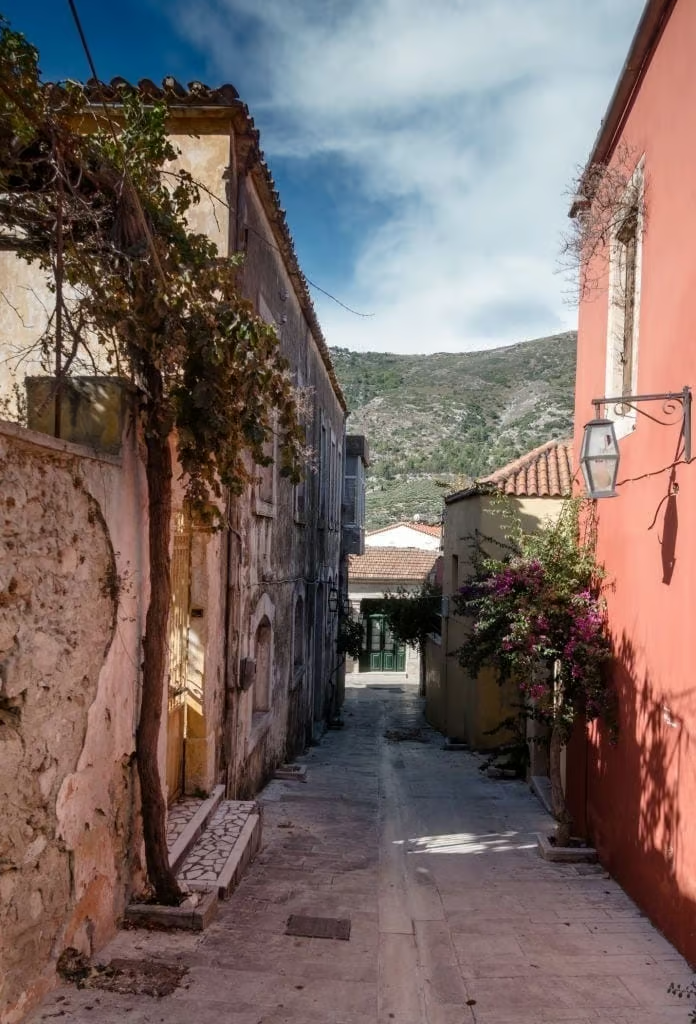
Archanes preserves traditional Cretan architecture above one of the most important Minoan royal cemeteries on the island. The Phourni necropolis above the modern village contains tholos tombs of Minoan elites, including unlooted royal burials yielding gold jewellery, ivory carvings, and ritual vessels, many displayed in the Archaeological Museum of Archanes. The peak of nearby Mount Giouchtas holds a Minoan peak sanctuary, open-air religious site, and is, according to legend, the burial place of Zeus.
The village is well-known for its wines (Stilianou Winery and others) and traditional Cretan tavernas. April–May and October–November are the ideal months for visits. Reachable from Heraklion in 20 minutes by car.
Planning Your Visit to Crete’s Ancient Cities
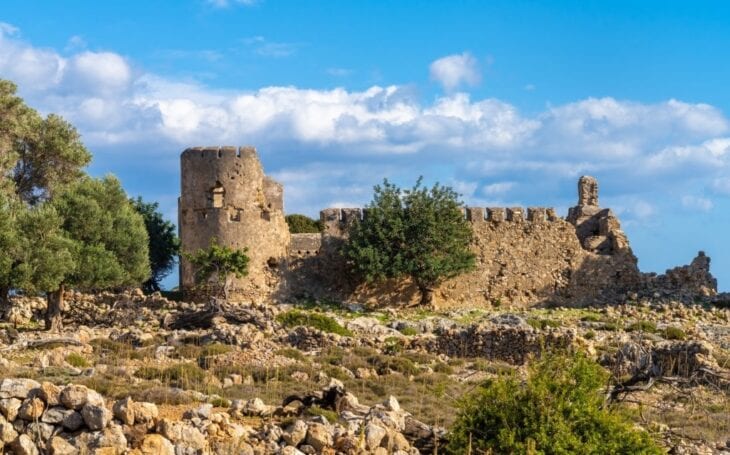
Most of Crete’s ancient sites lie away from main roads and cannot be reached by public bus, a rental car is the practical requirement for visiting more than two sites in a single trip.
Getting There: Do You Need a Car?
The KTEL bus network connects the major cities (Heraklion, Chania, Rethymno, Agios Nikolaos) but does not serve most archaeological sites. Knossos has a regular bus from Heraklion; Phaistos, Gortyn, Eleftherna, and Aptera all require a car or guided tour. A car rental in Crete starts from €11 ($12.63, £9.32)/day for long-term hire and €20 ($22.96, £16.95)–€40 ($45.92, £33.90)/day in peak season for short stays.
Entry Fees and Opening Hours (2026)
| Site | Entry | Hours (peak) | Notes |
|---|---|---|---|
| Knossos | €15 ($17.22, £12.71) (€20 ($22.96, £16.95) combo) | Daily 8:00–20:00 | Combined with Heraklion Museum |
| Phaistos | €8 ($9.18, £6.78) | Daily 8:30–15:30 | Combined with Agia Triada |
| Malia | €6 ($6.89, £5.09) | Daily 8:30–15:30 | , |
| Gortyn | €6 ($6.89, £5.09) | Daily 8:00–20:00 | Allow 2+ hours; site is dispersed |
| Aptera | ~€2 ($2.30, £1.70) | 8:00–14:30 (closed Mon) | , |
| Eleftherna Museum | €4 ($4.59, £3.39) | Daily 10:00–18:00 | Site free |
| Lebena | Free | , | Hike or bus access |
| Kamara (Sunken City) | Free | Snorkel access | 13 min by car from Elounda |
Always verify current fees at odysseus.culture.gr, fees and hours change seasonally.
Best Time to Visit
April–May and October–November are ideal for visiting Crete’s ancient cities, mild temperatures, fewer crowds, and longer site opening hours than winter. June–September is hot but crowded; allow early-morning starts to avoid midday sun. December–March: many sites have reduced hours; check before visiting.
Two-Day Suggested Itinerary
- Day 1 (Heraklion area): Knossos (morning) → Heraklion Archaeological Museum (afternoon) → Archanes Phourni necropolis (late afternoon).
- Day 2 (Messara plain): Phaistos + Agia Triada (morning) → Gortyn (afternoon) → Lebena beach + Asklepieion ruins (evening).
A full circuit covering all 14 sites takes 5–7 days with a rental car based in Heraklion or Chania.
Do you need to rent a car to visit the Ancient Cities in Crete?
Yes, renting a car is essential when visiting the ancient cities of Crete. Some attractions in the ancient cities of Crete cannot be accessed with public transportation, and it will be time-consuming before a tourist can arrive at the specific location. Car hire in Crete becomes easier and convenient when traveling in Crete, to fully explore the cities and reach destinations without a hassle. Tourists who want to rent a car in Crete will need to prepare their age, driving license, documents, car condition, and fuel.

What are the factors to consider before renting a car in Crete?
There are certain things a tourist should consider before renting a car in Crete to guarantee a safe and hassle-free journey.
Listed below are factors to consider before renting a car in Crete.
- Insurance: Collision Damage Waiver is included in car rentals as well as driver’s credit or debit card as a guarantee in renting a car in Crete. However, there are additional fees that apply for excess and no credit card. Renters should also remember that neither of those insurances covers damage to cars mirrors and glasses. If there is an accident, renters should contact the station as soon as possible and remain in the location until someone from the station arrives.
- Driver’s Age: Drivers must be over 21 years old to drive the rental cars in Crete, and should also have a driver’s license for a year.
- Driver’s Gender: Both female and male can drive without any restriction. Anyone who wants to rent a car can access car rentals in Crete, but the name of the driver should be included in the written agreement.
- Car Type: A car type should be appropriate for the number of people who are traveling with extra spaces for other necessities, such as bags. There are plenty of cars that are manual and automatic to choose from in Crete.
- Documents needed for renting a car: The documents they will need from renters are the driver’s license and credit or debit card of the driver. However, if the driver forgot to bring their driver’s license, a second driver with valid documents can drive the car. Driver’s license is important in driving in Greece.
How much does a car rental in Crete cost?
Tourists that will need to be picked up and dropped off at any airport or port in Crete will need to rent a car. A car type that has a manual and automatic transmission can cost about €250 ($287.03, £211.88) for a week’s trip to Crete. A day and night trip will range from €30 ($34.44, £25.43) to €40 ($45.92, £33.90). This kind of price in a car will give renters a good deal with a 4-door car, and fully air-conditioned. It will be perfect enough for 3 to 4 persons that can take them to their chosen destinations.

Frequently Asked Questions
Which is the oldest ancient city in Crete?
Knossos is the oldest continuously inhabited site on Crete and one of the oldest in Europe. Settlement at Knossos dates to approximately 7000 BCE (Neolithic), with peak occupation during the Bronze Age as the centre of the Minoan civilization (c. 1900–1450 BCE). It was excavated by Sir Arthur Evans beginning in 1900.
What are the most important Minoan sites in Crete?
The four major Minoan palace sites are Knossos (largest, 5 km (3.11 miles) from Heraklion), Phaistos (second-largest, Messara plain), Malia (third-largest, north coast east of Heraklion), and Zakros (easternmost, Sitia peninsula). The royal villa of Agia Triada (next to Phaistos) and the harbor city of Amnisos complete the core Minoan circuit.
Is Gortyn worth visiting?
Yes, Gortyn is one of the most historically important sites in Crete and arguably the most underrated. As the Roman capital of Crete for nearly 900 years (67 BCE – 824 CE), Gortyn preserves the Law Code of Gortyn (5th c. BCE, the most complete surviving Greek legal text), the Basilica of Saint Titus, and a Roman amphitheatre. The site is dispersed across olive groves; allow 2+ hours.
How many days do you need to visit Crete's ancient sites?
For the core highlights (Knossos + Phaistos + Gortyn + Heraklion Archaeological Museum), allow 2 full days. To cover all 14 sites in this guide, including western Crete (Aptera, Cydonia/Chania) and eastern sites (Itanos, Kamara), plan 5–7 days with a rental car.
Which is the most visited ancient city in Crete?
Knossos is the single most visited archaeological site in Crete, drawing approximately 1 million visitors per year. Heraklion (the modern capital, built atop ancient Heracleum) is the most-visited modern city for tourists, with roughly 6.8 million arrivals in 2022 (Wizz Air Cities Index 2022).
Do I need a car to visit Crete's ancient cities?
Yes, most archaeological sites are not served by public transport. Knossos has a regular Heraklion bus, but Phaistos, Gortyn, Eleftherna, and Aptera all require a private vehicle, taxi, or guided tour. Car rentals in Crete start from €11 ($12.63, £9.32)/day for long-term hire and €20 ($22.96, £16.95)–€40 ($45.92, £33.90)/day for short stays. Rental Center Crete provides direct delivery to Heraklion and Chania airports.
Sources: Hellenic Ministry of Culture (odysseus.culture.gr); Evans, A.J., The Palace of Minos (Macmillan, 1921–1935); Stampolidis, N.Ch. (ed.), Eleutherna: Polis, Acropolis, Necropolis (University of Crete Press, 2004); Ammianus Marcellinus, Res Gestae 26.10 (365 CE earthquake); University of Crete excavation reports.
Auguest 18, 2026. Entry fees verified against Hellenic Ministry of Culture pricing. Outdated COVID-era health protocol references have been removed. Internal factual contradictions (Aptera destruction date) have been corrected to 365 CE based on Ammianus Marcellinus.