







Mantinades are known across Greece as the most distinctive feature of Cretan traditional culture. They are embraced by all generations and woven seamlessly into Cretan daily life, where this folk poetry remains a living part of contemporary celebration rather than a museum piece.
This article is intended as a cultural introduction to mantinades for visitors to Crete. For an authoritative academic treatment, we recommend the work of the Michalis Kafkalas Cretan Rhymers’ Association and the archives of explorecrete.com/cretan-music.
What Are Mantinades?
Mantinades are two-line rhyming couplets of fifteen syllables each, improvised in the Cretan dialect to express the full range of human emotion – from love and longing to grief, humor, and pride in Cretan identity. Unlike limericks, which have five short lines and a playful tone, mantinades consist of two longer lines and convey a far broader range of sentiments. Their clever construction requires skill, which makes them both an art form and an everyday folk song heard across the island.
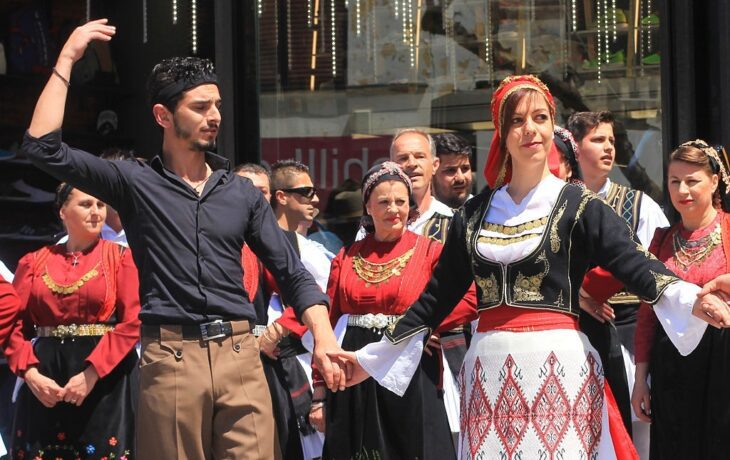
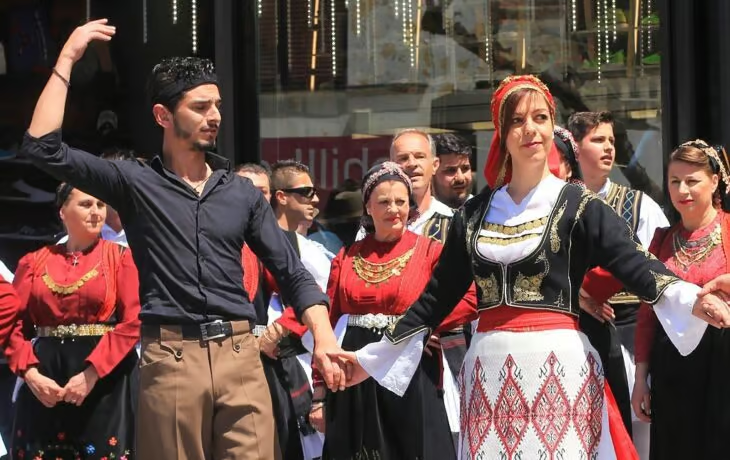
Mantinades are composed and performed in the Cretan dialect – a distinct variety of Greek with its own phonology and vocabulary – which gives them a regional character that is immediately recognizable to Greek listeners as distinctly Cretan. Mantinades require an acquired skill to craft well – the best performers can compose a perfect couplet for any occasion or emotion on the spot.
The Form: Dekapentasyllabic and Iambic Verse
Mantinades are rhyming couplets, each comprising two lines of fifteen syllables, known as dekapentasyllabic verse. This poetic form emphasizes symmetry and rhythm, deeply rooted in Cretan oral traditions. The structured syllabic count and rhyming pattern enhance its lyrical quality, allowing for emotional expression and cultural storytelling.
Dekapentasyllabic verse is a fifteen-syllable poetic meter widely used in the Byzantine period. It is also called “political” verse, where “political” derives from “polis”, meaning city – signifying secular poetry focused on daily life rather than religious themes. This form became prominent in popular and folk traditions.
Within this meter, mantinades follow an iambic rhythm: each line moves in a pattern of a short, unstressed syllable followed by a longer, stressed syllable. This iambic structure gives the couplets their melodic, song-like cadence and is central to the mantinada’s expressive form.
The Name: Where Does “Mantinades” Come From?
The word “Mantinades” originates from two potential sources. One ties it to the Greek verb “mantevo”, meaning “to divine”, reflecting ancient poetic prophecies. The other links it to the Italian “mattino” (dawn) or “mattinata” (morning), influenced by Venetian rule over Crete, where mantinades emerged.
Mantinades as an Oral Tradition
Unlike most literary traditions, mantinades are primarily an oral art form. Most are never written down – not even in a notebook – and even fewer are published. They are composed on the spot, performed once, and passed on by word of mouth when they are memorable enough to survive. This oral nature is central to the mantinada’s identity: it is a living form of communication, not a text to be read.
The History of Mantinades
Mantinades emerged in Crete during the 15th century under Venetian rule, when Cretan poets first encountered European rhyming traditions and began crafting the syllabic couplets that would define Cretan folk culture for the next six centuries.
Venetian Crete and the Cretan Renaissance (15th–17th c.)
Mantinades flourished in the Byzantine Era – specifically during Venetian rule over Crete (1205–1669). While much of Greece fell under the control of the Ottoman Empire, beginning from 1430 in some areas, even before the fall of Constantinople, Crete remained Christian under the Venetians. This was a period of cultural flourishing, sometimes called the “Cretan Renaissance”, when Cretan poets blended Byzantine secular verse with the rhyming forms arriving from Renaissance Italy. Mantinades were a key form of cultural expression in this era, and remain so today. The roots of Cretan poetry reach back even further, to ancient figures such as the Cretan seer-poet Epimenides, whose verse tradition predates the medieval couplet by more than a thousand years.
The Erotokritos: 10,000 Verses That Shaped a Tradition
The single greatest work of the Cretan Renaissance is the Erotokritos, an epic poem written by Vitsentzos Kornaros around 1590. Composed in more than 10,000 rhymed dekapentasyllabic verses, the same fifteen-syllable form used in mantinades, it tells a tale of love and chivalry that Cretans have recited from memory for centuries. The Erotokritos both drew on the living mantinada tradition and reinforced it, fixing the dekapentasyllabic couplet at the heart of Cretan literary identity.
Mantinades Beyond Crete: Kasos, Karpathos, and Cyprus
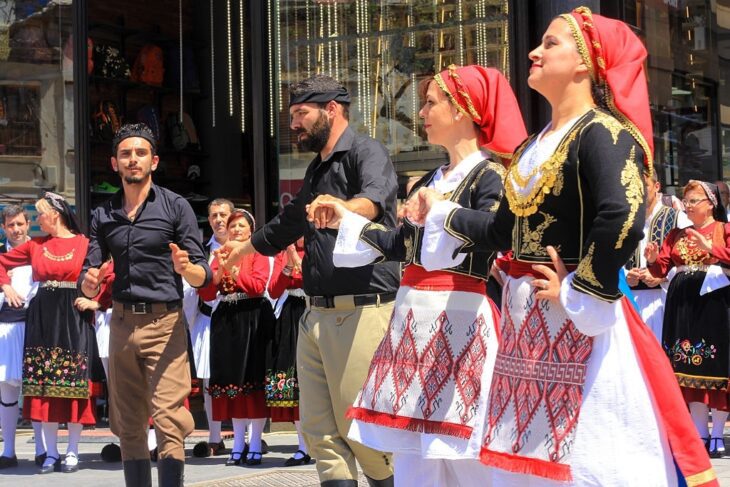
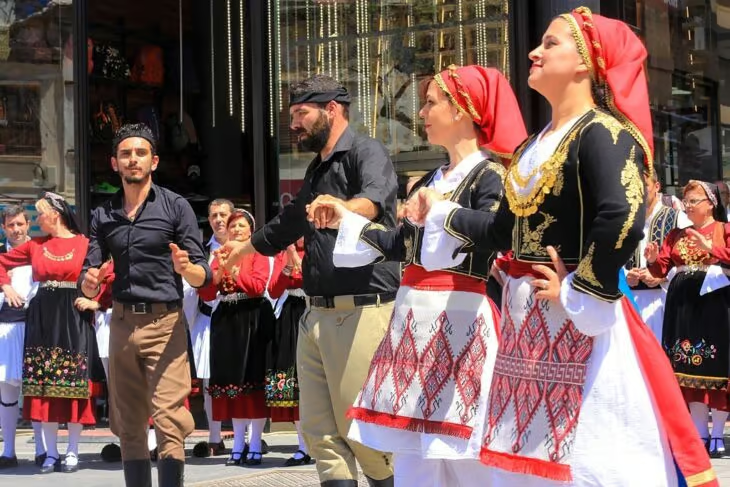
Mantinades are not exclusive to Crete. The folk couplets of Kasos and Karpathos – islands to the east of Crete – are also called mantinades, and similar rhyming couplets appear across other Aegean and Ionian islands. In Cyprus, the equivalent tradition is called “tsatista.” The difference is that in Crete, new mantinades continue to be created at the same pace as ever – especially in the villages – while in the rest of Greece the tradition has largely faded.
What Are Mantinades About?
Love is the most common subject of mantinades, but they address every aspect of life – death, exile, the beauty of Crete, daily hardship, and contemporary humor, including modern jokes about the internet and sheep farming.
Mantinades address every register of human experience: love is the dominant theme, but they also commemorate the dead (and are often inscribed on Cretan tombs), satirize daily life, express longing and exile, and embrace contemporary humor. Their combination of wit and emotional depth makes them both an art form and a social language – as the poet Nikos Kazantzakis observed, the mantinada is “the voice that expresses a masculine but extremely sensitive soul: the Cretan Soul.”
Mantinades About Love
Love and desire are the heartbeat of the tradition, and the most quoted mantinades are declarations of longing:
“Κάθε λεπτό σε σκέφτομαι κάθε στιγμή μου λείπεις, υπάρχεις μες στο αίμα μου σαν τον ιό της γρίπης!”
“Kathe lepto se skeftomai, kathe stigmi mou leipeis, Iparcheis mes sto aima mou san ton io tis gripis”
“I think of you each moment, ever I miss you, it’s true, You run in my blood like a virus, like some kind of flu.”
The other great love of the Cretan poet is Crete itself:
“Όσο υπάρχουν τα βουνά και στέκει ο Ψηλορείτης, δεν έχουν φόβο να χαθούν τα έθιμα της Κρήτης”.
“Oso yparchoun ta vouna kai steki o Psiloritis, then exoun fovo na hathoun ta ethima tis Kritis.”
“As long as there are snowy peaks, and proudly stands Mt. Psiloriti, There is no fear that we will lose the precious customs of Kriti”
Humorous and Contemporary Mantinades
Mantinades are not only solemn. Wit and satire are an essential part of the form, and the tradition has adapted easily to modern life. Today’s poets compose couplets about the internet, mobile phones, and village life – a single mantinada might rhyme a slow internet modem against the rhythms of sheep farming. This contemporary humor keeps the form alive among younger Cretans, who share new mantinades on social media just as their grandparents traded them at the kafeneio.
How Are Mantinades Performed?
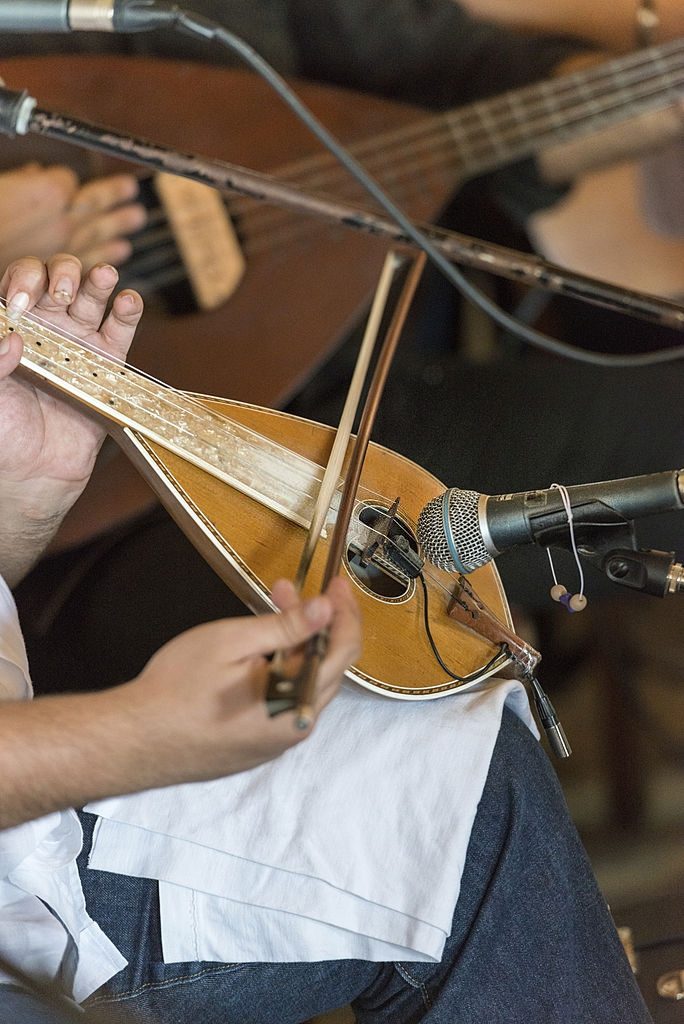
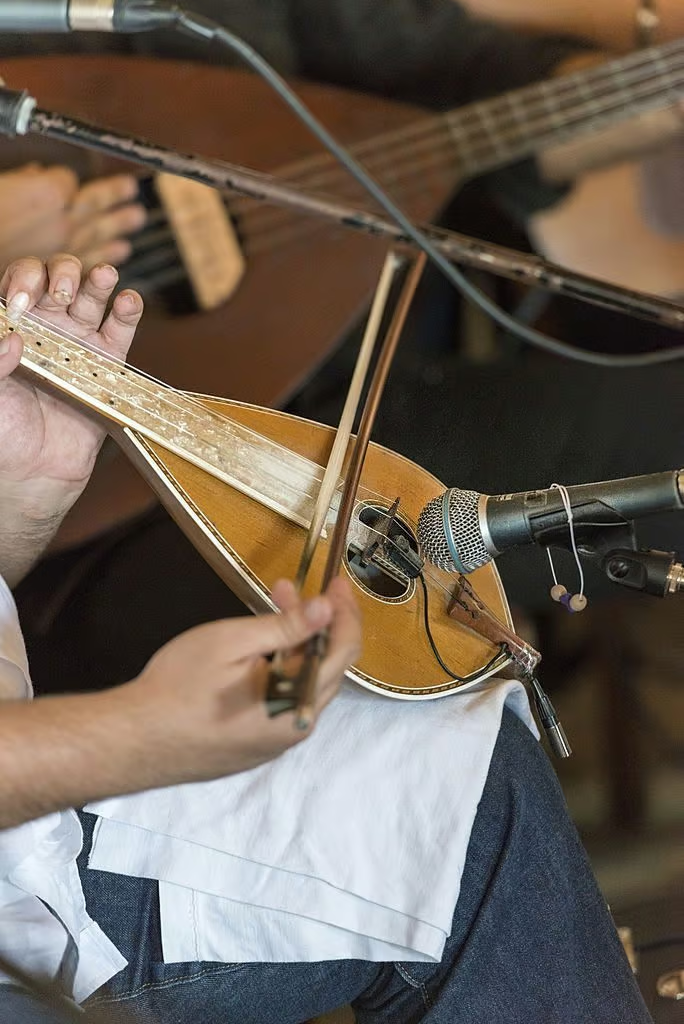
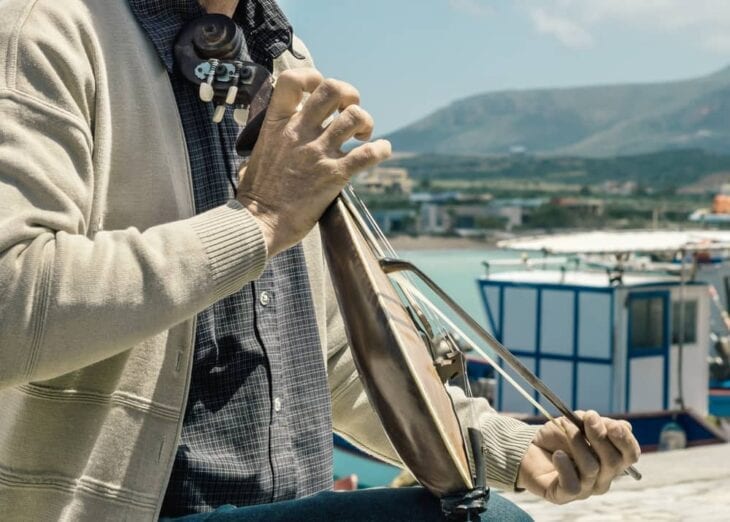
Mantinades are most commonly heard accompanied by the Cretan lyra – a small bowed instrument distinct from the ancient lyre – and the laouto, a lute-like stringed instrument, performed in real time as an improvised exchange between two or more participants.
The Cretan Lyra and Laouto
A mantinada is, strictly speaking, a rhyming couplet rather than a song lyric, yet its strong rhythmic quality and lilting cadence make it feel inherently musical. In practice it is very common for a mantinada to be sung, and it is exceptionally well suited to instrumental accompaniment. The Cretan lyra – a small, three-stringed bowed instrument held upright on the knee – is its classic partner, often joined by the “laouto”, a long-necked stringed instrument similar to a lute. Together the lyra and laouto provide the melody and rhythm over which the singer delivers the couplet.
Antiphonal Form: The Mantinada as Dialogue
Mantinades are inherently antiphonal – one couplet invites a response, and the exchange continues like a lyrical contest. Spontaneous performances are common in everyday social settings: after a meal with raki, at the village café, or at a festival. Think of it as a southern Mediterranean rap battle rooted in Byzantine tradition, where wit and improvisation matter more than preparation.
Mantinada Contests and Cultural Events
Formal mantinada contests bring together performers called mantinadomachos, who must improvise responses to each other’s couplets within seconds, adhering to a set theme – events organized by municipalities across Crete and the Cretan diaspora in Athens.
The Michalis Kafkalas Cretan Rhymers’ Association
Mantinada contests are competitive events that celebrate the traditional art of the mantinada. Participants, called mantinadomachos, rapidly exchange couplets, adhering to a theme and improvising their responses on the spot. Events are hosted by Cretan municipalities, cultural associations, and media platforms, preserving the art form while engaging modern audiences through radio, newspapers, and themed competitions. Major contests are organized by the Municipalities of Agios Nikolaos and Ierapetra, the Philologists’ Association of Chania Prefecture, the Cretan Students’ Union of Athens, and the “Michalis Kafkalas” Cretan Rhymers’ Association, which runs the annual Pancretan Mantinada Competitions.
The House of the Mantinada, Korfes Village
In the village of Korfes, on the slopes of Mount Psiloritis, the House of the Mantinada preserves and exhibits the living heritage of the form. This small folk collection gathers recordings, written couplets, and instruments, documenting both the historic and contemporary mantinada and offering visitors a dedicated place to encounter the tradition outside of a live performance.
Where to Hear Authentic Mantinades in Crete
The village of Anogia in the Mylopotamos district of Rethymno is widely regarded as the heartland of authentic mantinades, where the tradition is still practiced daily in the local kafeneions and at the annual summer festivals.
Anogia: The Village of Mantinades
Anogia, perched high on the slopes of Psiloritis in the Mylopotamos district of Rethymno, has produced many of Crete’s most celebrated lyra players and mantinada singers. Local musicians gather at the kafeneions most evenings, and a visitor who lingers over a raki is likely to hear couplets improvised and exchanged across the room – the tradition lived rather than performed for an audience.
Festivals and Celebrations Where Mantinades Are Performed
Beyond Anogia, mantinades fill the summer festivals across the island. The annual celebrations and mantinada competitions of Agios Nikolaos and Ierapetra draw performers from across Crete and the diaspora, while weddings, baptisms, and saint’s-day panigyria everywhere on the island remain the natural home of the improvised couplet. Renting a car makes these mountain villages and festival towns easy to reach, since the most authentic performances happen far from the main resorts.
The Most Famous Mantinada
The most celebrated mantinada is a line from Erotokritos, the epic by Vitsentzos Kornaros – a poem of more than 10,000 dekapentasyllabic verses that Cretans have been reciting from memory since it was written around 1590. Composed by this prominent Cretan poet of the late Renaissance, the Erotokritos is celebrated across Greece and embodies the rich oral tradition and cultural heritage of the mantinada.

Mantinades reveal themselves through their distinctive rhythm – once learned, they are recognizable at any Cretan gathering, an enduring cultural treasure of Greece that you can still hear sung today.