








The poem unfolds in ancient Athens through key moments of secret love, separation, combat, and reunion, reflecting deep lessons about loyalty, endurance, and sacrifice. Cretan musicians have helped preserve Erotokritos for centuries by adapting parts of the story into songs, often using the traditional form of mantinades, and the poem remains a strong symbol of cultural pride in education, music, and literature today.
This article is written for cultural and travel information purposes by Rental Center Crete. For academic research on Erotokritos, readers are encouraged to consult the scholarly edition by Stefanos Xanthoudides (1915), the English translation by Theodore Stephanides (Papazissis Publishers, Athens, 1984), and the entry in the Brill Greek Studies catalogue.
What Does the Name “Erotokritos” Mean?
The name Erotokritos combines the Greek words Eros (love) and kritos (judged or chosen), meaning “judged by love” – a name that defines the hero’s entire destiny in the poem. It conveys themes of unwavering love, chivalry, and fidelity, the qualities that are central to the work it titles.
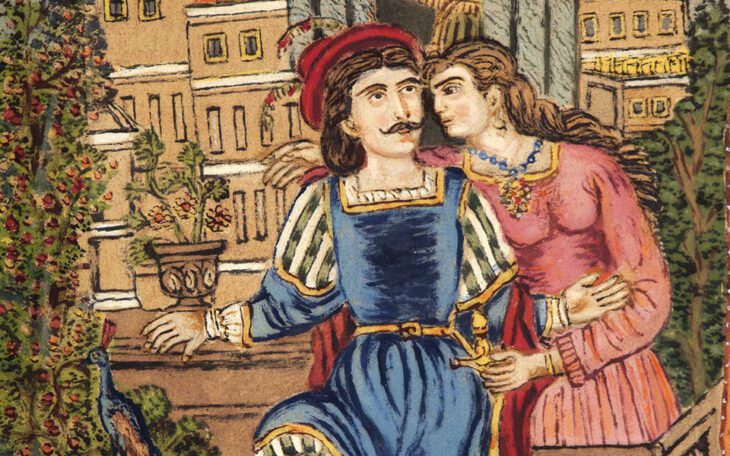
Erotokritos embodies the Greek tradition of romantic heroism: the protagonist chosen by love itself to endure exile, war, and disguise before claiming his beloved. The name defines the character’s role from the beginning, linking love not only to passion but to personal sacrifice and strength. The Greek language often embeds deep meaning into names, and Kornaros’ choice of Erotokritos underlines the cultural value placed on perseverance in matters of the heart. Today the name survives as a traditional Greek male first name.
Who Is Aretousa?
Aretousa is the daughter of King Heracles of Athens and the female lead of Erotokritos. Unlike the passive heroines of many medieval romances, Aretousa is an active agent in her own fate: she chooses her engagement to Erotokritos in secret, refuses to marry a prince of Byzantium under royal pressure, and endures three years of imprisonment rather than betray her love. Scholars compare her courage to that of Desdemona and Juliet, and she is regarded as one of the earliest heroines of vernacular Greek literature to embody both romantic fidelity and personal dignity. Her name, Aretousa, connects her to the nymph Arethusa of Greek mythology – a figure associated with transformation and perseverance.
What Is the Story of Erotokritos?
Erotokritos tells the five-act story of a young man of humble birth who falls in love with a princess, is exiled, fights in disguise to save the king’s life, and ultimately wins the right to marry her – a classic arc of love tested by loyalty and courage. The poem is set in ancient Athens, a legendary city where honor, loyalty, and courage define personal destiny, and its two leads are Erotokritos, a brave and talented young man, and Princess Aretousa, the proud and noble daughter of King Heracles.


Part 1 – The Secret Love
The love story begins when Erotokritos, son of Pezostratos, a trusted advisor at the royal court, falls in love with Aretousa from afar. Too humble in rank to declare himself, he sings serenades beneath her window at night, accompanied by his closest friend Polydoros. Aretousa is captivated by the unknown singer’s voice without knowing his identity. When King Heracles sends soldiers to seize the mysterious serenader, Erotokritos and Polydoros fight them off in the dark, and Erotokritos is later sent away to the island of Euboea while the truth of the romance is still hidden.
Part 2 – The Jousting Tournament
King Heracles proclaims a great jousting tournament to lift the kingdom’s spirits, drawing fourteen noble champions from across the Greek world to compete for honor before the court. Erotokritos enters and, through skill and courage, defeats every rival to win the tournament. His victory earns the admiration of the court and the open attention of Aretousa, but it also brings the lovers’ impossible difference in rank into sharp focus before the king.
Part 3 – The Secret Engagement and Exile
Encouraged by his triumph, Erotokritos and Aretousa exchange vows in secret and become engaged, with Aretousa accepting an engagement ring as a token of their bond. When Erotokritos’ father approaches the king to ask for Aretousa’s hand on his son’s behalf, King Heracles is enraged that a man of humble birth would aspire to marry the princess, and he banishes Erotokritos from Athens. On the night of the secret engagement, just before his banishment, Erotokritos sings a farewell to Aretousa under her window, knowing he may never return.
Part 4 – Aretousa’s Imprisonment and Erotokritos’ Return
After three years in exile, Erotokritos learned that his beloved Aretousa had been imprisoned by her father for refusing every suitor, including the prince of Byzantium. He returned to Athens in secret, concealing his identity by darkening his face with a magic concoction. When Vladistratos, king of Vlachia, besieged Athens, Erotokritos fought alongside the city’s defenders and personally saved King Heracles’ life during the battle against the Vlachs. He then defeated the Vlach champion Aristos in single combat, securing Athens’ freedom – all without revealing who he was. Only when the king, in gratitude, offered him Aretousa’s hand did Erotokritos begin to unmask himself.
Part 5 – The Test of Faith and the Happy Ending
Before revealing himself, the still-disguised Erotokritos visited the imprisoned Aretousa to test her faithfulness, claiming that Erotokritos was dead and that he himself now sought her hand. Aretousa refused him outright, declaring she would rather remain imprisoned than betray her vow – proof that her love had survived three years of separation. Only then did Erotokritos wash away his disguise and reveal his true face. King Heracles, having seen the young hero save both his life and his city, finally approved the marriage. Erotokritos and Aretousa were united after years of hardship, and Erotokritos ascended the throne. The inspiring lessons of the poem emphasize that true love must endure trials, remain faithful through separation, and prove itself through action.
Vitsentzos Kornaros, the poet who wrote Erotokritos, was born in Sitia, Crete, where Sitia Airport today carries his name as a tribute to his lasting contribution to Greek literature and cultural pride.
What Is the History of Erotokritos?
Erotokritos was composed by Vitsentzos Kornaros in Sitia, Crete, between 1600 and 1610, spent over a century circulating as handwritten manuscripts, and was first printed in Venice in 1713. Its history is inseparable from the Cretan Renaissance – a period of remarkable cultural flowering on the island from the late 16th to mid-17th century, made possible by Venetian patronage and the relative tolerance of the island’s occupiers. Kornaros wrote Erotokritos at the height of this Renaissance, when Cretan poets were absorbing Italian and European Renaissance literary models and transforming them into original works of enduring power. The poem’s primary source of inspiration was the French romance Paris et Vienne by Pierre de la Cypède (published 1487), which Kornaros encountered through Italian translations – but Erotokritos surpasses its model in both literary quality and emotional depth.
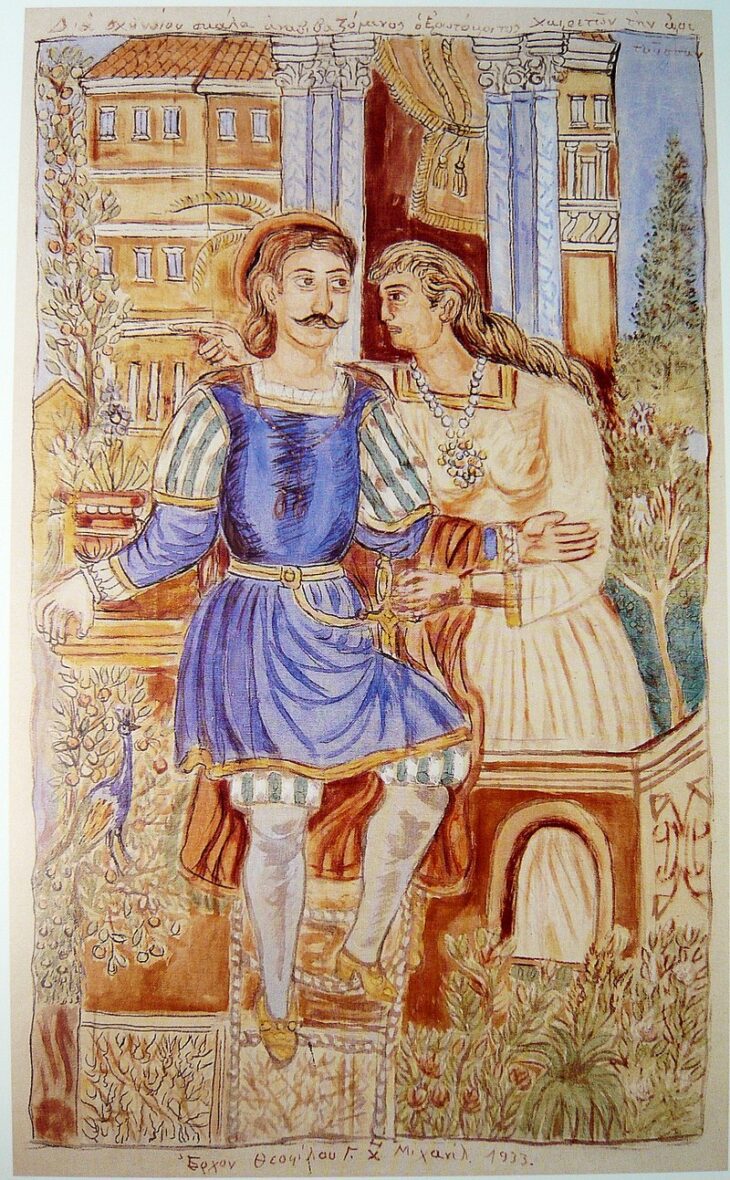
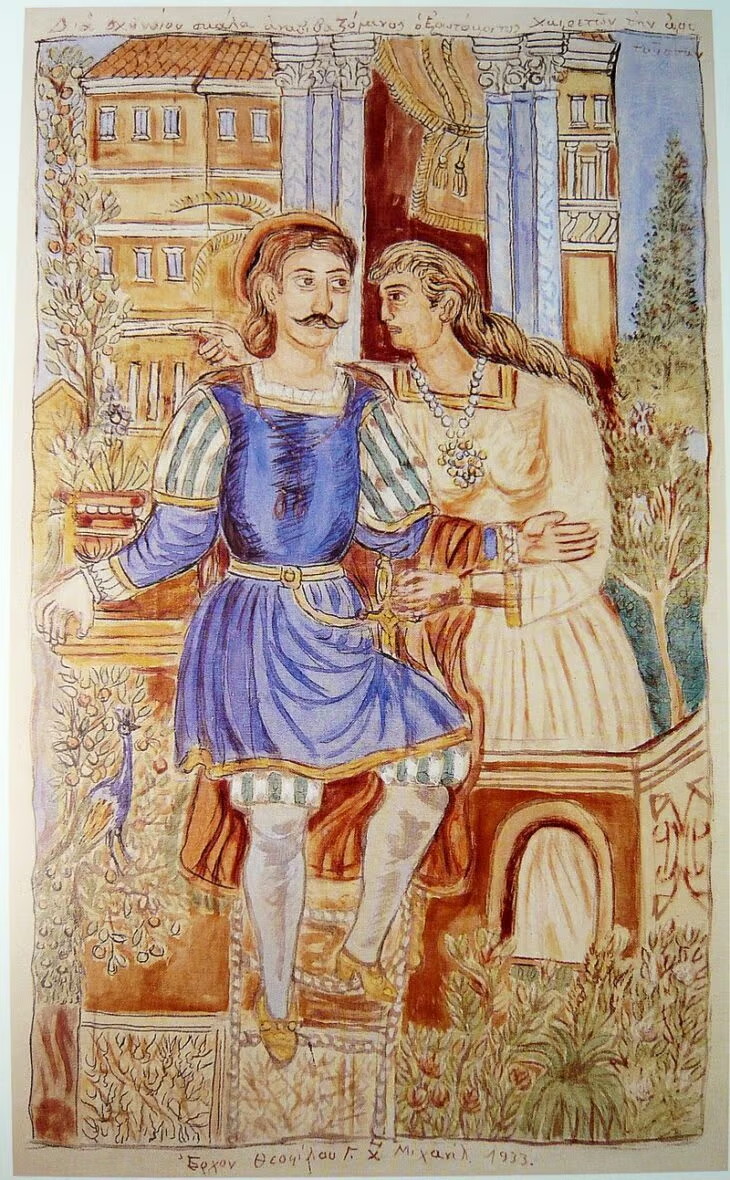
Erotokritos circulated exclusively as handwritten manuscripts for over a century before its first print edition appeared in Venice in 1713. By that point, generations of Cretans had already memorized thousands of verses, reciting them at festivals and weddings – making oral transmission the poem’s primary distribution channel under Venetian and, later, Ottoman occupation. The 1713 Venice edition was reprinted in 1737; the earliest surviving manuscript (c. 1710) is now held at the British Library. A first modern scholarly edition was published by Stefanos Xanthoudides in 1915, and Theodore Stephanides produced the first complete English translation in verse in 1984.
Key Dates and Editions
| Year | Event |
|---|---|
| c. 1600–1610 | Vitsentzos Kornaros composes Erotokritos in Sitia, Crete |
| 17th century | Poem circulates as handwritten manuscripts; memorized and sung orally |
| c. 1710 | Earliest surviving manuscript written (now at the British Library) |
| 1713 | First print edition published in Venice |
| 1737 | Venice edition reprinted |
| 1915 | First modern scholarly edition by Stefanos Xanthoudides |
| 1984 | First complete English translation in verse by Theodore Stephanides |
For further reading: The earliest surviving manuscript of Erotokritos (c. 1710) is preserved at the British Library, London. The Gennadius Library in Athens holds a copy of the first 1713 Venice print edition. The standard modern scholarly edition is Stefanos Xanthoudides, Erotokritos (Heraklion, 1915). The first complete English verse translation is Theodore Stephanides, Erotokritos (Papazissis, Athens, 1984).
What Is the Literary Style of Erotokritos?
Erotokritos is written in 10,012 fifteen-syllable iambic couplets called mantinades – the living verse form of Crete – using the spoken Cretan dialect of the early 17th century. As a knightly novel, or romance in verse, it belongs to the European Renaissance tradition of chivalric storytelling while remaining unmistakably Cretan in language and spirit.
Mantinades – The Verse Form
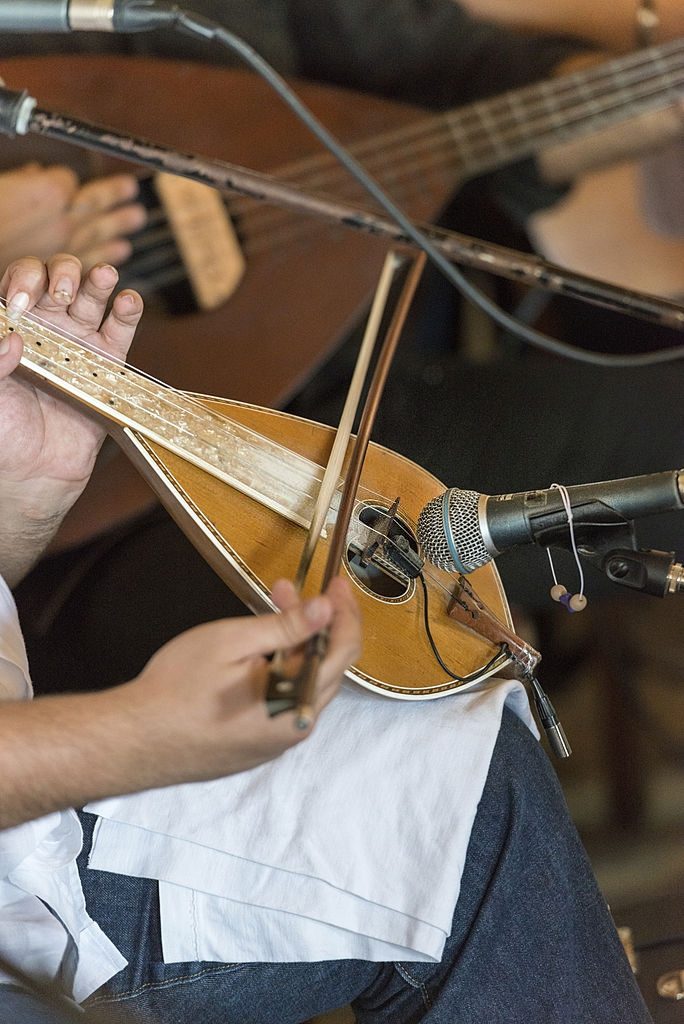
Erotokritos is composed of over 10,000 rhyming couplets called mantinades. These iambic couplets of 15 syllables per line – “dekapentasyllabic” verses – have a musical cadence built on the iambic pattern of a short, light syllable followed by a longer, stressed one. Mantinades are in themselves a living form of popular artistic expression in Crete: skillful practitioners can still compose them on the spot, with spontaneity and wit, to suit any occasion. They take very naturally to music, especially when accompanied by the Cretan lyra (played with a bow) and the laouto (a stringed instrument similar to a lute).
Themes – Love, Friendship, Patriotism, and Gender Equality
Erotokritos weaves together love, patriotism, and friendship into a single narrative arc – Erotokritos fights for his country even after it exiled him, and Aretousa chooses imprisonment over dishonor. Friendship is as central to the poem as love. Polydoros, Erotokritos’ closest companion, accompanies him on the fateful serenade under Aretousa’s window, and stands by his side when the king sends soldiers to arrest the unknown singer. Later, while Erotokritos is in exile at Euboea, it is Polydoros who brings him news of Aretousa’s imprisonment – a detail that drives Erotokritos to return and fight. Their bond is one of the poem’s clearest expressions of the value placed on loyalty and male friendship in the Cretan Renaissance ethos.
The poem is also remarkable for its early treatment of gender equality. Aretousa is no passive prize: she shows uncompromising virtue and pride in preferring imprisonment to a forced marriage. She is true to her great love for Erotokritos, but more importantly she is true to herself – making her one of the most independent female figures in vernacular Greek literature.
Literary Sources and Influences
Kornaros drew on the French romance Paris et Vienne and the broader chivalric tradition of the European Renaissance, reaching Cretan readers through Italian translations circulating during Venetian rule. He deliberately wrote in the Cretan dialect of Greek rather than Italian, transforming an imported knightly romance into a profoundly local work. In a final flourish, the last twelve verses of the poem reveal the author’s identity – Vitsentzos Kornaros of Sitia – a signature that confirmed his authorship for later scholars such as Stefanos Xanthoudides.
How Is Erotokritos Musically Adapted?
Musicians in Crete have set passages of Erotokritos to music since the poem was first composed, with Nikos Xylouris producing the most celebrated modern recording using the lyra and laouto. Erotokritos inspired generations of Cretan musicians – from Nikos Xylouris to Psarantonis – to set its fifteen-syllable verses to the lyra and laouto. Nikos Xylouris – known as “Psaronikos” and “the voice of Crete” – chose specific passages from Kornaros’ text and framed the poem’s emotional scenes with traditional Cretan rhythms. Psarantonis and Loudovikos ton Anogeion followed with their own interpretations, each preserving the mantinada verse structure while introducing modern melodic variations. These adaptations keep the fifteen-syllable verse intact and remain a vital part of Cretan identity, frequently performed at festivals, family gatherings, and cultural celebrations across Greece.
What Are the Lyrics of the Song in English?
The lyrics of the song are built on the original fifteen-syllable verse structure, a hallmark of traditional Cretan poetry, and come directly from the Cretan dialect of the Greek language. The lyrics below come from Part 3 of Erotokritos – the night of the secret engagement, immediately before Erotokritos is banished from Athens. In this scene, Erotokritos sings his farewell to Aretousa under her window, knowing he may never return. The passage is one of the most frequently performed in Cretan music:
_Have you heard of the sad news Aretousa?
Your father has exiled me
He has given me only four more days to stay,
And after that I must go far away abroad alone
And how am I going to be separated from you,
And how am I going to live without you into such exile?
My end is coming, know it my lady
that they will bury me in exile, my remains will be there
I understand that your father is going to get you married soon,
seeking a son of a king and nobleman worthy of you
And you cannot resist the wishes of your family,
They defeat your mind and alter your desire._
_Only one favor I am asking you, my heart’s ruler,
And after that I would happily be done with my life;
The moment you will get engaged sigh deeply
And when you are a bride, when you change as a married woman
Let your tear drop and say “Poor Erotokritos
What I promised you I forgot, what you wanted exists no more_
_Once every month in your room
Think what I have suffered for you, feel sorry for me in your heart
And take this painting from the drawer
and the songs I sang to you, that you enjoy so much
And read them, look at them and think of me
that I was exiled for you far away
And when they tell you I am dead, feel sorry for me and cry
And the songs I created, burn them in fire_
_No matter where I end up and how long I live,
I promise you neither to see another woman nor to gaze at.
And let ill-fated me vow that I never saw you,
That you were like a lit candle extinguished in my hands_
_Better to be with you in death than with another one in life,
It is for you that my body was born into this world!_
What Is the Difference Between the Poem and Its Musical Adaptations?
The main difference between Erotokritos and its song adaptations lies in the depth and detail of the narrative. The original poem by Vitsentzos Kornaros is a full-length work of 10,012 verses covering the complete development of the love story between Erotokritos and Aretousa across all five parts. The musical adaptations focus only on selected emotional moments, summarizing major events into short, lyrical mantinades – traditional fifteen-syllable rhyming couplets often sung during celebrations. These versions highlight feelings of loyalty, longing, and sacrifice without recounting the full complexity of the plot, offering a condensed experience that is easier to perform at festivals and cultural gatherings.
How Does Erotokritos Influence Greek Culture Today?
Erotokritos remains one of the most widely recognized works in Greek cultural life: taught in schools, performed at festivals, and cited by every major 20th-century Greek poet as a foundational influence.
Erotokritos in Education and Literature
Schools across Greece introduce Erotokritos to students as a fundamental piece of national literature, ensuring that new generations understand its lessons about love, perseverance, and honor. With its values so important to Greeks – bravery, friendship, and patriotism – Erotokritos has been a source of inspiration to the poets who shaped the culture of modern Greece: Dionysios Solomos (writer of the Hymn to Liberty, which supplies the lyrics to the National Anthem), Kostis Palamas (who wrote the words to the Olympic Hymn), and Giorgos Seferis (a key figure of 20th-century Greek letters and a Nobel laureate poet).
Erotokritos in Art and Public Space
Cretan musicians continue to perform adaptations of Erotokritos during festivals and cultural events, keeping the story alive through music and oral tradition. Writers, playwrights, and filmmakers draw on its themes to explore personal sacrifice and unwavering devotion, and theatrical productions of the poem appear regularly on the Greek stage. The poem’s place in public memory is marked physically as well: Kornarou Square in Heraklion honors the poet with a monument depicting the lovers, making Erotokritos a visible part of the island’s everyday landscape.