









A camera fine on a rental car reaches the rental company first, because the company is the car’s registered owner. The rental company then has 7 days to name the renter as the driver, and the fine passes to the renter. This guide sets out the current fines, the speed limits in force since 1 January 2026, and the EU rules due in 2027 and 2029 that decide whether a fine or a driving ban follows you home.
What changed in Greece’s traffic fines in 2025?
Greece replaced its Road Traffic Code (KOK) with Law 5209/2025, published in the Government Gazette (FEK 100/A) on 13 June 2025. The new code brought in higher fines, fixed fine categories and a 5-year repeat-offence window. The toughest fines applied from 13 June 2025, the day of publication: phone use, seatbelts, helmets, red lights, drink-driving, licences and parking. The rest of the code applied from 13 September 2025, and the 30 km/h default speed limit in towns applied from 1 January 2026. The full text is available in the Government Gazette PDF of Law 5209/2025.
Fine tables for Greece published before June 2025 show the old, lower figures. Treat any Greek fine table dated before the reform as out of date.
How do Greek fine categories work?
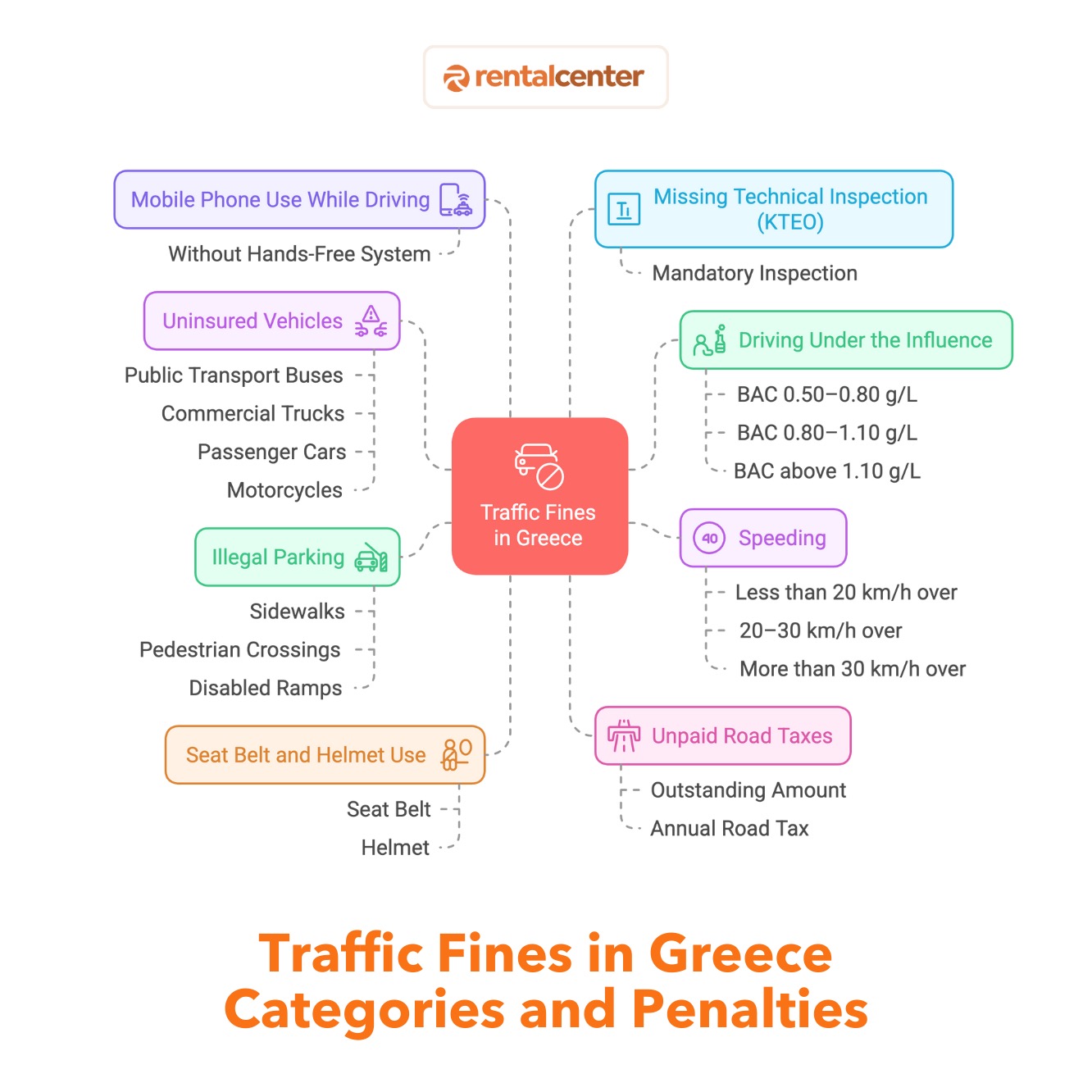
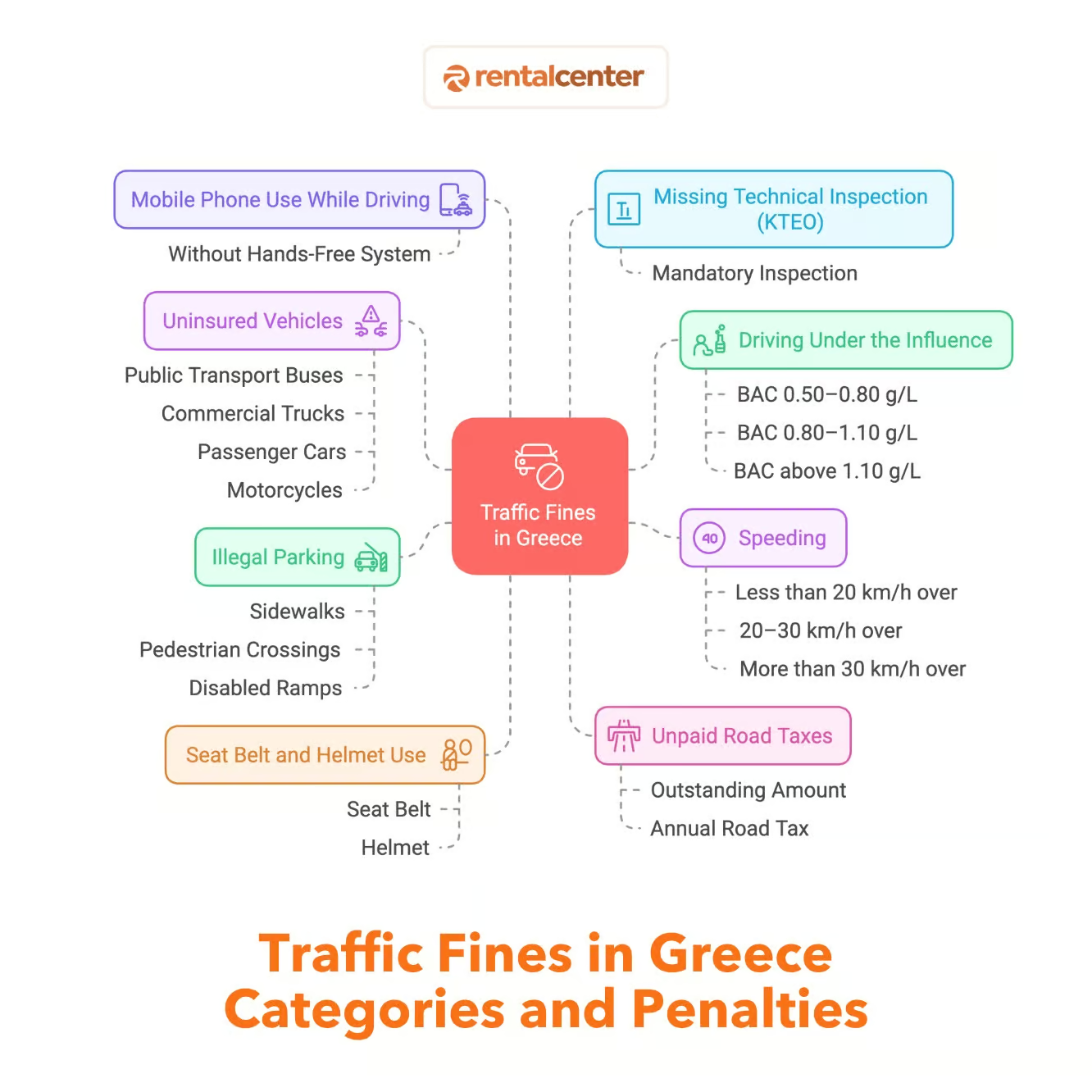
Greek fines follow fixed categories: most offences cost €30 ($34.44, £25.43), €150 ($172.22, £127.13) or €350 ($401.84, £296.63), with a licence removal of 10, 20 or 30 days for the more serious version of each category. Law 5209/2025 assigns each offence to a category, and Article 108 fixes the penalty for that category. The most serious offences sit in category E4, which carries its own fine and suspension, set offence by offence.
A fine category is a penalty band that sets the fine and any licence removal for every offence placed in it.
| Category | Fine | Licence removal |
|---|---|---|
| E1-A | €30 ($34.44, £25.43) | None |
| E1-B | €30 ($34.44, £25.43) | 10 days |
| E2-A | €150 ($172.22, £127.13) | None |
| E2-B | €150 ($172.22, £127.13) | 20 days |
| E3-A | €350 ($401.84, £296.63) | None |
| E3-B | €350 ($401.84, £296.63) | 30 days |
| Anti-social add-on (Σ) | No extra fine | 40 extra days |
| E4 | Set per offence, typically €700–2,000 ($803.67–2,296.20, £593.25–1,695.00) | Set per offence, typically 30 to 90 days on the spot, up to 1 year |
What are the fines for drink-driving (DUI) in Greece?
Drink-driving in Greece costs from €350 ($401.84, £296.63) to €1,200 ($1,377.72, £1,017.00), and the highest tier adds at least 2 months’ imprisonment. Greece applies one legal limit to every driver: 0.50 g/l of alcohol in the blood, or 0.25 mg/l in exhaled breath, under Article 46 of Law 5209/2025. The same limit covers novice, professional and motorcycle drivers, because the new code sets no lower threshold for any group. Police immobilise the vehicle in all three alcohol tiers.
A drink-driving tier is a band of measured blood or breath alcohol that fixes the fine, the licence removal and any prison term.
| Alcohol level (blood, breath) | Fine | Licence removal | Other penalties |
|---|---|---|---|
| 0.50–0.80 g/l blood (0.25–0.40 mg/l breath) | €350 ($401.84, £296.63) | 30 days | Vehicle immobilised; licence returned only on proof of payment |
| 0.80–1.10 g/l blood (0.40–0.60 mg/l breath) | €700 ($803.67, £593.25) | 90 days, on the spot | Vehicle immobilised |
| Above 1.10 g/l blood (above 0.60 mg/l breath) | €1,200 ($1,377.72, £1,017.00) | 180 days, licence and registration, on the spot | Vehicle immobilised; at least 2 months’ imprisonment |
| Above 1.10 g/l, 2nd offence within 5 years | €2,000 ($2,296.20, £1,695.00) | 7 years | Retraining and re-testing |
| Above 1.10 g/l, 3rd offence | €4,000 ($4,592.40, £3,390.00) | 10 years | Retraining and re-testing |
Refusing a breath or blood test counts as a reading above 1.10 g/l. Driving under the influence of drugs or impairing medicines carries at least 2 months’ imprisonment, a fine of at least €200 ($229.62, £169.50) and a court-ordered licence removal of 3 to 6 months.
The same alcohol limit applies whether the drinks were beer or raki (tsikoudia), Crete’s traditional spirit. Our guide to raki and tsikoudia covers what it is and how strong it runs. Plan a taxi or a designated driver for the evening you drink it, and save the hire car for the next morning.
What are the speeding fines in Greece?
Speeding in Greece is fined on a five-step ladder based on how far over the limit the driver was caught, from €150 ($172.22, £127.13) for up to 20 km/h over to €2,000 ($2,296.20, £1,695.00) and a 1-year licence removal for driving above 200 km/h.
A speeding tier is the band of excess speed over the posted limit that sets the fine and the licence removal.
| Excess speed | Fine | Licence removal |
|---|---|---|
| Up to 20 km/h over | €150 ($172.22, £127.13) | None |
| 20–30 km/h over | €150 ($172.22, £127.13) | 20 days |
| 30–50 km/h over | €350 ($401.84, £296.63) | 30 days |
| More than 50 km/h over | €700 ($803.67, £593.25) | 60 days, on the spot |
| Above 200 km/h | €2,000 ($2,296.20, £1,695.00) | 1 year, on the spot |
Absolute speed caps apply on top of this ladder. Driving above 150 km/h on a motorway, 130 km/h on an expressway, or 120 km/h on any other road carries the €350 ($401.84, £296.63) fine and a 30-day licence removal, even when the excess above the posted limit is smaller. Carrying a radar detector or jammer costs the same €350 ($401.84, £296.63) and 30 days.
Repeat speeding escalates within a 5-year window. A second offence of more than 50 km/h over costs €1,000 ($1,148.10, £847.50) and 180 days, and a third costs €2,000 ($2,296.20, £1,695.00) and 1 year. Driving above 200 km/h a third time reaches €8,000 ($9,184.80, £6,780.00) and a 4-year licence removal.
What are the speed limits in Greece?
Greek speed limits for cars are 30 km/h on urban streets with one lane per direction, 50 km/h on larger urban roads, 90 km/h outside built-up areas, 110 km/h on expressways and 130 km/h on motorways. Posted signs override these defaults, and the 30 km/h urban default has applied since 1 January 2026. Outside built-up areas, the limits for cars match the old code.
A default speed limit is the maximum speed that applies on a road type when no sign sets a different one.
| Road type | Car or motorcycle over 125 cc | Motorcycle up to 125 cc |
|---|---|---|
| Urban street, one lane per direction | 30 km/h | 30 km/h |
| Urban road with 2+ lanes per direction or a central median | 50 km/h | 50 km/h |
| Road outside built-up areas | 90 km/h | 70 km/h |
| Unpaved road outside built-up areas | 40 km/h | 40 km/h |
| Expressway | 110 km/h | 80 km/h |
| Motorway | 130 km/h | 80 km/h |
Mopeds are limited to 45 km/h on every road. On Crete’s VOAK north coast road, posted limits are often 70 to 90 km/h, so read the signs rather than the road-type default.
Seatbelt, helmet and mobile-phone fines
Driving without a seatbelt, riding without a helmet, or holding a phone while driving each cost €350 ($401.84, £296.63) and a 30-day licence removal in Greece. Drivers and riders also answer for their passengers, because Article 37 of Law 5209/2025 obliges them to check that every passenger wears a seatbelt or helmet.


A passenger-safety fine is a penalty that can fall on the passenger, the driver, or both, depending on who broke which rule.
| Offence | Who is fined | Fine | Licence removal |
|---|---|---|---|
| Driver without seatbelt | Driver | €350 ($401.84, £296.63) | 30 days |
| Passenger without seatbelt | Passenger | €150 ($172.22, £127.13) | None |
| Passenger without seatbelt | Driver | €150 ($172.22, £127.13) | 20 days |
| Child under 12 in the front seat without an approved restraint | Driver | €350 ($401.84, £296.63) | 30 days |
| Rider without helmet | Rider | €350 ($401.84, £296.63) | 30 days |
| Passenger without helmet | Passenger | €350 ($401.84, £296.63) | None |
| Passenger without helmet | Rider, even when wearing a helmet | €350 ($401.84, £296.63) | 30 days |
| Handheld phone while driving or riding | Driver or rider | €350 ($401.84, £296.63) | 30 days |
Phone use while moving is legal only with the phone in a mount for hands-free calls or navigation, or with a wireless earpiece. A driver whose phone use causes a crash with serious injury or death faces criminal prosecution for dangerous driving under Article 290A of the Penal Code, and investigators may lift phone-record secrecy. A repeat of that offence within 5 years costs €2,000 ($2,296.20, £1,695.00) and a 4-year licence removal, and a third costs €4,000 ($4,592.40, £3,390.00) and 8 years.
What are the fines for running a red light or a STOP sign in Greece?
Running a red light in Greece costs €700 ($803.67, £593.25) and a 60-day licence removal on the spot, and ignoring a STOP sign costs €350 ($401.84, £296.63) and 30 days. The red-light rule covers a steady red, a flashing red at rail crossings or bridges, a red arrow and a red X over a lane. A STOP-sign offence that causes a crash rises to €700 ($803.67, £593.25) and 60 days, and a crash with serious injury or death adds criminal penalties under Article 290A of the Penal Code. The no-U-turn sign carries the same penalties as the STOP sign.
Red-light repeats escalate within 5 years. A second red-light offence costs €1,000 ($1,148.10, £847.50) and 180 days, and a third costs €2,000 ($2,296.20, £1,695.00) and 1 year. A red light run that causes a crash moves to the higher ladder: €2,000 ($2,296.20, £1,695.00) and 4 years for a second offence.
Can you ride a scooter or quad in Crete on a car licence?
A quad, yes, and a scooter or motorbike, only when your licence shows the motorcycle category. In Greece, quads (ATVs) are driven on a normal category B car licence. Scooters and motorbikes need the right motorcycle category (AM, A1, A2 or A) on the rider’s own licence. Greece lets a car licence cover small motorbikes only for Greek licences, after several years and in some cases with a code on the licence, so the rule does not help a visitor with a foreign car-only licence.
Riding without the right category counts as driving without a licence under Article 98 of Law 5209/2025. The fine is €500 ($574.05, £423.75) on a moped, motorbike, scooter or quad and €700 ($803.67, £593.25) in a car, with the licence removed for 1 year and the vehicle’s registration for 30 days. Driving while your licence is already removed is a criminal offence, with up to 1 year’s imprisonment and a fine of at least €2,000 ($2,296.20, £1,695.00). Some foreign car licences include the AM moped category by national rule, so check the categories printed on your own licence before you rent a scooter. Our page on whether you need an international driving permit to rent in Crete covers which licences rental companies accept.
How can scooters filter through traffic in Greece?
Scooters and motorbikes may filter between lanes only on roads with 2 or more lanes per direction, at 20 km/h or less, and only while other traffic is stopped. Riders must use dipped headlights, give way and keep a safe side distance, and a breach costs €30 ($34.44, £25.43) and a 10-day licence removal. At some traffic lights, a painted waiting box 4 to 5 metres deep in front of the stop line is reserved for bicycles, scooters and motorbikes. Car drivers must stop behind that box.
How are repeat traffic offences punished in Greece?
Repeat traffic offences in Greece escalate to €1,000 ($1,148.10, £847.50) and 180 days for a second offence within 5 years, and €2,000 ($2,296.20, £1,695.00) and 1 year for a third. The same offence counts as a repeat only within 5 years of the previous one, and after 5 clean years a new offence counts as a first. Every repeat also requires retraining and a new test before the licence comes back.
A repeat-offence ladder is the fixed sequence of fines and licence removals for committing the same offence a second and third time within 5 years.
| Offence | 2nd offence within 5 years | 3rd offence |
|---|---|---|
| Phone, driver seatbelt, helmet, child restraint, red light, STOP sign, more than 50 km/h over, drink-driving up to 1.10 g/l, disabled-bay parking | €1,000 ($1,148.10, £847.50) + 180 days | €2,000 ($2,296.20, £1,695.00) + 1 year |
| Racing, stunt driving or above 200 km/h | €4,000 ($4,592.40, £3,390.00) + 2 years | €8,000 ($9,184.80, £6,780.00) + 4 years |
| Red light or STOP sign causing a crash; phone use causing a crash with serious injury or death; driving while your licence is removed | €2,000 ($2,296.20, £1,695.00) + 4 years | €4,000 ($4,592.40, £3,390.00) + 8 years |
| Drink-driving above 1.10 g/l, or driving on drugs | €2,000 ($2,296.20, £1,695.00) + 7 years | €4,000 ($4,592.40, £3,390.00) + 10 years |
| Hit-and-run | €2,000 ($2,296.20, £1,695.00) + 7 years | €4,000 ($4,592.40, £3,390.00) + licence removed for life |
How does the Greek penalty-points system work?
Greece withdraws a driving licence when the driver reaches 25 penalty points within 3 years, under the Driver Behaviour Control System (ΣΕΣΟ). The system also withdraws a licence, whatever the points total, when a driver commits the same serious offence twice within 1 year. Those serious offences are running a red light, ignoring a STOP or no-entry sign, racing, rail-crossing offences, motorway central-reservation offences and drink-driving. Each offence and its points are deleted 3 years after they were recorded.
The points values still come from a 2007 ministerial decision, because Law 5209/2025 left new point values to a future decision that had not been published by October 2026. Under the 2007 decision, an offence carries 3 to 9 points, and a first withdrawal lasts 6 months. Greek licence holders can check their points at seso.services.gov.gr, which requires Taxisnet credentials, so most visitors cannot log in. The law does not yet say how points apply to foreign licence holders.
Are there speed cameras in Greece and Crete?
Yes, Greece enforces traffic rules with fixed and mobile cameras, and Law 5209/2025 also allows cameras on emergency vehicles and public-transport buses. Warning signs are required before camera locations. Camera fines are addressed to the vehicle’s registered owner, whoever was driving.
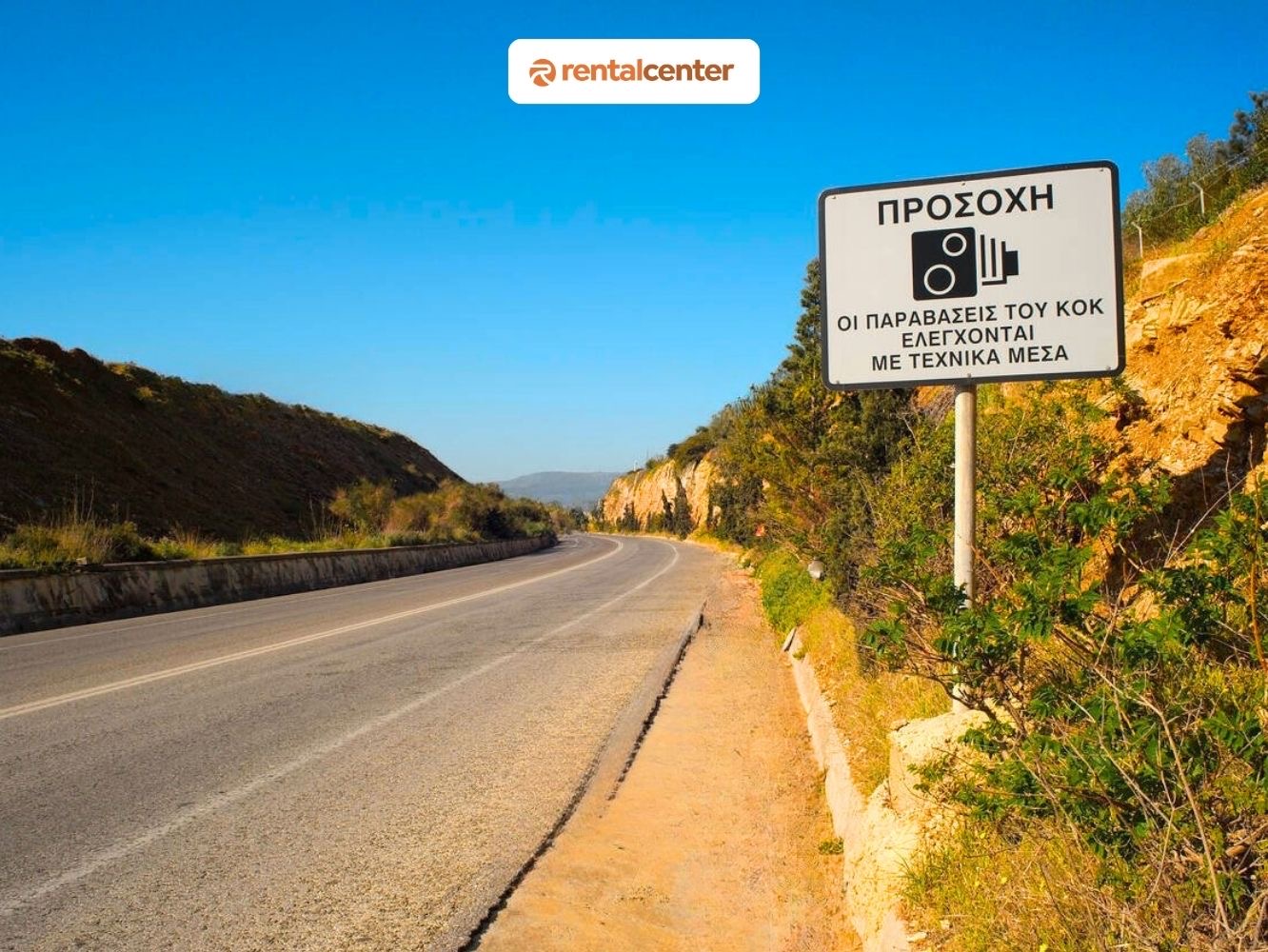
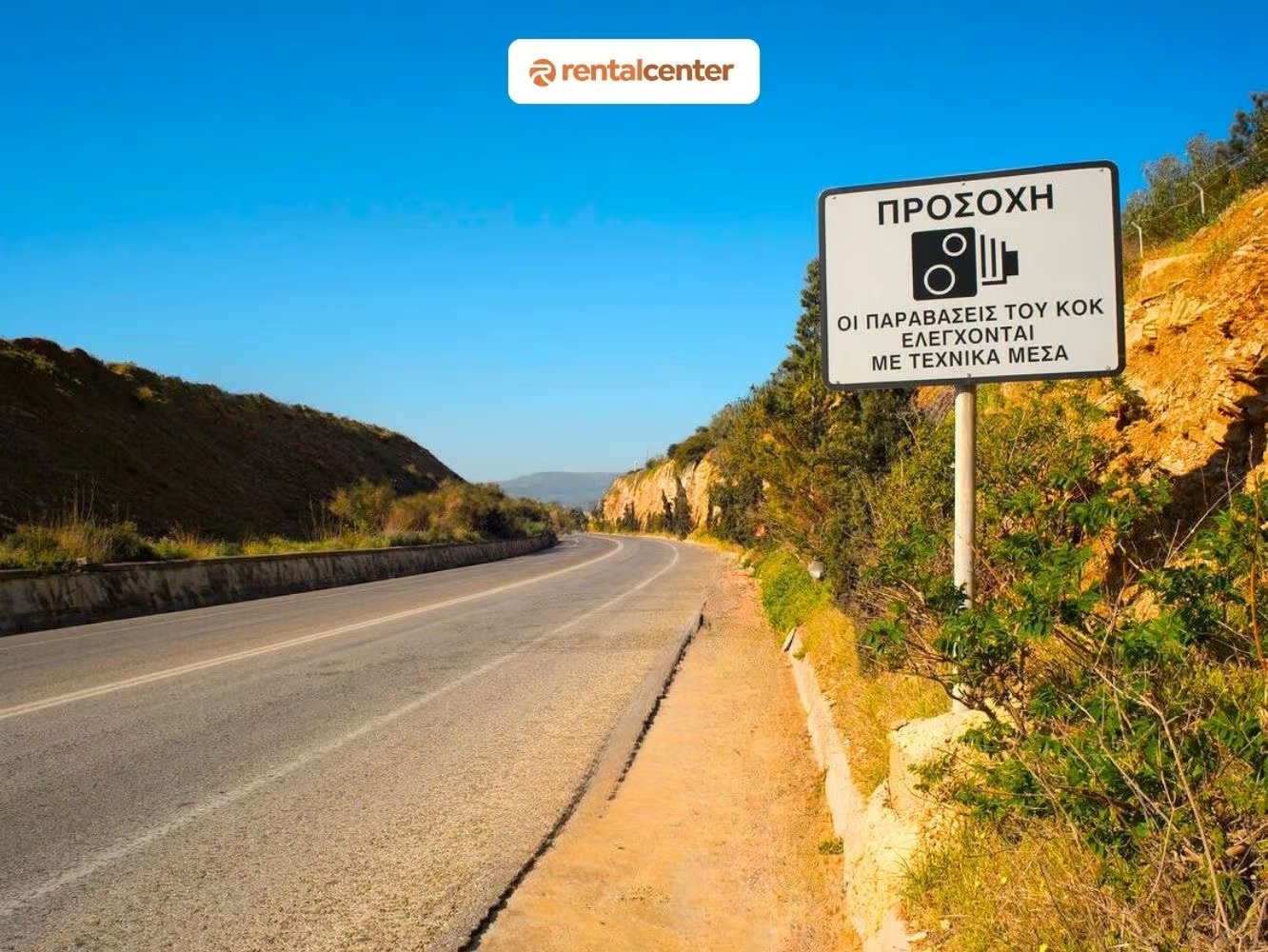
Crete’s VOAK north coast road (national road 90, signed E65 and E75) has had fixed speed cameras since 2014. Local press reports from 2015 to 2017 counted 36 units over the 225 km (139.81 miles) between Kissamos and Pachia Ammos, but no current official count has been published. Assume a camera can appear anywhere along the route.
The European Commission’s 2026 road safety report on Greece describes a plan for gradually up to 4,000 cameras covering speeding, helmets, seatbelts, phone use and red lights. That plan pairs the cameras with an integrated digital fines system linking police, vehicle, driver, inspection, insurance and tax databases, expected from early 2026. Both are plans, not systems confirmed as running nationwide.
Are AI traffic cameras fining drivers in Crete?
No, AI traffic cameras were not fining drivers in Crete as of October 2026. The Ministry of Digital Governance started issuing camera fines through gov.gr and the Gov.gr Wallet on 28 March 2026, in a pilot covering AI cameras at 8 high-risk points in Attica and cameras on 10 buses. The government announced about 1,000 cameras for Attica, Thessaloniki and Crete in 2026, but the tender was still under evaluation in October 2026. A camera fine on a rental car goes to the rental company as owner, not to the tourist’s Gov.gr Wallet.
Parking fines and licence-plate removal
Parking in a disabled bay, or blocking a disabled ramp or tactile paving, costs €150 ($172.22, £127.13), a 60-day licence removal and a 70-day removal of the plates, and the vehicle is towed immediately. The fine is halved for mopeds and motorcycles. A second offence within 5 years costs €1,000 ($1,148.10, £847.50) and 180 days. When the car belongs to a rental company, the renter named in the rental contract counts as the offender for parking offences.
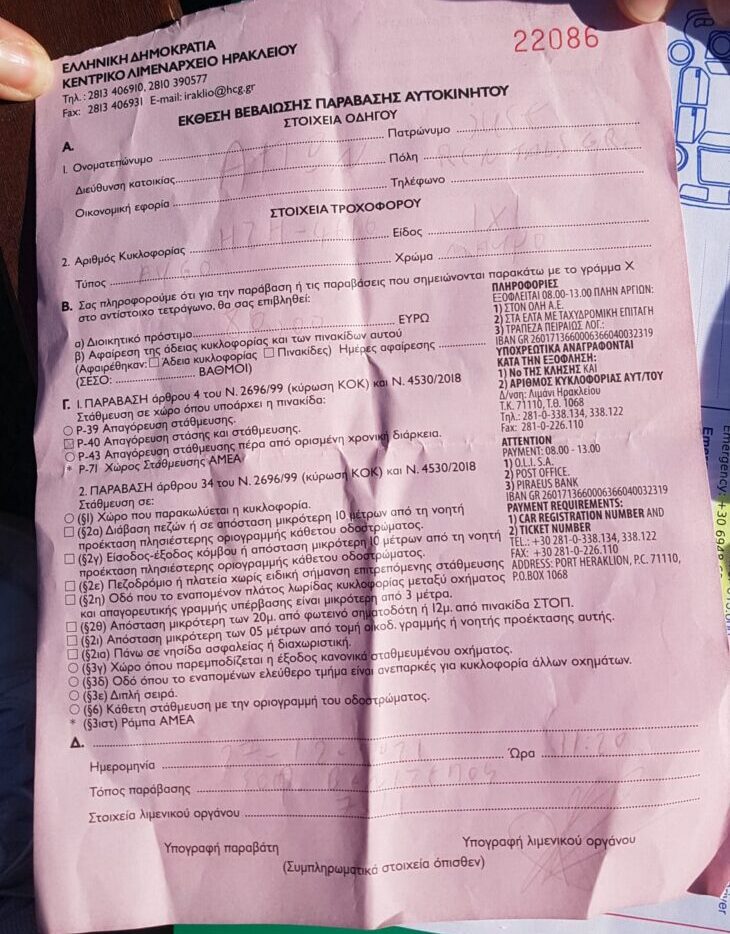
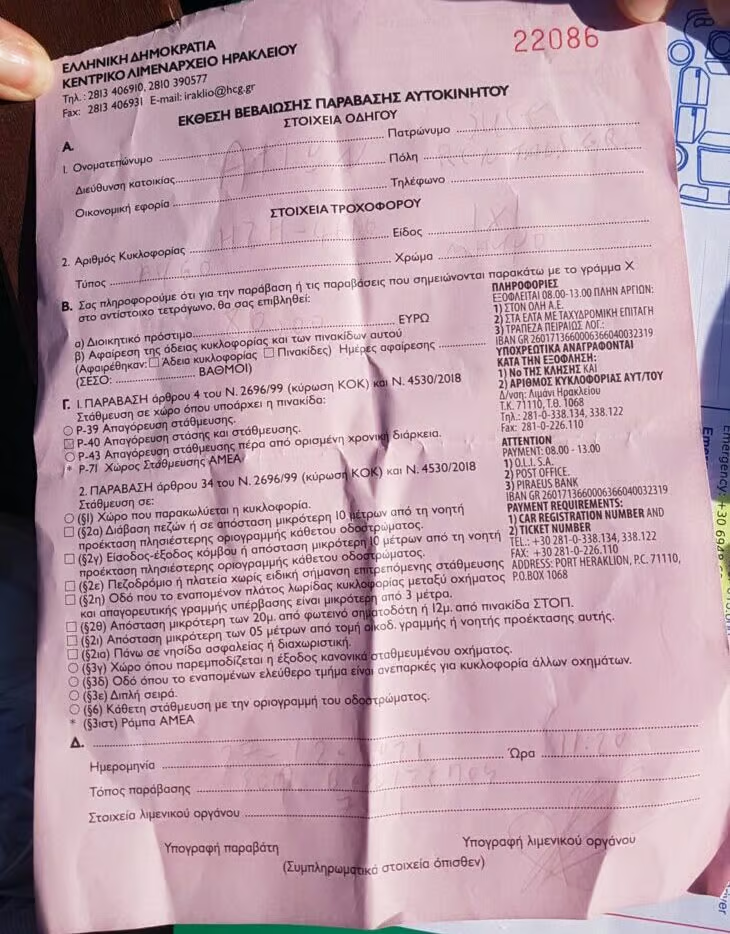
General, non-moving parking tickets, such as an expired pay-and-display ticket, have historically carried a lower base fine, commonly cited around €80 ($91.85, £67.80) with a 50% discount for payment within 10 days. That administrative fine sits outside the 2025 Traffic Code reform, and its current amount could not be independently confirmed for this guide, so check the figure printed on the actual ticket rather than assuming it is unchanged.
Either type of parking ticket can be paid through the channels listed below.
- ELTA post offices
- Banks, during business hours
- E-banking, if the ticket carries a barcode
- Taxisnet, for electronic fines
The registered owner has to pay the fine first at the local traffic police department to recover removed plates. Non-Greek residents without a Greek VAT number should contact the fines office directly for payment instructions. Objections to a traffic ticket must be filed within 3 days of service, and unpaid fines become public debt after 2 months.
Finding a legal space before you stop costs less than any ticket. For the island’s capital, our guide to parking in Heraklion lists where to leave a car.
Who pays a traffic fine on a rental car in Crete?
The renter pays, but a camera or plate-only fine reaches the rental company first. Article 107(6) of Law 5209/2025 sends these fines to the registered owner, which for a hire car is the rental company. The rental company then has an exclusive 7-day window to name the actual driver with a signed declaration, together with the driver’s own declaration. The law names rental and leasing companies explicitly, and an owner that misses the 7-day window is treated as the offender.
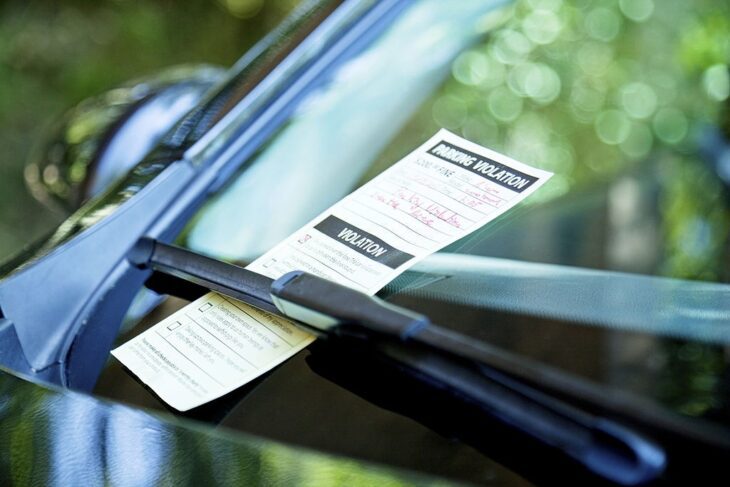
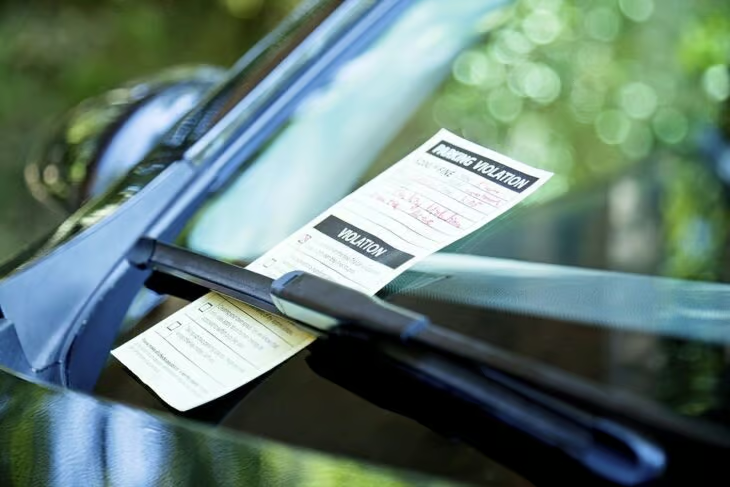
Parking tickets follow a shorter route. Article 38(13) treats the renter named in the rental contract as the offender, so the ticket is in the renter’s name from the start. A registration removal that lasts longer than the rental does not strand the car: Article 106(3) returns the plates to the rental company when it shows the rental agreement. Check your rental agreement for how Rental Center Crete processes a fine.
Keep your contact details current with us, so a camera-issued ticket does not sit unresolved and collect late penalties before you hear about it. Read the full contract rules in our rental terms and conditions before pickup.
Will a Greek traffic fine follow you home from 2027?
A Greek traffic fine follows you home under the new EU rules only when the car is registered in another EU country, such as your own car driven to Greece or a car rented in another EU country. These rules come from Directive (EU) 2024/3237 on cross-border exchange of information on road-safety-related traffic offences, which EU countries must write into national law by 20 July 2027. A Greek-registered rental car in Crete stays a domestic case, handled through the rental company under Greek law.
The directive’s recital 9 notes that “serious road-safety-related traffic offences are being committed in cars rented in other Member States”. The EU response raises the offences pursued across borders from 8 to 18. The original 8 are speeding, not wearing a seatbelt, failing to stop at a red light, drink-driving, drug-driving, not wearing a helmet, using a forbidden lane and illegal phone use. The 10 added offences are listed below.
- Failing to keep a safe distance from the vehicle in front
- Overtaking dangerously
- Parking or stopping dangerously (unpaid parking fees are excluded)
- Crossing solid lines
- Driving the wrong way
- Blocking emergency corridors or failing to give way to emergency vehicles
- Using an overloaded vehicle
- Breaching vehicle-access restrictions, such as pedestrian or school zones
- Leaving the scene of a crash (hit-and-run)
- Breaking the rules at a railway level crossing
Offence notices must be issued within 11 months of the offence once the automated vehicle search succeeds, in the language of the vehicle’s registration document. Final, unpaid administrative fines above €70 ($80.37, £59.33) can be passed to the driver’s home country for collection. The directive covers EU countries only, so UK-registered cars and UK drivers are outside it. Greece had not yet transposed the directive as of October 2026.
Which Greek driving bans will follow EU licence holders home from 2029?
From 26 November 2029, a Greek driving ban follows an EU licence holder home only for drink-driving, drug-driving, speeding, or a crash causing death or serious injury, and only when the ban lasts at least 3 months. Directive (EU) 2025/2206 sets these rules, and EU countries must adopt them by 26 November 2028. The home country may refuse to apply a speeding ban for less than 50 km/h over the limit.
Greek 30-day and 60-day suspensions for phone use, seatbelts or red lights will not follow drivers home under these rules. A 180-day ban for drink-driving above 1.10 g/l, or a 1-year ban for driving above 200 km/h, qualifies for notification to the EU country that issued the licence, once it is final. UK licences are not covered. Rental companies must also accept driving licences in all formats, including mobile licences, from 26 November 2029.
Uninsured vehicles, KTEO and road tax fines
Driving an uninsured vehicle, missing the mandatory roadworthiness inspection (KTEO), or leaving road tax unpaid each carries its own fixed fine, independent of how fast or how carefully anyone was driving.
A compliance fine is a fixed penalty for a vehicle’s legal status rather than for how it was driven.
| Compliance issue | Fine |
|---|---|
| Uninsured passenger car | €500 ($574.05, £423.75) |
| Uninsured bus or commercial truck | €1,000 ($1,148.10, £847.50) |
| Uninsured motorcycle | €250 ($287.03, £211.88) |
| Missing KTEO inspection | €400 ($459.24, £339.00) |
| Unpaid road tax | Outstanding amount, plus the full annual tax due |
Greece activated an automated cross-checking system in October 2025 that flags uninsured vehicles every six months, with KTEO status joining that check from 2026. A first offence in this group reaches up to €1,000 ($1,148.10, £847.50), and a repeat within three years doubles it to €2,000 ($2,296.20, £1,695.00). None of this applies to a well-maintained rental fleet, but it matters if you bring your own car into Greece or extend a stay long enough to need a local inspection.
Is driving in Greece safe?
Driving in Greece is safer than it was, but still riskier than the EU average. Greece recorded 519 road deaths in 2025, down 21.8% from 664 in 2024, according to provisional figures from the Hellenic Statistical Authority (ELSTAT) published in September 2026. ELSTAT also counted 502 serious injuries and 10,545 injury accidents, down 4.1%, and the 2025 figures stay provisional until early 2027.
Greece’s death rate fell to about 50 per million inhabitants in 2025, against an EU average of 43. The National Technical University of Athens (NTUA) road safety observatory put the 2025 rate at 49.7, down from 63.8 in 2024, in a post on 6 April 2026. The European Transport Safety Council (ETSC) 2026 PIN report ranks the 22% fall as the second-largest drop among the 30 countries it monitors, behind Estonia, while deaths across the EU fell 2%. The Hellenic Association of Insurance Companies (EAEE) puts deaths per 100,000 inhabitants at 4.9 in 2025, down from 6.3 in 2024.
Recorded serious injuries in Greece fell 48% between 2015 and 2025, according to ETSC, but the figure needs a caveat. Greece records about 1 serious injury per road death, against about 22 in the Netherlands, and ETSC attributes that gap to better police reporting of injuries elsewhere rather than to safer Greek roads.
Two-wheelers carry the highest risk. Riders of motorcycles and scooters made up 38% of Greek road deaths in 2023, against 19% across the EU, according to the European Commission. Give scooters and motorbikes extra room, whatever vehicle you drive. For the island’s full set of road rules, from which side you drive on to how roundabout priority works, see our guide to driving in Crete.


How safe are Crete’s roads in 2026?
Crete’s roads are not following the national decline in 2026. ELSTAT monthly data show 21 road deaths in Crete from January to July 2026, against 14 in the same months of 2025, while road deaths across Greece fell 9.6% over the same period. Our own sum of ELSTAT’s monthly tables gives about 32 road deaths in Crete in 2025, since ELSTAT publishes no separate annual figure for the island.
Greek islands as a whole were above target in 2023. The European Commission’s 2026 monitoring report counts 110 deaths on Greek islands in 2023, against a 2019 baseline of 124, an interim 2023 target of 91 and a 2030 target of 50.
Crete’s north coast road has received safety upgrades. The Commission cites the central barriers installed on the Crete North Axis in 2022 as good practice, noting that “first results showed a significant reduction in fatalities on these roads”. The Commission expects the 310 km (192.63 miles) Crete motorway around 2030. The Hersonissos to Neapoli section is due in 2028, and the 157 km (97.56 miles) Chania to Heraklion section is reported to finish around 2030. Away from the main road, sharp bends, narrow lanes and livestock on the carriageway are the more common everyday hazards.
How do Greek drivers behave on the road?
Greek drivers keep to speed limits on urban roads and motorways more often than in 2022, but wear seatbelts far less than the EU average. Speed compliance rose on urban roads and motorways, while compliance on rural roads fell.
A road-safety performance indicator measures the share of drivers or riders following a core rule, and the European Commission’s 2026 report gives the Greek figures below.
| Indicator | Greece 2022 | Greece 2025 | EU 2025 |
|---|---|---|---|
| Cars within speed limits, urban roads | 58.8% | 73.0% | Not published |
| Cars within speed limits, motorways | 77.7% | 92.0% | Not published |
| Cars within speed limits, rural roads | 84.4% | 79.0% | Not published |
| Helmet use, riders | 80.3% | 85.7% | 97.6% |
| Helmet use, passengers | 65.5% | 86.6% | 97.0% |
| Front seatbelt use (2025 weekdays only) | 71.8% | 68.9% | 92.4% |
| Drivers not using a handheld phone | 92.7% | 89.1% | 94.5% |
The average Greek passenger car is around 17.5 years old, against an EU average of 12.5, according to ACEA data cited by the Commission.