


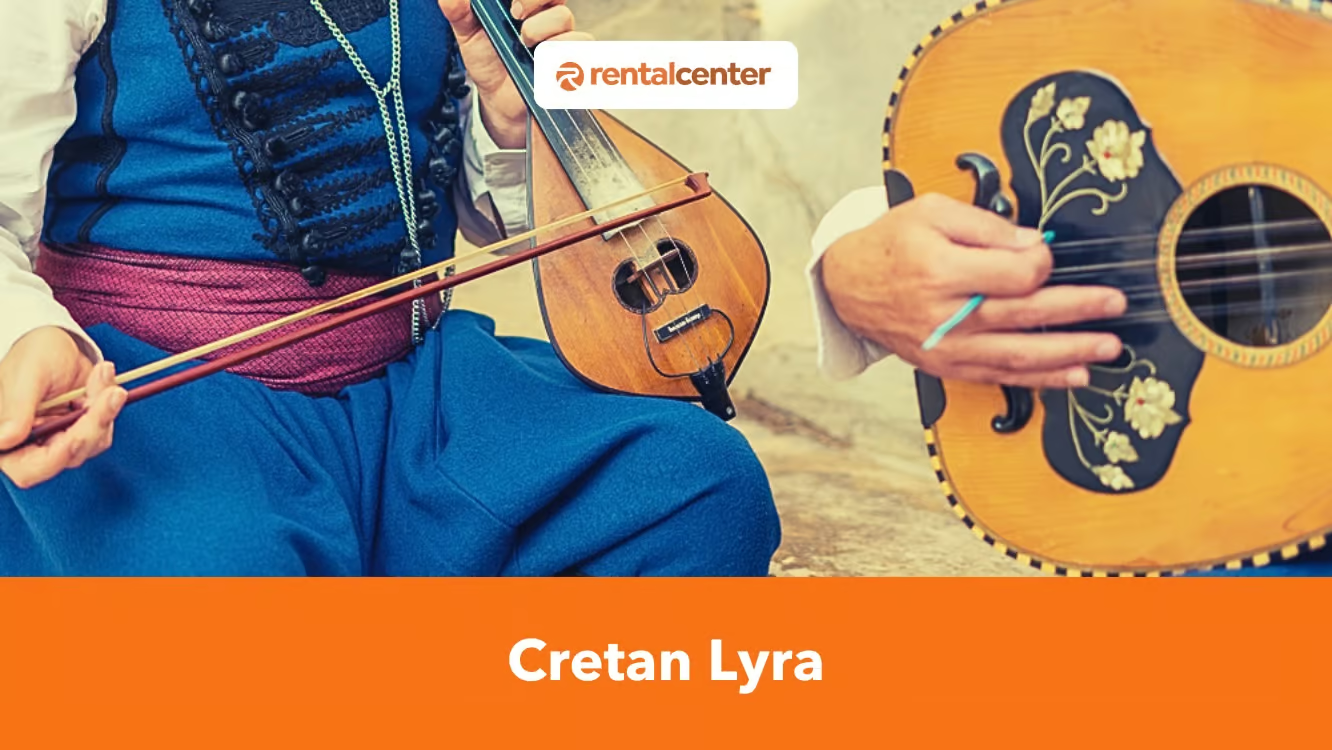
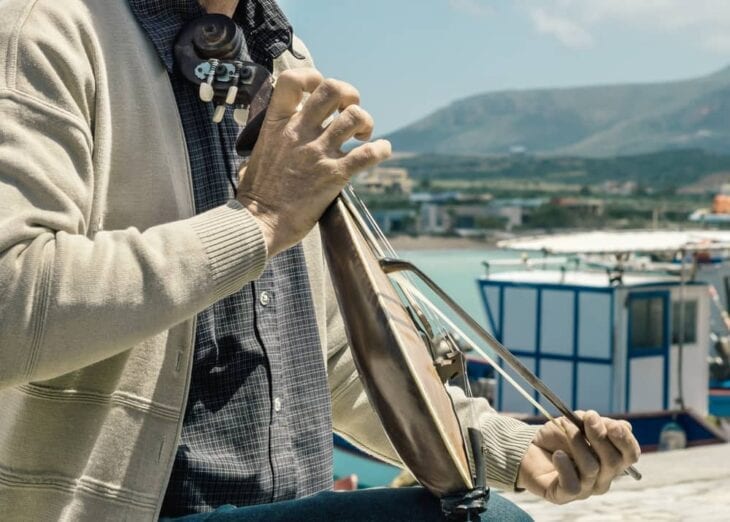
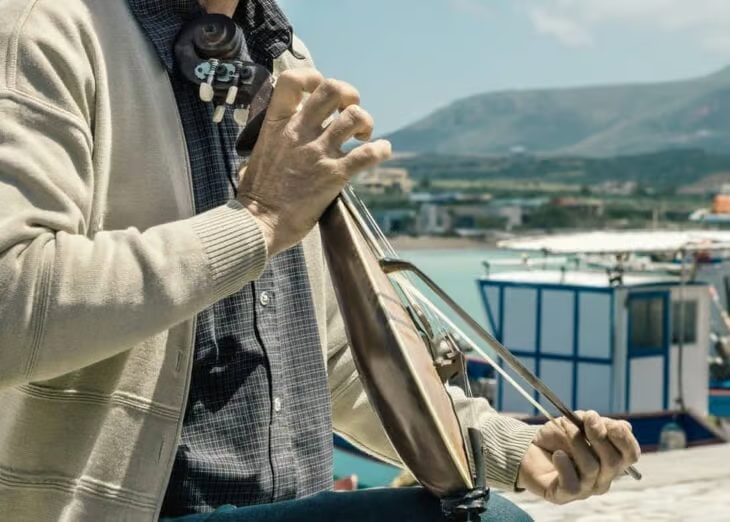
The Cretan lyra (Κρητική λύρα, pronounced kreh-TEE-kee LEE-ra) is a pear-shaped, three-stringed bowed instrument descended from the Byzantine lyra – Crete’s most emblematic musical instrument and the heartbeat of its folk tradition. It is carved from a single piece of wood, traditionally plane tree, walnut, or mulberry, and is held vertically on the player’s lap rather than under the chin like a violin.
Similar bowed lyra instruments appear across the former Byzantine Empire – the Politiki lyra of Constantinople, the Calabrian lyra of Southern Italy, and the gadulka of Bulgaria all share the same Byzantine lineage. Their spread followed Orthodox Christian cultural networks, making the Cretan lyra part of a living family of instruments that once united the eastern Mediterranean world.
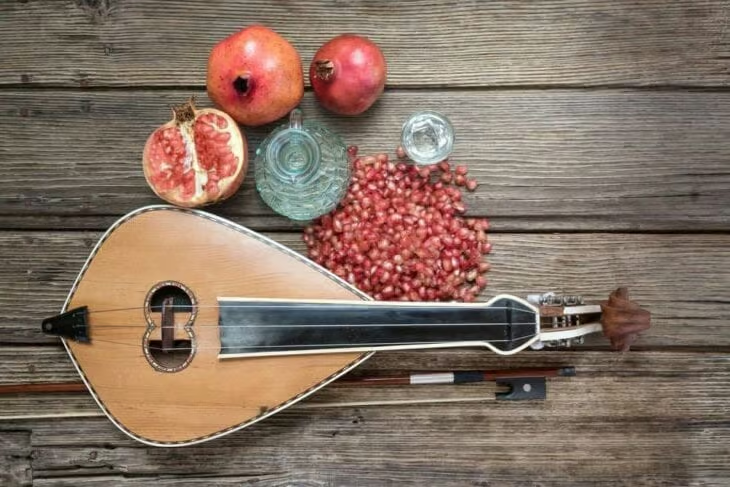
Instrument Construction: Shape, Wood, and Strings
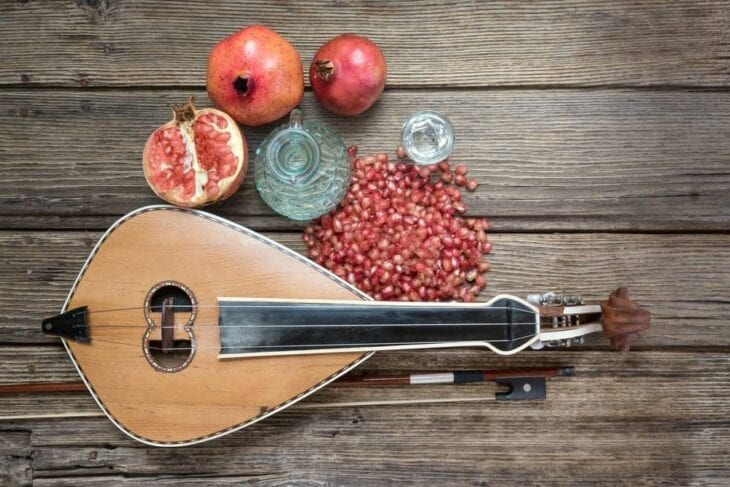
The lyra’s pear-shaped (or oval) soundbox is carved from a single block of wood – most often mulberry, walnut, plane tree, or cedar – with a thin wooden soundboard glued on top. It carries three strings, historically of gut and today usually of steel or synthetic material. The body is compact, typically around 30–50 cm in length, which allows the player to hold it upright on the knee and rotate it toward each string rather than pressing across a fingerboard.
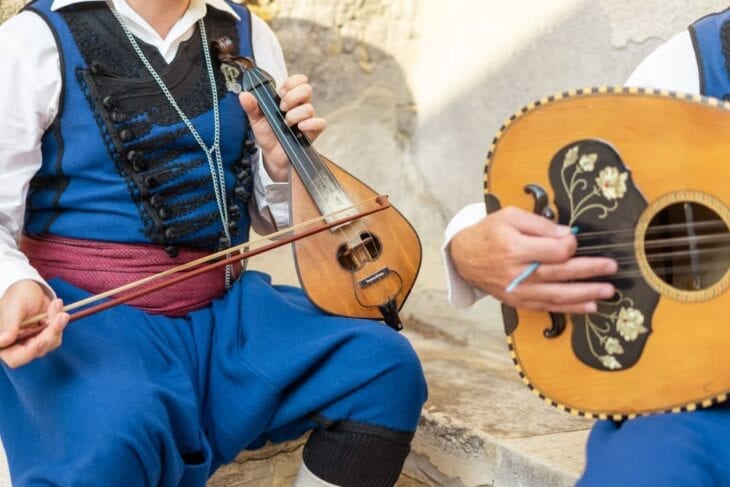
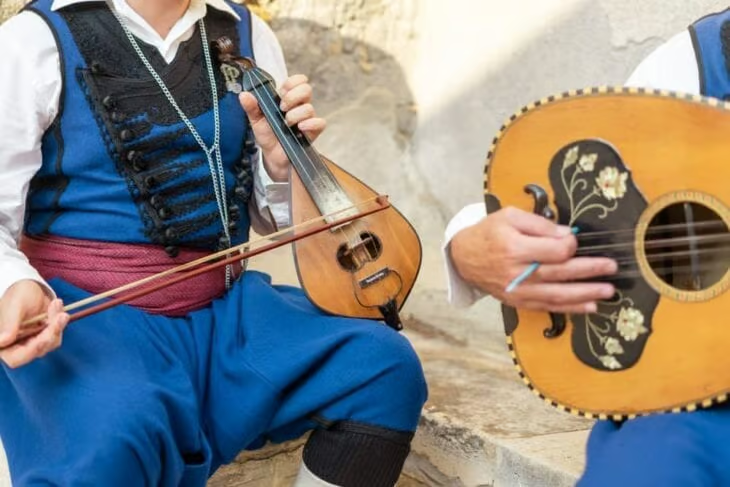
How the Cretan Lyra Is Played?
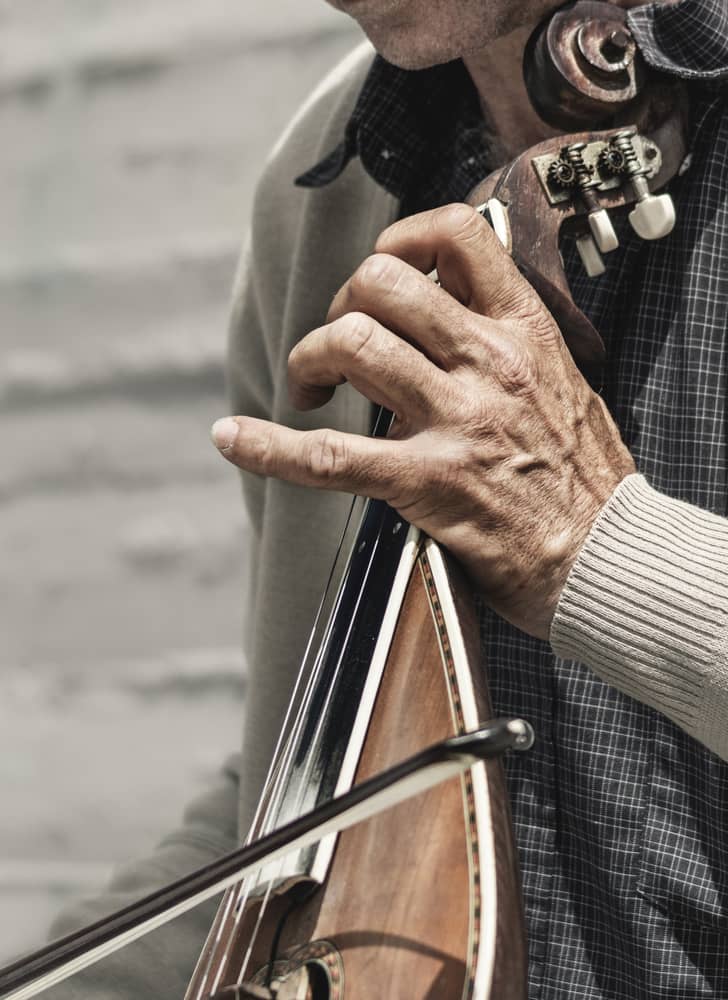
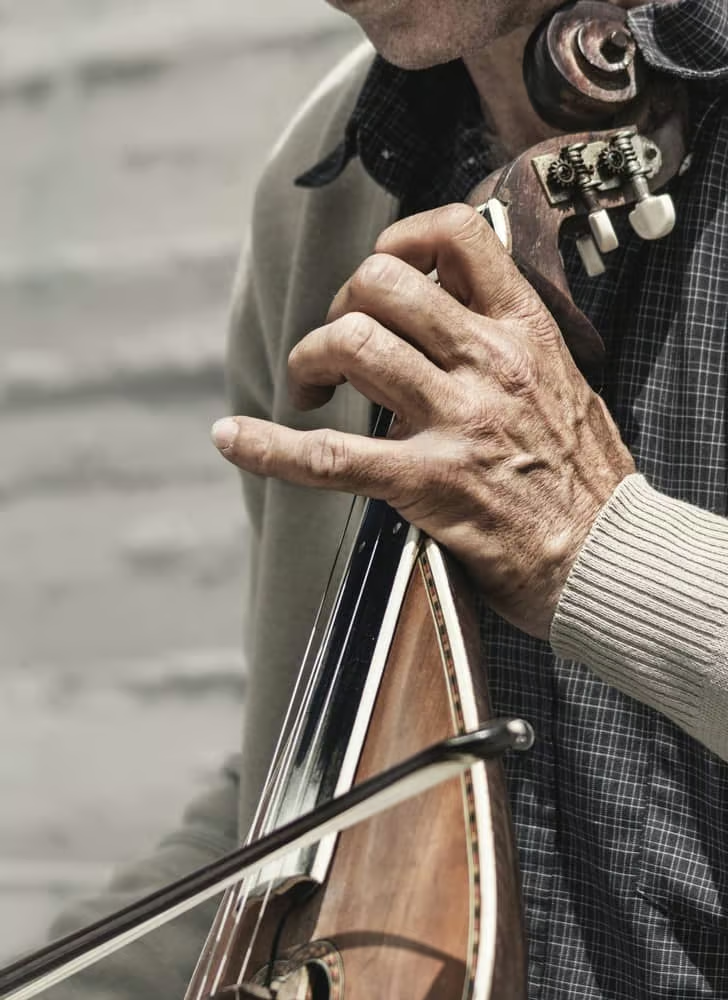
Unlike a violin – where players press their fingertips onto the strings – the Cretan lyra is played with the sides of the fingernails, which brush lightly against the strings from the side. This technique creates the instrument’s signature trembling, almost weeping vibrato.
The bow (doxari) is made of horsehair and held in the right hand, while the lyra rests upright on the player’s left knee or thigh. Historically, the bow carried a row of small spherical bells called gerakokoudouna (hawk bells) that added a rhythmic jingle to the melody as the bow moved. Today, most players use a standard violin-style bow.
How to Tune a Cretan Lyra?
The standard Cretan lyra is tuned in fifths, the same interval system used for a violin. The three strings are tuned from lowest to highest: G3 – D4 – A4. The four-string variant adds a high E5 string on top, making it identical in tuning to a full violin.
To tune by ear, match the lowest string (G) to the G string of a violin, or use a digital chromatic tuner. Traditional players often tune by feel and by comparison with the other instruments in the ensemble. Today, clip-on chromatic tuners – included with most new lyras from luthiers like Stagakis in Rethymno – make tuning straightforward even for beginners.
Types of Cretan Lyra: Lyraki, Vrontolyra, and Common Lyra
There are three main types of Cretan lyra:
- Lyraki (λυράκι) – A small lyra nearly identical to the original Byzantine lyra. Used primarily to accompany dances; rarely seen today outside museums and among specialist players.
- Vrontolyra (βροντόλυρα) – Literally “thunder lyra,” with a powerful, resonant sound designed to accompany vocals and fill outdoor festival spaces without amplification.
- Common lyra (λύρα κοινή) – The standard instrument used today, combining the lyraki’s design with violin influences adopted in the 20th century. This is the lyra you will hear at festivals and see in instrument shops.
Cretan Lyra vs Pontic Lyra: Key Differences
The main difference between the Cretan lyra and the Pontic lyra lies in their origin, design, and musical style. The Cretan lyra, originating from Crete, features a pear-shaped body and accompanies traditional Cretan folk music, tuned in fifths and played with a side-nail technique. The Pontic lyra (kemençe), from the Pontus region on the Black Sea coast, has a much more elongated, narrow body, three strings tuned in fourths, and drives the faster, sharper rhythms of Pontic Greek music. Both are upright bowed instruments, but they differ sharply in construction, tuning, and cultural repertoire.
The Origins and History of the Cretan Lyra
The Cretan lyra traces its roots to the Byzantine lyra, introduced to Crete after 961 AD when the Byzantine Empire reconquered the island from Arab rule and noble families from Constantinople resettled there. Over the following centuries the instrument absorbed local and foreign influences while remaining the backbone of Cretan music.
Venetian Influence and the Modern Lyra
During the long Venetian occupation of Crete (1204–1669), contact with Western European string instruments gradually reshaped the lyra. The violin’s construction and the four-fifths tuning influenced the modern “common lyra,” which blends the older Byzantine form with violin features adopted through the 19th and 20th centuries. This is why today’s standard lyra sounds and tunes so much like the lower strings of a violin.
Mantinades: The Poetry of the Cretan Lyra
The melodic, hypnotic, sing-song chanting of Cretan music has its roots in Mantinades – traditional rhyming couplets of fifteen syllables that date back to the Byzantine era. Each mantinada is a complete two-line poem, often improvised on the spot to comment on love, loss, hospitality, or current events. The Erotokritos, a famous 17th-century epic love poem written by the Cretan poet Vitsentzos Kornaros, uses this same rhyming pattern. Mantinades remain a living part of Cretan culture today: after a meal and some raki, spontaneous mantinades are common, especially in the villages.
As for the form of Cretan music, Arabic music plays a role too. Some Cretan songs, like rebetiko songs, begin with a Taksim (or Taksimi) – an improvisational introduction, drawn from Arabic musical modes, that brings listeners into the mood of the song.
The Cultural Significance of the Cretan Lyra
The Cretan lyra is not merely a musical instrument – it is Crete’s most powerful symbol of cultural identity, used to express joy, sorrow, resistance, and celebration across every generation. Cretan music is deeply stirring and exciting: the tempos build, and the finest lyra players are known both for the speed of their playing and for the sheer endurance with which they sustain a song’s emotional pitch. To hear such a player live is an unforgettable emotional experience. At its finest, the Cretan lyra reveals the Cretan psyche – its pride, sorrow, endurance, and joy – in a way no other art form achieves.
Cretan Lyra and Traditional Dances
The Cretan lyra generates rhythms so insistent that remaining seated becomes genuinely difficult – in the heat of the moment you may well want to dance. Some dances enjoyed in Crete and common across Greece, like the Kalamatianos, are not difficult to pick up.
Other Cretan lyra songs accompany dances of great complexity and significance, such as the Pentozali. The dance – which means “five step” (pente is “five”) – takes its name from the 5th uprising of the Cretans against the Ottomans. “Zali” also means dizziness, appropriate for the speed and complexity of the dance. The dancers, like the lyra players, perform with great skill and stamina.
The Lyra as a Symbol of Resistance
The lyra has long carried the spirit of Cretan defiance. Nowhere is this clearer than in Anogia, a mountain village whose musicians and fighters resisted both the Ottoman occupation and the German occupation of WWII. The instrument’s bold, driving sound became inseparable from the island’s history of rebellion – a soundtrack to survival and pride.
Famous Cretan Lyra Players
The most celebrated Cretan lyra players – from the legendary Nikos Xylouris (Psaronikos) of Anogia to contemporary artists like Vasilis Skoulas – have elevated the instrument to international recognition. The Cretan lyra tradition lives through its great players, from legend to the present day:
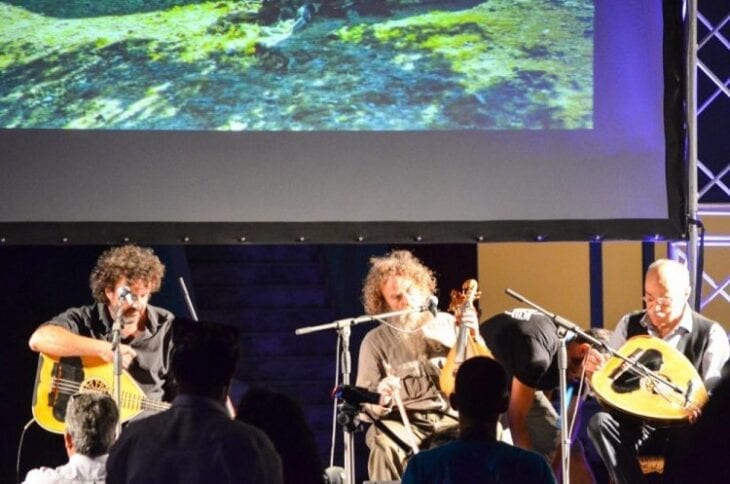
- Nikos Xylouris (Psaronikos, 1936–1980) – Anogia’s most celebrated musician and composer; his adaptation of the Erotokritos remains a beloved classic. His brothers Antonis Xylouris (Psarantonis) and Yiannis Xylouris (Psarayiannis) also became renowned lyra players.
- Antonis Xylouris (Psarantonis, born 1942) – One of the most revered living lyra players; his fierce, expressive style is widely considered a gold standard of Cretan playing.
- Thanassis Skordalos (1920–1990) – A master of the vrontolyra style, known for the power and speed of his playing.
- Vasilis Skoulas – A contemporary lyrist from Anogia with international performances, who has introduced Cretan music to new global audiences.
- Georgia Dagaki – One of the prominent female lyra players, breaking tradition while honouring it.
Where to Hear the Cretan Lyra in Crete?
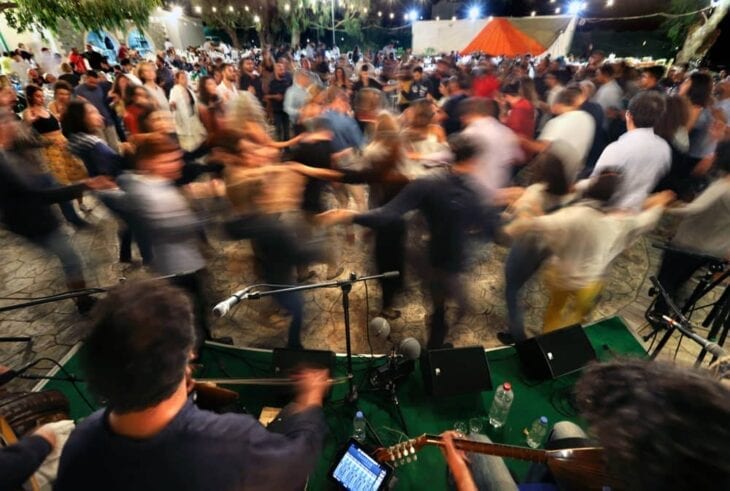
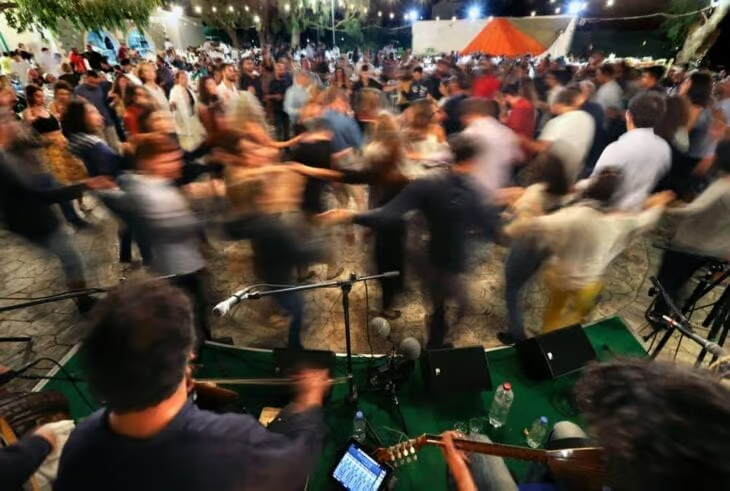
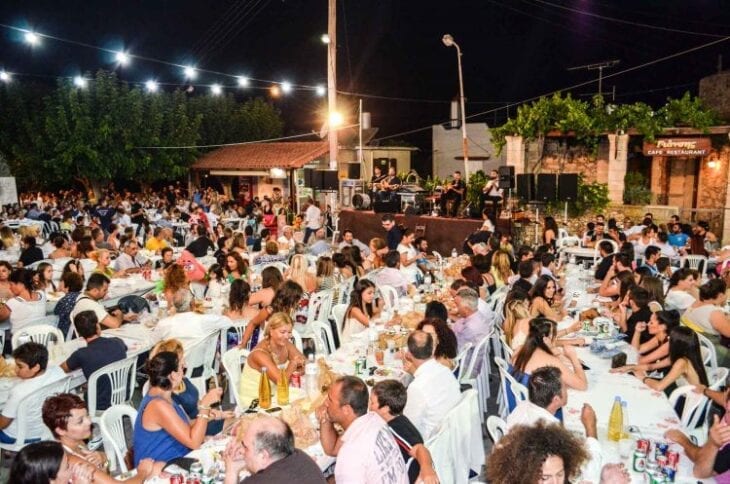
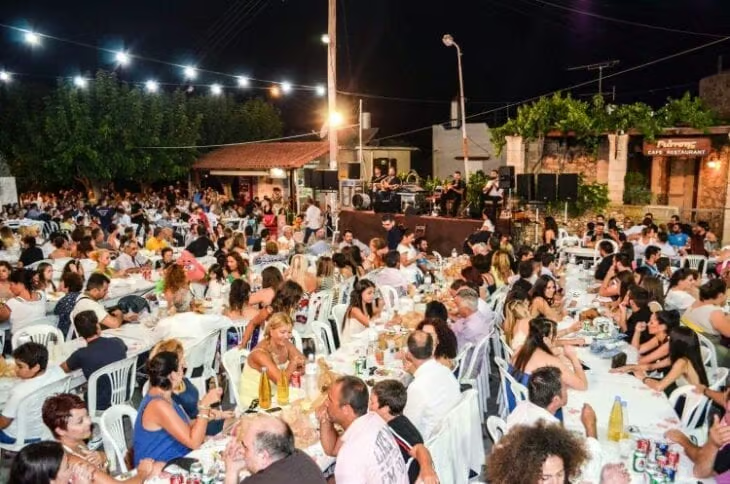
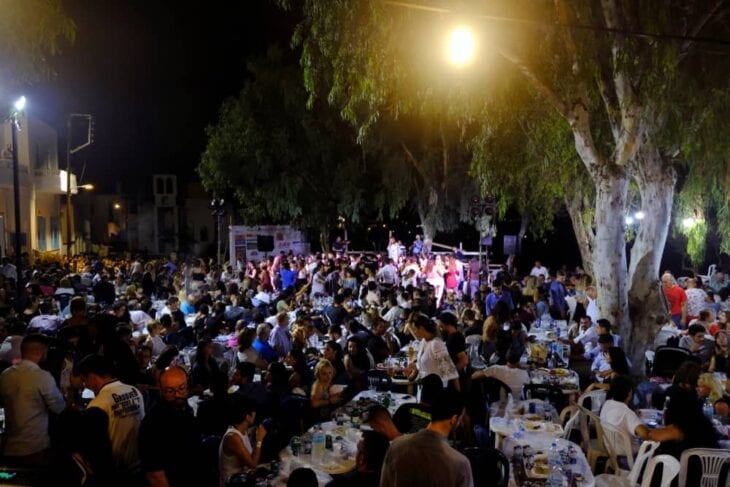
The best places to hear the Cretan lyra live are village festivals (panigiri), traditional tavernas with live music, and especially the mountain village of Anogia – the spiritual capital of lyra music on the island. There is no better setting than a traditional festival in Crete, where the lyra plays late into the night.
- Village festivals (panigiri) – Every village celebrates its patron saint’s feast day with live lyra, dancing, wine, and traditional food late into the night. This is the ideal setting: chairs and tables fill the square and surrounding streets, and the music carries on until dawn. Watch for posters as you drive around the island – look for a black-shirted musician with a lyra on his lap and note the date, then ask at a café for directions to the village.
- Anogia – The mountain village (~1h15min from Heraklion, ~1h30min from Rethymno) where the lyra is woven into daily life; home of the Xylouris musical dynasty.
- Tavernas and live-music restaurants – Especially in the tourist areas of Heraklion, Rethymno, and Chania; ask locals about live paréa nights.
- Traditional weddings and baptisms – If you are invited, these are the most authentic experiences of the Cretan lyra.
- Cultural festivals – Summer events in Anogia, Archanes, and Chania regularly feature live lyra performances, often with dancers in traditional folk costume.
- Lyra workshops and luthier studios – The Stagakis workshop in Rethymno (and other local luthiers) occasionally welcome visitors who want to see a lyra being made.
Anogia: The Village of the Lyra
Anogia, a mountain village on Mt. Psiloritis, sits over 700 metres above sea level and is renowned for the Cretan lyra, deeply embedded in its cultural life. It produced one of Crete’s most legendary musicians – Nikos Xylouris (Psaronikos) – and remains a place where live lyra is a regular part of village life.
Anogia would be famous even without its musical heritage. It lies near the Ideon Cave, one of two caves claimed as the birthplace of Zeus. But it is the village’s rugged terrain and equally rugged inhabitants that built its legend: the people of Anogia are renowned for bravery throughout both the Ottoman occupation and WWII. The village was burnt twice by the Ottomans, and in 1944 it was razed entirely by German forces in retaliation for its role in the abduction of a German general. Anogia, therefore, is the logical birthplace of a famous Cretan lyra player – the village embodies the bold spirit of Crete reflected so deeply in the music.
The Cretan Lyra Today: A Living Tradition
The Cretan lyra is a living tradition: young Cretans learn it in workshops and online courses, and contemporary musicians continue to evolve its sound while preserving its soul. This is not the music of older Cretans alone, but of all Cretans – you will see many young people learning the lyra and dancing with great spirit to its music.
The Cretan lyra actively inspires contemporary musicians, who weave its rhythms into experimental compositions and international performances. It drives the rhythmic core of contemporary Greek experimental music, bridging folk tradition and modern composition. The lyra is not only a vital part of Cretan traditional culture but of contemporary Greek culture as well.
Learning the Cretan Lyra: Workshops and Online Lessons
Today the lyra is taught far beyond the family settings where it was once passed down. Music schools and cultural associations across Crete – particularly in Heraklion, Rethymno, and Anogia – offer lessons, and a growing number of online courses and video tutorials make the basics accessible to learners worldwide. Beginners typically start with tuning (G–D–A), bow control, and the side-nail fingering technique before moving on to dance rhythms like the syrtos and pentozali.
Buying a Cretan Lyra: Prices and What to Expect
A hand-crafted Cretan lyra from a master luthier typically costs between €600 ($686.22, £510.42) and €1.3 ($1.49, £1.11), depending on the maker and the wood used. Beginner instruments from established workshops such as Stagakis in Rethymno start around €600 ($686.22, £510.42) and usually include a bow, a case, and a digital tuner. Professional, made-to-order instruments by renowned luthiers can exceed €1.3 ($1.49, £1.11).
Frequently Asked Questions
What is a Cretan lyra?
The Cretan lyra (Κρητική λύρα, pronounced kreh-TEE-kee LEE-ra) is a pear-shaped, three-stringed bowed instrument – Crete’s most emblematic traditional instrument, descended from the Byzantine lyra and central to Cretan folk music for over 1,000 years. It is held upright on the lap and played with the sides of the fingernails.
How do you tune a Cretan lyra?
The standard three-string lyra is tuned G3–D4–A4 (in fifths, like a violin). The four-string variant adds a high E5 on top. Use a digital chromatic tuner, or match the strings to the lower three strings of a violin.
What is the difference between the Cretan lyra and the Pontic lyra?
The Cretan lyra has a pear-shaped body, is tuned in fifths, and accompanies Cretan folk music. The Pontic lyra (kemençe) has a long, narrow body, is tuned in fourths, and drives the faster rhythms of Pontic Greek music. Both are upright bowed instruments but differ in construction, tuning, and repertoire.
How much does a Cretan lyra cost?
A hand-crafted Cretan lyra costs roughly €600 ($686.22, £510.42)–€1.3 ($1.49, £1.11). Beginner instruments from workshops like Stagakis in Rethymno start near €600 ($686.22, £510.42) (often with a bow, case, and tuner included), while professional made-to-order lyras can cost more than €1.3 ($1.49, £1.11).
Where can I hear the Cretan lyra?
The best places are village festivals (panigiri), traditional tavernas with live music, weddings and baptisms, and the mountain village of Anogia – the spiritual home of the lyra.
How is "Cretan lyra" pronounced?
In Greek it is Κρητική λύρα – pronounced kreh-TEE-kee LEE-ra. “Lyra” is the Greek word for lyre. In English, “Cretan lyra” is standard; the spelling “lira” also appears, but “lyra” is preferred.