






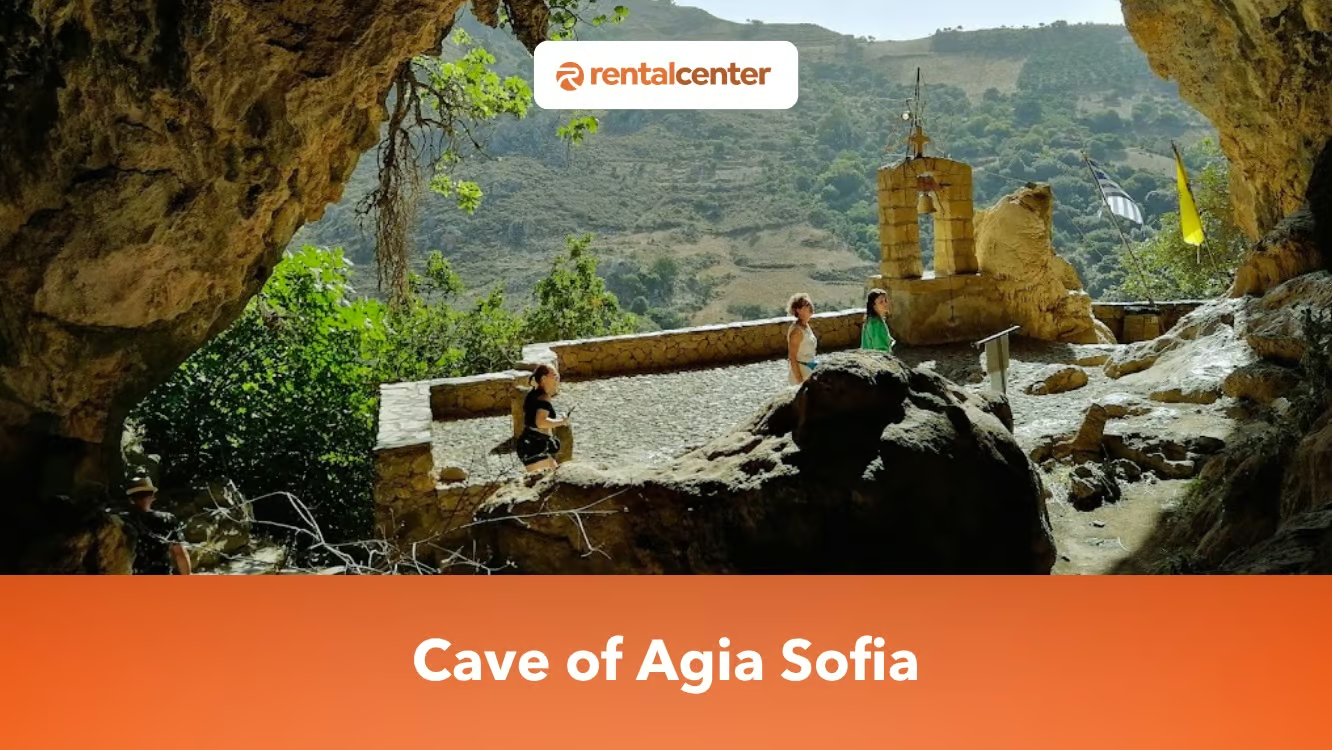
The cave forms a single large chamber whose figure is almost circular, with a diameter of 50 m, a height that reaches 20 m in places and an entrance opening of 20 m, according to Incredible Crete, the Region of Crete’s official tourism portal. CretanBeaches reports an entrance width of 25 m and two chambers on different levels, and MeetCrete describes a 20 m ceiling and a 70 m diameter – so treat the figures as a range rather than a single survey. The chapel of Agia Sofia itself measures 6 x 3 m and stands at the left edge of the entrance, per Incredible Crete.
The air inside the cave is cool and damp, and the open front of the chamber frames a view down the Topolia gorge. Renting a car in Crete is the practical way to reach the cave, because no direct bus line serves the site and the stop pairs naturally with an Elafonisi day trip.
What is the Cave of Agia Sofia?
The Cave of Agia Sofia is a natural cave on Crete that holds a Byzantine-era chapel, stalactite and stalagmite formations and a documented archaeological record. The cave sits above the Topolia gorge in the Chania regional unit and functions today both as a geological landmark and as an active place of worship.
Mineral-rich water carved the cave’s stalactites and stalagmites over thousands of years through erosion and dissolution. Stalactites hang from the ceiling and stalagmites rise from the floor, and MeetCrete records individual stalactites up to 5 m long. CretanBeaches classifies the cave as “dry” – it holds no standing water – and notes that an asphalt road serves the site.
Speleologist Ioannis Petrohilos, known as the Patriarch of Greek Speleology, and his wife Anna discovered and documented the cave in the 1930s, opening the site to the scientific study of its artefacts and its history.
Cave Dimensions and Formations
The Cave of Agia Sofia measures roughly 50 to 70 m across, reaches about 20 m in ceiling height and opens through an entrance 20 to 25 m wide. The figures come from three independent sources and do not fully agree, so the article reports them as a range:
- Diameter: 50 m (Incredible Crete / Region of Crete); 70 m (MeetCrete).
- Height: variable, reaching 20 m at several points (Incredible Crete and CretanBeaches); 20 m ceiling (MeetCrete).
- Entrance opening: 20 m (Incredible Crete); 25 m wide (CretanBeaches).
- Chapel inside the cave: 6 x 3 m, at the left edge of the entrance (Incredible Crete).
- Longest stalactites: up to 5 m (MeetCrete).
How was the Cave of Agia Sofia Named?
Worshippers named the cave after Agia Sofia, the Holy Wisdom, because the chapel inside it honours that saint. Agia Sofia means “Holy Wisdom” in Greek and is a common dedication for churches that venerate God’s omniscient wisdom.
The term “Agia Sofia” came to refer to both the cave and the religious devotion practised inside it. The naming carries the cave’s spiritual significance, its link to the saint and the rituals held in its chambers.
Where is the Cave of Agia Sofia Located in Crete?
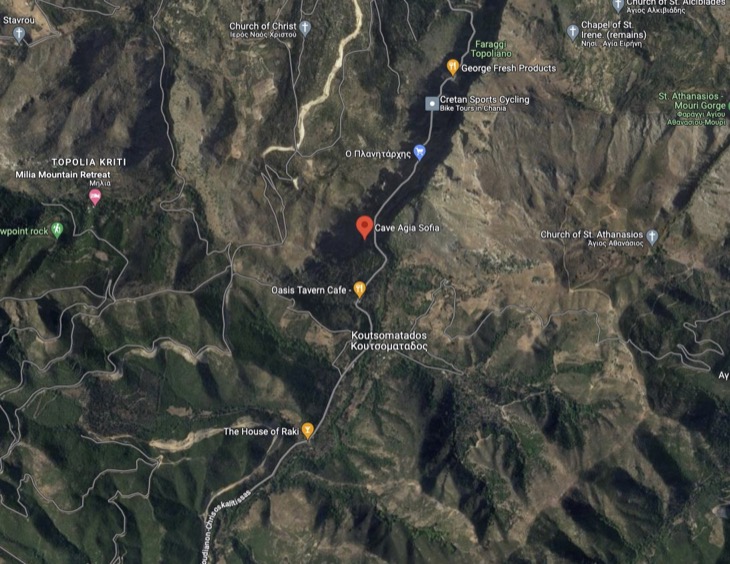
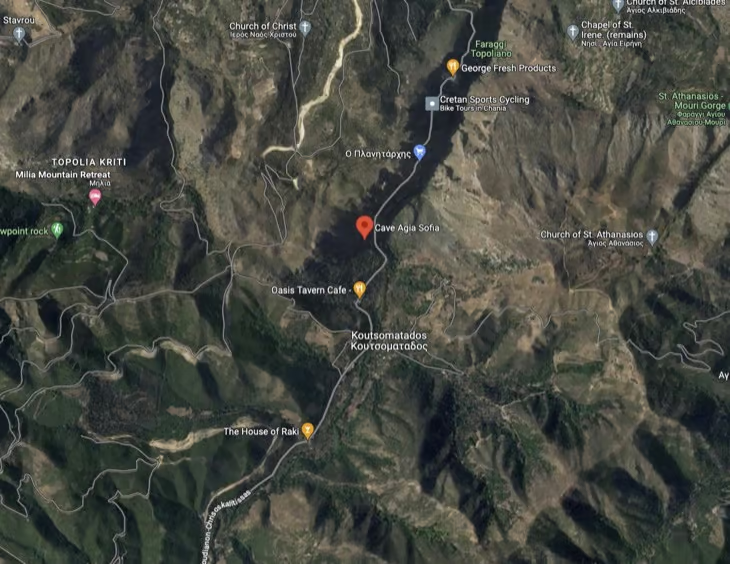
The Cave of Agia Sofia sits on the western wall of the Topolia gorge, near the village of Topolia in the Kissamos area, Chania regional unit, western Crete (postcode 734 00). The cave lies beside the main road that runs from Chania towards Elafonisi, which makes it a natural stop on that drive.
Incredible Crete, the Region of Crete’s tourism portal, places the cave 47 km (29.20 miles) from the city of Chania, and CretanBeaches gives the same 47 km (29.20 miles), described as south-west of Chania. Chania International Airport lies approximately 64.2 km (39.89 miles) away by road.
The cave overlooks the Topolia gorge and belongs to the group of historically significant caves in Crete. Its position on the Elafonisi road makes it reachable from most bases in western Crete with a rental car.
Topolia Gorge – the Cave’s Neighbouring Landmark
The Topolia gorge runs directly below the Cave of Agia Sofia, and the open front of the cave looks straight down into it. Tripadvisor lists the gorge 2.1 km (1.30 miles) from the cave as a separate attraction, and Komoot reports that walkers descend into the gorge from the cave itself. Drivers approaching from the north pass through a road tunnel cut into the rock before reaching the cave. Visitors on a wider route pair the cave with another Crete landmark on the same drive.
What is the Cave of Agia Sofia Known For?
The Cave of Agia Sofia is known for its stalactite and stalagmite formations, its Byzantine chapel, its Neolithic-to-Roman archaeological finds and one spider species that lives nowhere else.
Calcite formations decorate the chamber and give the cave its geological reputation. Byzantine-era worshippers used the cave as a place of religious observance, and the icons, inscriptions and frescoes they left behind still stand inside it.
The archaeological record reaches far further back than the Byzantine period. P. Faure identified pottery sherds from the Neolithic, Classical and Roman periods, and in 1963 S. Hood found a clay figurine from the 4th century BC together with Neolithic, pre-Minoan, post-Minoan III, Classical, Hellenistic and Roman ceramics, according to Incredible Crete. MeetCrete reports that Neolithic finds provide the evidence of the cave’s use in ancient times.
Biologists know the cave for a different reason: it hosts the spider Pholcus creticus, a stenoendemic species that has been identified in this cave only, according to CretanBeaches.
The cave still serves religious purposes. Its chapel draws pilgrims and visitors, and MeetCrete reports that the birth of Christ is celebrated inside the Cave of Agia Sofia every year on 24 December. MeetCrete also records the local legend of Saint George, whose horse is said to have left a hoofprint here.
How to Get to the Cave of Agia Sofia in Crete?
To reach the Cave of Agia Sofia, drive west from Chania on the E65 towards Kissamos, then follow the Elafonisi road south to Topolia. The steps to get to the Cave of Agia Sofia in Crete are listed below.
- Rent a car and drive from Chania. Renting a car in Crete is a convenient way to reach the Cave of Agia Sofia, because no direct public transport serves the site.
- Take the Vorios Odikos Axonas Kritis/E65 Road. The E65 is the recommended route west out of Chania because it is fast and safe.
- Follow the E65 road. The drive covers approximately 50 to 60 km (37.28 miles) and takes around 40 minutes to 1 hour from Chania International Airport.
- Turn south towards Topolia and Elafonisi. The cave stands beside the main Elafonisi road, on the western wall of the Topolia gorge, immediately after the road tunnel when approaching from the north.
- Park at the roadside parking area below the cave. The parking area sits at the foot of the stairway that leads up to the entrance.
- Climb the 257 steps to the cave entrance. The stairway rises from the parking area to the cave mouth, and 2 taverns/cafés along the way offer a rest stop, according to MeetCrete.
What to See in the Cave of Agia Sofia Crete?
The things to see in the Cave of Agia Sofia Crete are listed below.
- Stalactites and stalagmites: Mineral deposits form the hanging stalactites and the rising stalagmites, and the longest stalactites reach 5 m (MeetCrete).
- Byzantine frescoes and icons: Religious artworks from the Byzantine era mark the cave’s history as a place of worship.
- Cave interior: The open front, the cool air and the natural light create the chamber’s distinctive atmosphere.
- Underground chapel: The 6 x 3 m chapel of Agia Sofia stands at the left edge of the entrance and still hosts religious services.
- Gorge view: The mouth of the cave frames the Topolia gorge below.
- Fig-tree entrance: A large fig tree forms the passage into the cave chapel, as MeetCrete describes it.
How Far is the Cave of Agia Sofia from the Airport?
The Cave of Agia Sofia lies approximately 64.2 km (39.89 miles) from Chania International Airport, which is roughly 1 hour and 2 minutes of driving. Traffic conditions, road quality and the route taken all influence the travel time.
Drivers take the Vorios Odikos Axonas Kritis/E65 route from the airport and then turn south towards Topolia. A reliable navigation system or GPS helps on the smaller roads of the last section. The same rules for driving in Crete apply on the E65 and on the Elafonisi road.
Find below an image map of the Cave of Agia Sofia.
How Far is the Cave of Agia Sofia from Chania?
The Cave of Agia Sofia lies 47 km (29.20 miles) from the city of Chania, according to Incredible Crete, the Region of Crete’s official tourism portal; CretanBeaches gives the same 47 km (29.20 miles) and places the cave south-west of the city. The drive follows the E65 west, then the Elafonisi road south to Topolia.
How Much is the Admission for the Cave of Agia Sofia Tour in Crete?
The admission for the Cave of Agia Sofia tour in Crete varies from around €40.50 ($46.50, £34.32) to €597.37 ($685.84, £506.27).
The Elafonisi Full-Day Tour from Chania is a €40.50 ($46.50, £34.32) worth package that allows visitors to visit Elafonisi Beach and explore the Cave of Agia Sofia as an inclusion. The duration of the tour is around 8 to 10 hours, which means tourists have ample time to wander around the area.
The Elafonisi Beach and Agia Sofia Cave Tour is another package that costs €39.47 ($45.32, £33.45) per adult person. The package allows tourists to visit Elafonisi Beach and stop by the Agia Sofia Cave. The duration of the tour is approximately 10 hours, giving the opportunity to tourists to explore the two locations and appreciate their beauty.
The Tailored Private Elafonisi Day Tour from Heraklion is a package that covers up to 3 people. The price is around €597.37 ($685.84, £506.27) and already includes access to Elafonisi Beach and a visit to the Cave of Agia Sofia. The duration of the tour is around 8 hours at maximum.
What are the Challenges Getting into the Cave of Agia Sofia in Crete?
The main challenge is physical: visitors climb 257 steps from the parking area to the cave entrance, and 2 taverns/cafés on the stairway serve as rest stops (MeetCrete). The challenges of getting into the Cave of Agia Sofia in Crete are listed below.
- The 257-step climb: The stairway from the parking area to the cave entrance is the only way up, and it demands a steady pace in summer heat.
- Accessibility: People with mobility limitations find the site difficult, because the route to the cave includes steps, rough ground and natural obstacles.
- Ground and lighting inside: Komoot reports that the cave has no marked path and no lighting, and that visitors climb over rock inside – a torch and sturdy shoes are the gear that competitors recommend most often.
- Limited access or restrictions: The chapel is an active place of worship, so parts of the cave are restricted and visitors keep to the marked route.
- Environmental factors: The cave stays cooler and more humid than the outside, so a light layer and closed shoes make the visit more comfortable.
- Safety precautions: Surfaces are slippery and ceilings are low in places, so visitors watch their footing and follow posted instructions.
- Tour availability and bookings: Booking ahead matters in the peak season, because tour capacity and parking are both limited.
Driving to the cave means driving the roads to Topolia. Road conditions vary, so drive cautiously and expect twists, turns and narrow passages. Visitors who are not used to mountain roads should choose the right car to rent before they set off.
Hiking near the cave varies in difficulty depending on the trail chosen. Some routes involve uphill sections, uneven paths or rocky terrain, so wear appropriate footwear, carry water and prepare for changing weather.
What are the Nearest Hotels in the Cave of Agia Sofia Crete?
The nearest hotels in the Cave of Agia Sofia Crete are listed below.
What are the Nearest Restaurants to eat in the Cave of Agia Sofia Crete?
The nearest restaurants to eat in the Cave of Agia Sofia Crete are listed below.
FAQ about visiting Cave of Agia Sofia
What are the Rules about visiting the Cave of Agia Sofia?
The rules about visiting the Cave of Agia Sofia are listed below.
- Wear proper attire, because the cave is devoted to religious activities. Avoid revealing clothing or attire that is inappropriate for a sacred site.
- Respect any restrictions on photography or videography within the cave. Some religious sites prohibit photography or restrict it to certain areas, so follow the instructions of guides or posted signs.
- Keep a quiet and respectful demeanour within the cave. Keep noise to a minimum to preserve the tranquillity and to avoid disturbing other visitors or ongoing religious practices.
- Follow the designated paths and the instructions on restricted areas. Some sections are off-limits or reserved for religious ceremonies, so respect the boundaries.
- Dispose of any waste or litter properly. Use designated waste bins or carry rubbish out with you.
- Listen to the instructions of guides, staff or local authorities. They are there to protect visitors and preserve the site.
When is the Best Time to Visit the Cave of Agia Sofia in Crete?
The best time to visit the Cave of Agia Sofia in Crete is during the shoulder seasons – April to May and September to October. The shoulder seasons bring milder weather and thinner crowds than the peak summer months, which makes the 257-step climb far more comfortable.
Spring adds wildflowers and green landscape to the drive and the walk up. The mild weather suits outdoor activity and trekking around the cave.
Autumn cools the island down and coincides with the harvest season, which makes the surrounding countryside particularly attractive.
Summer, from June to August, brings the heat and the biggest crowds. Visitors travelling in summer should arrive early in the day to avoid both. The same seasonal pattern shapes the wider question of the best time to visit Crete as a whole.
Can I Bring Food to the Cave of Agia Sofia?
No, visitors do not bring food into the Cave of Agia Sofia. Eating inside the cave is not allowed, as a sign of respect for the sacred nature of the site. Food also attracts pests and creates litter, which disrupts the environment and affects the preservation of the cave.
Eat any food or snacks outside the cave premises, before or after the visit. Designated areas and nearby facilities – including the taverns and cafés on the stairway – serve visitors who want a meal or a picnic. Carry any waste out and dispose of it in the bins outside the cave area.
Are there Parking Spots in the Cave of Agia Sofia?
Yes, there is a parking area at the Cave of Agia Sofia. The parking area sits at the base of the cave, below the stairway that leads to the entrance, and it is a short distance from the cave itself. The parking area fills up in peak season, because the space available is limited.