




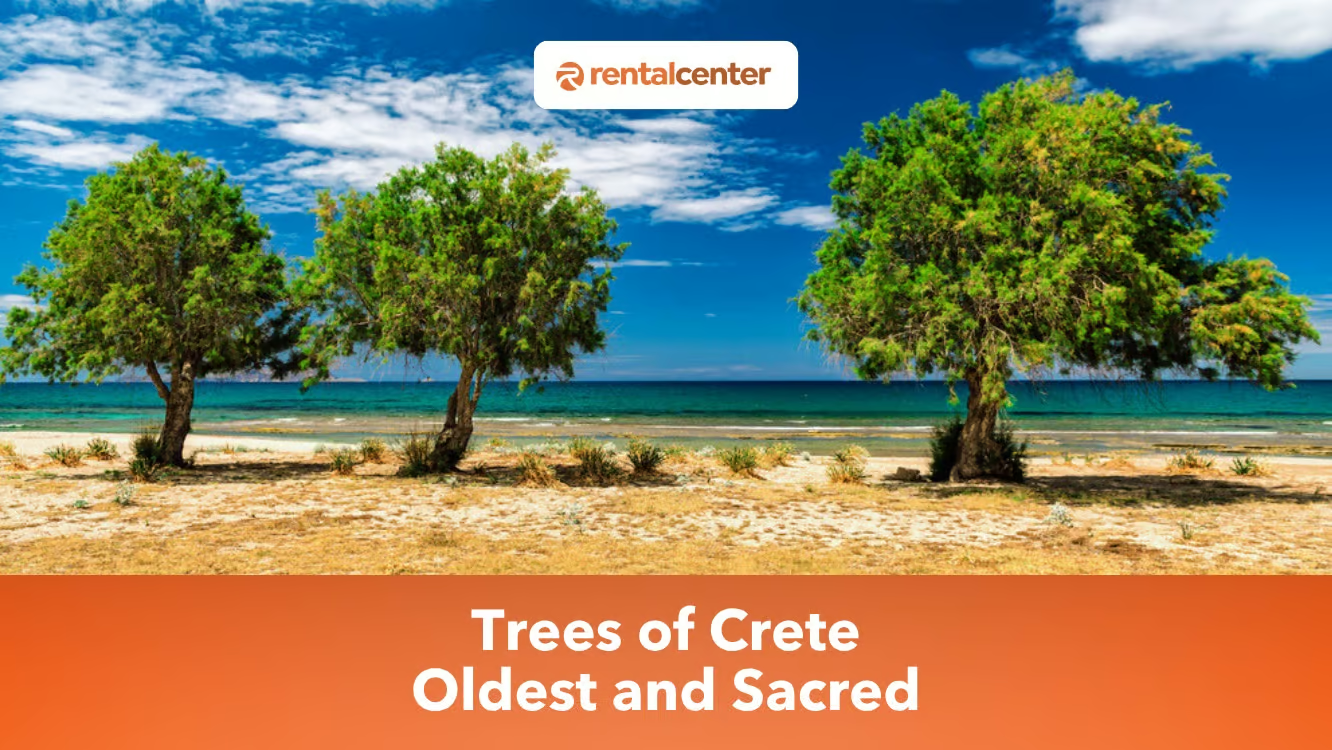
These trees stand scattered across the island, from Chania in the west to Lassithi in the east, and each one carries verifiable facts rather than vague legend: ages ranging from roughly 1,600 to 3,250 years, trunk perimeters of up to more than 22 meters, and protected natural monument status granted by ACOM. Their sacrality is the result of millennia of yearning for the divine, justice, liberty, and forgiveness.
The Association of Cretan Olive Municipalities (ACOM) is the body in charge of identifying and registering Crete’s monumental olive trees. ACOM has registered more than a thousand trees across the island, all of them carrying characteristics that set them apart from ordinary olive trees. The 14 sacred trees form the smaller, older core of that register: they have been living and fruiting for hundreds, and in several cases thousands, of years. Visiting one of them is a strong option if you want to skip the crowds at conventional tourist sites and connect with Crete’s history and culture.
A note on tree ages: Ages given below are estimates. Agronomists date living olive trees from trunk circumference and archaeological context rather than from stump rings, so precise dating of a living tree is inherently approximate.
The Mother Olive in Kamilari
The Mother Olive of Kamilari, a Thrombolia tree estimated at 2,800 years old, grows in the municipality of Phaistos in south-central Crete and ranks among the island’s most visited sacred trees. Local growers grafted this Thrombolia varietal – known locally as Hontrolia – onto a wild olive rootstock, the propagation technique that let the tree survive for close to three millennia. Locals also call it Mana Elia, meaning “Mother Olive Tree”. If you visit the area’s archaeological sites, take a few minutes to see this natural wonder too.
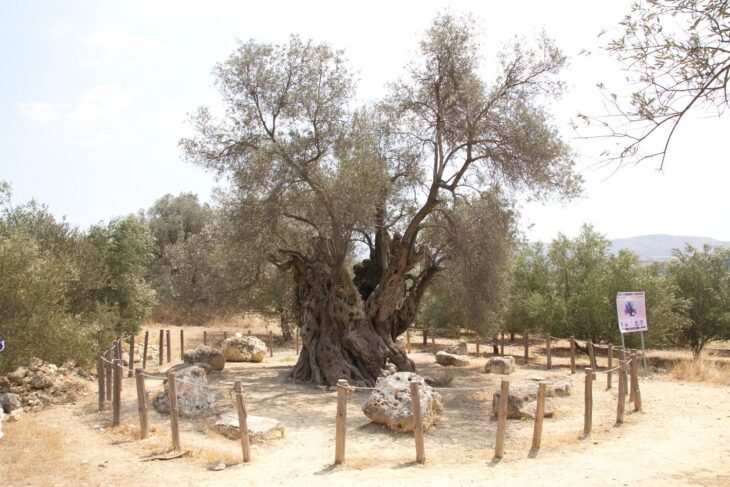
The Kamilari tree dates back to the Roman era (67 BC – 330 AD) and is 2,800 years old. Its trunk measures a perimeter of roughly 9.5 meters at the base. The Kamilari Tholos Tomb stands 1,000 meters away and the Minoan Palace of Phaistos 1,400 meters away, which makes the tree an easy addition to an archaeological day out.
The Minoan sacred stones of Kamilari
The sacred stones of Kamilari are 12 large stones that ring the trunk of the Mother Olive, and 8 of them carry carved ancient Minoan symbols. The Cultural Association of Kamilari placed those stones around the tree as a community effort to safeguard the natural monument. Among the carved symbols is the double axe, or labrys, the emblem most closely tied to Minoan religion – a direct link between this living tree and the civilization that once harvested olives on the same plain.
The Olive Tree of Vouves
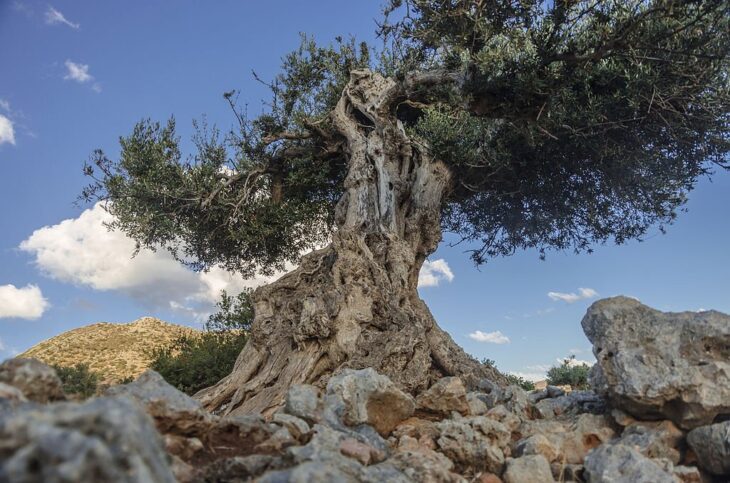
The Olive Tree of Vouves, in the village of Ano Vouves in the Kolymvari area of the Chania region, is the most famous ancient olive tree in Crete and one of the oldest olive trees in the world. The Vouves tree still produces fruit today, and its hollow, sculpted trunk is the reason ACOM declared it a natural monument, citing the shape and the exceptional aesthetics of its relief trunk.
Estimates of its age diverge by roughly a thousand years, and honest reporting means giving the range rather than a single figure. Greece Is dates the tree to about 3,000 years, placing its sprouting in the Minoan era. Forbes, in a March 2025 article cited by Wikipedia, describes it as a 4,000-year-old olive tree. Both figures are estimates, not measurements.
Two facts about Vouves are firmly documented. In 1997 the tree was declared a protected natural monument, and in October 2009 the Olive Tree Museum of Vouves opened in a nearby 19th-century house, displaying the traditional tools and the process of olive cultivation. Branches from the Vouves tree were used to weave the victors’ wreaths for the winners of the 2004 Athens Olympics and the 2008 Beijing Olympics.
How the age of an olive tree is estimated
Agronomists estimate the age of an ancient olive tree from the circumference of its trunk, because counting stump rings is unreliable in olive trees. “Estimating the age of olive trees based on the stump rings, as usually done with other trees, is not easy. If the circumference is more than ten meters, then the tree is certainly very old. To put it in context, the circumference of a modern-day tree trunk is from half to one meter”, says agronomist Nikos Mihelakis, an olive tree researcher and scientific consultant at ACOM. Measured against that scale, the Cretan monumental trees – with perimeters of 9.5, 19.4 and even 22 meters – sit far beyond anything a modern grove produces.
The Monumental Olive Tree of Gortyn
The Gortyn Monumental Olive Tree, about 1,600 years old, has wrapped its growing trunk around an embedded Roman column inside the ancient site of Gortyn. This hontroelia variety grew from a wild olive rootstock, the same grafting technique found in the Kamilari and Kavousi trees.
Gortyn is known for its sacred olive tree, an ancient plane tree, and archaeological findings that identify it as one of the most important towns of Roman Crete. The site lies between Agioi Deka and Mitropoli, inside an old olive grove of striking beauty. You can tour the grove and observe archaeological artefacts such as destroyed buildings, scattered wall fragments, and fallen pillars.
The Elevated Olive Tree of Vatolakkos
The Elevated Olive Tree of Vatolakkos, at 2,000 years old, is the only Mastoeidis – or Tsounati – varietal on the island and one of three sacred trees recorded in the municipality of Platanias. The Vatolakkos tree takes its “elevated” name from the religious act of lifting the blessed bread and wine during the Eucharist liturgy.
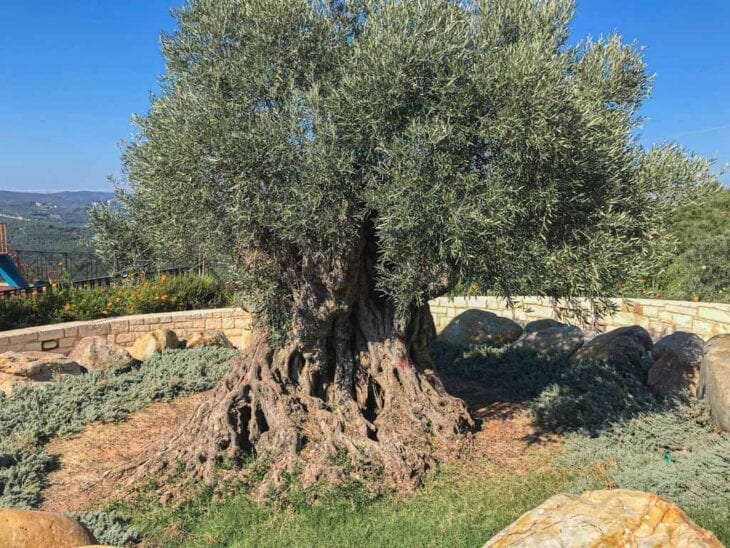
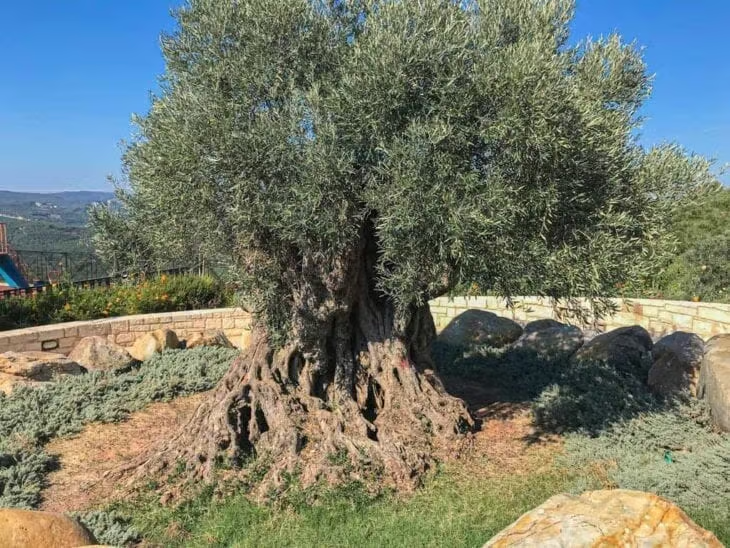
According to local tradition, a priest bored holes into the tree’s deformed trunk, filled them with incense, and sealed them to protect the village from plague and other ailments. The tree grew on a wild olive rootstock, and access to it is easy compared with the more remote monumental trees.
The Monumental Olive Trees of Amari
The Monumental Olive Trees of Amari are 2 sub-Minoan-era olive trees, over 3,000 years old, that still stand in the historic grove of the Amari municipality in the Rethymno region. These 2 trees date to the sub-Minoan period (1100–1000 BC) and outlasted the clearance of more than 1,000 grove trees that were uprooted because of low production.
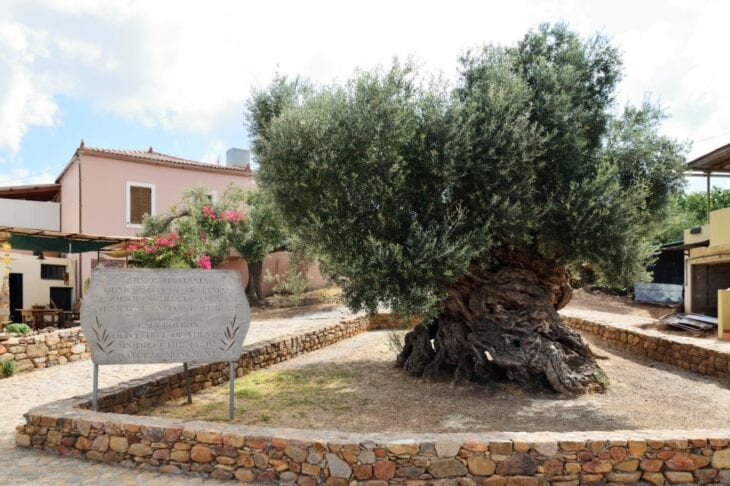
The grove itself stretches over 500 acres, not far from the Minoan village of Monastiraki. The base perimeters of the two survivors measure 18.80 and 19.40 meters. The Monastiraki Minoan Palace, around 1,000 meters from the grove, is a natural second stop in the neighbourhood.
The Monumental Olive Tree of Kavousi
The Monumental Olive Tree of Kavousi is the oldest tree in Crete, with an estimated age of 3,250 years. The Kavousi tree stands in Azorias, about one kilometre from Kavousi, and is also known as the Azorias Olive Tree. Growers propagated this mastoeidis – or mouratoelia – variety onto a wild olive rootstock, and that graft is regarded as the oldest surviving example of olive grafting.
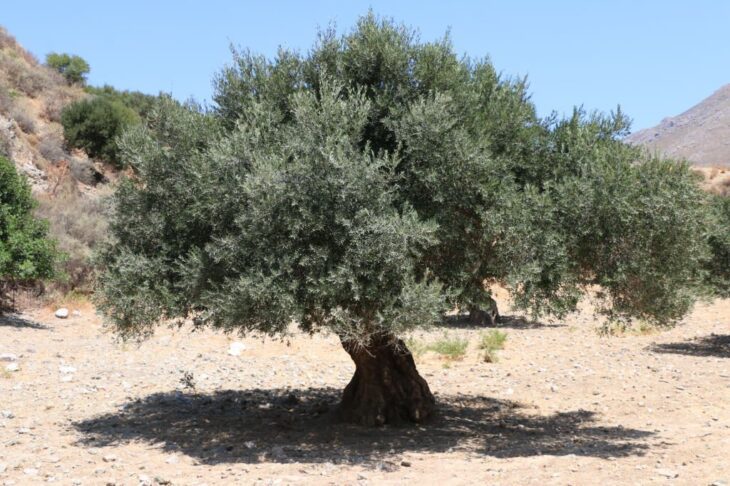
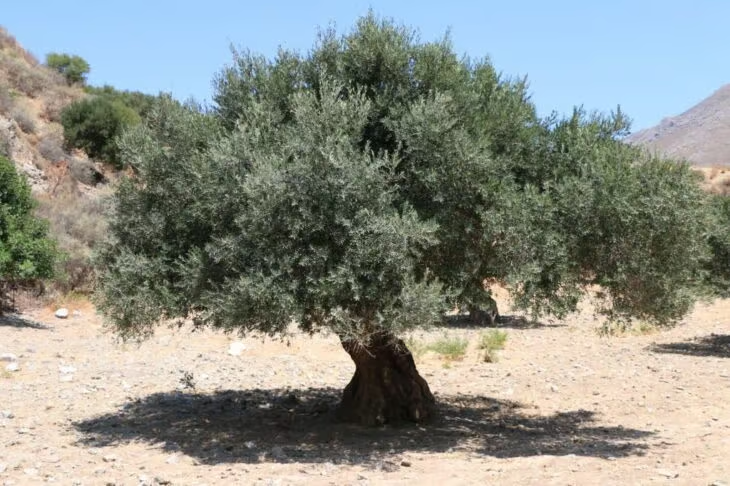
The tree measures a diameter of four to more than seven meters and a circumference of more than 22 meters at the base. The archaeological sites of Azorias and Vrontas and the ancient towns of Kastro all sit close by, so a single trip can cover all three.
The Sacred terebinth of Saint Fanourios
The sacred terebinth of Saint Fanourios grows about 100 meters from the church of Saint Fanourios, on the hill of Grivila near the village of Ahlade, and it anchors a religious custom that reaches back to Crete’s ancient tree-worship traditions. The terebinth is known as Evresi (Finding), because the miraculous icon of St. Fanourios is said to have been discovered here.
A walled enclosure at Evresi holds the “holy tree”, a terebinth (Pistacia terebinthus), together with a hollow rock and a shrine with an icon of St. Fanourios. According to legend, believers pass through the opening of the rock and then hang their garments and personal belongings on the tree to ward off disease and evil. The custom is a living survival of pre-Christian tree worship absorbed into Orthodox practice.
The Small Apples Of Kofinas
Every September 14th, on the Feast of the Holy Cross, dozens of people climb to the church of the Holy Cross on Kofinas, the tallest peak of the Asterousia range, to bless small apple-like fruits in a ritual that descends from Minoan nature and tree worship. The climb to Kofinas runs over a rocky path.
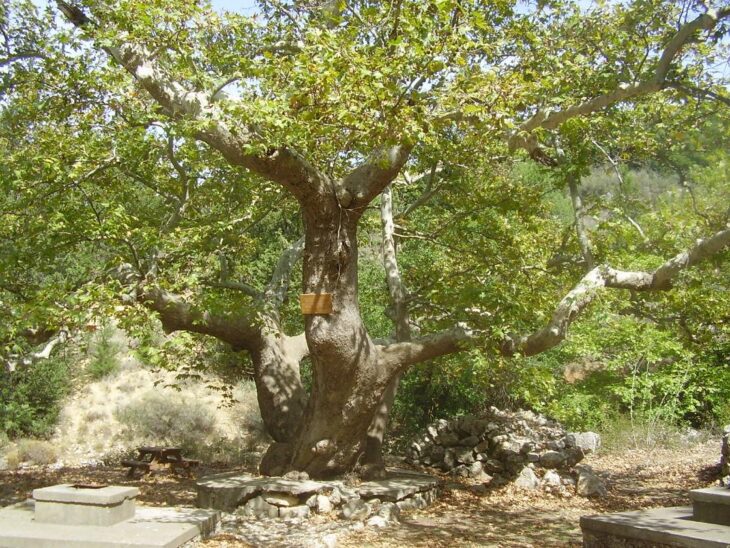
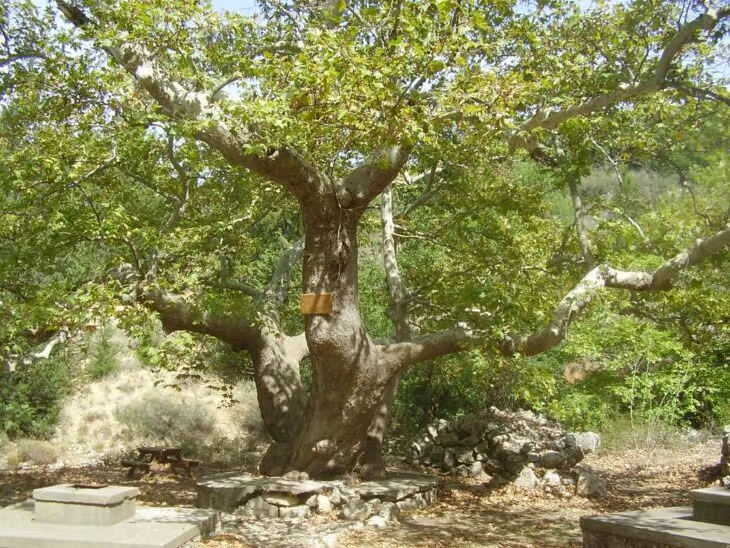
Three perennial whitebeams (Sorbus umbellata) grow on the north side of the mountain, and the locals call them “militses”, meaning small apple trees. The day before the feast, the locals pick the fruits, which look like little apples in cherry dimensions. They place the “apples” in a basket on top of Kofinas and present them to the priest in the morning.
After the doxology, the priest lifts the basket 3 times onto his head and blesses the fruits. He then distributes them to the attendees as “holy bread”. Many of them dry the apples and use them for medicine and other purposes.
The Sacred Plane Tree Keramota
A perennial plane tree of about 2,000 years grows at the eastern edge of the village of Keramota, in the region of Mylopotamos, and it holds the first temple ever built in Crete inside its hollow trunk. The Keramota tree belongs to the Platanus orientalis species and is the oldest recorded tree in the province of Mylopotamos.
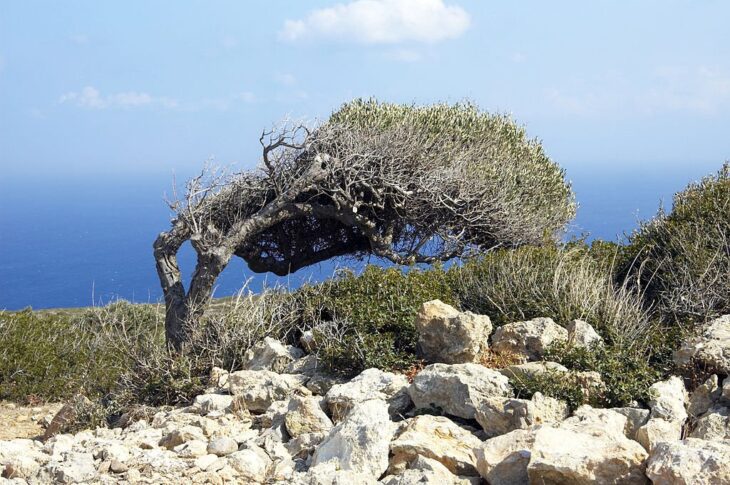
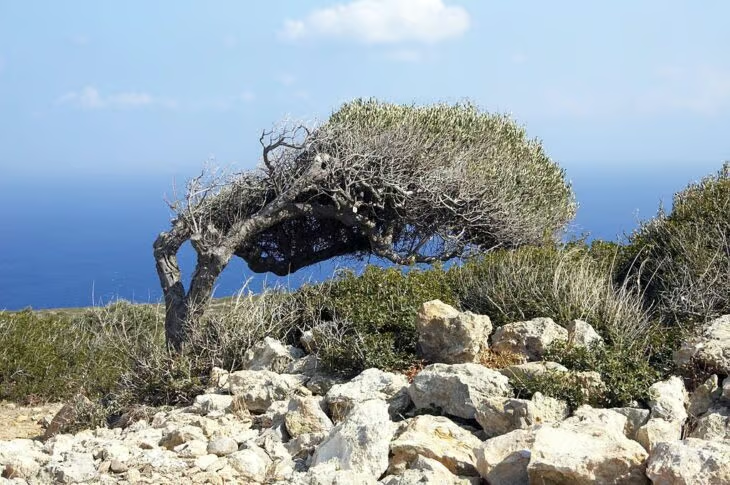
The trunk of the plane tree forms a very large cavity. A local built the first temple in Crete inside this trunk, positioning the hollow tree near the Panagia (Virgin Mary) and Saint Anne temples. While the trail to the trunk was being built, the floor was paved and icons were placed inside.
Other monumental trees worth a detour
ACOM has registered 2 more monumental olive trees that reward a detour, and each one is tied to a specific piece of Cretan history. The 2 trees, their locations and their historical role are listed below.
- Palea Roumata olive tree (Chania). This 3,000-year-old olive tree stands in the centre of Palea Roumata with a perimeter of 10.50 meters and a huge hollow in its trunk. Locals hid weapons inside that hollow during the Ottoman era, a committee against the German occupation met there in 1941, and the guns used in the battle of Anavos were hidden in the same cavity.
- Great Olive Tree of Aerinos. This monumental olive tree grows at an altitude of 700 meters near the settlement of Felesina, and its morphology is unusual: many stones are embedded directly in the trunk.
Which tree is the oldest in Crete?
The oldest tree in Crete is the Monumental Olive Tree of Kavousi, with an estimated age of 3,250 years. The Kavousi tree stands in Azorias, one kilometre from Kavousi, and is also known as the “Azorias Olive Tree”.
Where is the ancient olive tree in Crete?
Crete’s ancient olive trees stand in rural villages and archaeological sites across all four regional units, not inside the cities. The best-known are Vouves in the Kolymvari area of Chania, Vatolakkos and Palea Roumata in Chania, Amari in Rethymno, Kamilari and Gortyn in Heraklion, and Kavousi (Azorias) in Lassithi. Heraklion works as the practical base for reaching them, because it is the island’s main arrival and car rental hub rather than the location of the trees themselves.
Olive Harvesting in Crete
The olive harvest in Crete runs from late October through December and often into January, and it remains a hand-picked family tradition. Many people take a holiday from their jobs in towns and cities to join their family’s harvest. Most olives in Crete are harvested by hand with hand rakes.
Olive cultivation on the island reaches back to the Minoans, who gathered and processed olives and exported the oil, enriching the Minoan kingdom. Olive oil served the Minoans as a staple food and as a raw material for perfumes and medicines, which is one reason the olive tree was revered as a sacred gift from the gods.
Can you rent a car and visit the sacred trees of Crete?
Yes – renting a car is the most practical way to reach the sacred trees of Crete, because the trees are scattered across the island and most of them sit outside town centres with limited public transport. Buses often stop only at the nearest large town, which leaves travellers dependent on a taxi for the final stretch to the site. A rental car removes that gap and lets you combine several trees and archaeological sites in a single day.
Plan your visit. Most of the monumental trees stand in open, freely accessible village or grove locations, and the Mother Olive of Kamilari is listed as free to visit. Access varies: the Vatolakkos tree is easy to reach, while other trees sit on narrow rural roads that are more comfortable in a small car. Check seasonal opening hours for the nearby archaeological sites and for the Olive Tree Museum of Vouves before you set off, because their hours change through the year. Vehicle options and booking details are listed on Car Rental Crete.

How much does a car rental in Crete usually cost?
Crete car rental costs depend on the rental duration, the number of passengers, and the car category. Car rental in Crete for a week costs around €250 ($287.03, £211.88) for a four-seater with unlimited mileage. Day trips and night trips in Crete cost about €30 ($34.44, £25.43) to €40 ($45.92, £33.90). The rented cars come with manual or automatic transmission, air conditioning, and four doors. Return the car with the same amount of fuel as at the start of the trip to avoid extra charges.
Is car rental insurance required?
Yes, car rental insurance is required. You are liable for damage up to the full cost of the rented car if you decide not to add insurance. The minimum liability insurance required by the car rental company is typically included in the rental price, but it does not cover damage that you cause to the vehicle itself. In practice, you should hold car rental insurance on your rented car, whether it comes through the rental company, your own car insurance, your credit card, or an independent insurer. Accidents do occur, and if you are uninsured or your policy limits are exceeded, you may be left paying the bill yourself.