




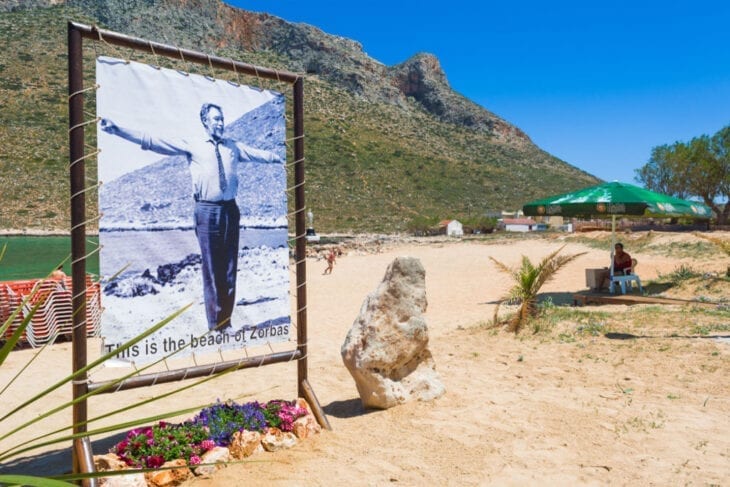
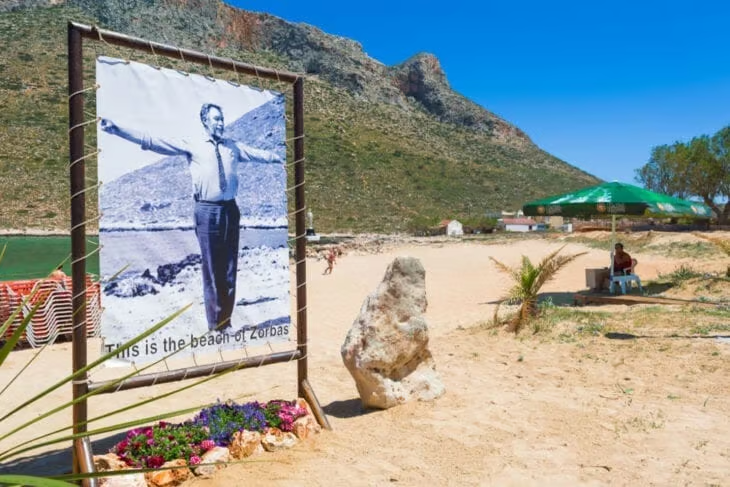
Zorba the Greek (1964) is the most famous movie filmed in Crete – shot at Stavros Beach near Chania and winner of three Academy Awards. Crete attracts international film productions with its diverse landscapes, ancient Minoan ruins, and Greece’s 40% EKOME production cash rebate, having hosted over 20 international and Greek productions – from Disney’s The Moon-Spinners (1964) to Amazon Studios’ Killer Heat (2023). This guide covers all 13 notable films shot on the island, their exact filming locations, IMDb scores, streaming availability, and how to visit the sets today.
Quick reference: all 13 movies filmed in Crete
| # | Film | Year | IMDb | Top filming location | Genre |
|---|---|---|---|---|---|
| 1 | The 11th Day: Crete 1941 | 2005 | 8.3 | Chania + WWII resistance sites | War documentary |
| 2 | The Moon-Spinners | 1964 | 6.5 | Elounda, Agios Nikolaos, Kritsa | Disney mystery-adventure |
| 3 | The Two Faces of January | 2014 | 6.2 | Knossos, Chalepa-Chania, Heraklion | Psychological thriller |
| 4 | Zorba the Greek | 1964 | 7.6 | Stavros Beach, Akrotiri, Kokkino Chorio | Drama |
| 5 | Days of ’36 | 1972 | 6.9 | Izzedin Fortress, Kalami | Political drama |
| 6 | The Last Note | 2017 | 7.6 | Chania prefecture, Izzeddin Fortress | Historical drama |
| 7 | He Who Must Die | 1957 | 7.5 | Kritsa village | Drama |
| 8 | Proti Fora Nonos / Little Greek Godfather | 2007 | 5.4 | Chania and surrounding villages | Comedy-drama |
| 9 | Summer Lovers | 1982 | 5.8 | Crete + Santorini, Mykonos | Romantic drama |
| 10 | God Loves Caviar | 2012 | 5.9 | Crete, Pylos, Aegina, Astrakhan | Biographical |
| 11 | 22 Bullets | 2010 | 6.6 | Cretan coastline (some scenes) | Crime thriller |
| 12 | El Greco | 2007 | 6.5 | Heraklion, Koules Fortress, Spain | Biographical |
| 13 | The Inbetweeners Movie | 2011 | 6.7 | Malia (setting); shot mainly in Spain | Comedy |
Which movies filmed in Crete are available to stream?
Five of the most-searched Crete films stream on major platforms in 2025; availability varies by region.
| Film | Netflix | Amazon Prime Video | Other platforms |
|---|---|---|---|
| Zorba the Greek (1964) | Check region | ✅ Rent / Buy | Criterion Channel |
| The Two Faces of January (2014) | ✅ (selected regions) | ✅ Rent / Buy | Apple TV |
| He Who Must Die (1957) | ❌ | ❌ | Criterion Channel |
| The Inbetweeners Movie (2011) | ✅ UK, IE | ✅ | Channel 4 (UK) |
| Killer Heat (2023) | ❌ | ✅ Prime Video original | – |
| The Moon-Spinners (1964) | ❌ | ✅ Rent / Buy | Disney+ (selected regions) |
| El Greco (2007) | Check region | ✅ Rent / Buy | – |
Streaming availability changes frequently and varies by country. Verify current options on JustWatch.com.
1. The 11th Day: Crete 1941 (2005)
The 11th Day: Crete 1941 is the highest-rated film on this list (IMDb 8.3/10) – a documentary about Crete’s civilian resistance against Nazi occupation, filmed at authentic WWII sites across the island.
The 2005 documentary, directed by Christos Epperson and written by Michael Epperson, recounts the Cretan civilian resistance against Nazi occupation during World War II. The 11th Day: Crete 1941 spans four years (1941–1945), documenting the courage of Cretan civilians and British Special Operations Executive (SOE) operatives through eyewitness interviews and reenactments.
Patrick Leigh Fermor – the British SOE operative behind the famous abduction of German General Heinrich Kreipe – anchors the documentary’s central narrative. Other contributors include George Tzitzikas, a local resistance hero, CIA historian Chase Brandon, and Professor Andre Gerolymatos, providing expert commentary.
The film was shot on location in Crete, with Chania and key resistance sites featured throughout. Production used authentic uniforms, weapons, and artefacts to ensure historical accuracy. Reenactments included Tyler Pawson as Billy Stanley Moss. Additional footage was filmed in Northern California to complement principal production. The 11th Day: Crete 1941 combines interviews, reenactments, and expert commentary; principal photography began in 2001 and the film was completed in 2005.
2. The Moon-Spinners (1964)
The Moon-Spinners (1964) was Disney’s first film shot in Crete, using Elounda and Agios Nikolaos as its primary backdrop – Walt Disney himself reportedly visited Neapoli during production.
The Moon-Spinners is a 1964 mystery-adventure produced by Walt Disney Productions and directed by James Neilson. Adapted from Mary Stewart’s 1962 suspense novel, it follows Nikky Ferris, a young Englishwoman who becomes entangled in a romantic and dangerous adventure involving stolen jewels while vacationing in Crete. The film marked Hayley Mills’s fifth Disney role and featured Pola Negri in her final screen performance.
The Moon-Spinners (1964) uses Elounda, near Agios Nikolaos, as its central backdrop, where the fictional Moon-Spinners Inn was set. Key scenes were filmed at the Vritomartes Taverna, the Panagia Kera Church in Kritsa (where Nikky discovers Mark wounded), and the Olous Archaeological Site, with its windmills appearing in the opening credits. Interior scenes were completed at Pinewood Studios in England.
Principal photography began on September 10, 1963, in Crete and wrapped in November. Studio work at Pinewood continued through January 1964. Hayley Mills stars as Nikky Ferris; Peter McEnery plays her romantic interest, Mark Camford; Eli Wallach plays the jewel thief, Stratos; Joan Greenwood appears as Aunt Frances; and Irene Papas plays Sophia. Pola Negri makes her final screen appearance as Madame Habib.
On IMDb, The Moon-Spinners holds 6.5/10 from over 3,100 user ratings. Although unrated on Rotten Tomatoes, it remains a beloved classic among fans of Hayley Mills and Disney’s live-action films of the era.
3. The Two Faces of January (2014)
The Two Faces of January (2014) filmed its Hitchcockian thriller across Chania’s Chalepa district, Heraklion, and the Minoan ruins of Knossos – earning an 80% critics score on Rotten Tomatoes.
The Two Faces of January is a 2014 psychological thriller written and directed by Hossein Amini, based on Patricia Highsmith’s 1964 novel. The film follows Chester MacFarland, a con artist; his wife, Colette; and Rydal Keener, a young tour guide, as they navigate a web of deceit, murder, and mistrust while travelling through Greece and Crete in 1962. The film channels Hitchcockian suspense through tense narrative pacing, complex characters, and authentic 1960s locations.
Extensive filming took place in Greece, particularly in Crete. Key scenes were shot in Chania, including the Chalepa district and old town, as well as in Heraklion and at the Minoan ruins of Knossos. These locations – along with Athens and Istanbul – ground the film’s 1962 period setting, with Knossos providing a visual metaphor for the Minoan labyrinth that mirrors the characters’ moral entrapment.
Principal photography began on October 1, 2012, covering locations in Greece, Crete, and Istanbul. Viggo Mortensen stars as Chester MacFarland, a morally ambiguous con artist. Kirsten Dunst plays Colette, his elegant yet fragile wife. Oscar Isaac portrays Rydal Keener, a tour guide drawn into their dangerous intrigue. The supporting cast includes Daisy Bevan, David Warshofsky, and Prometheus Aleifer.
On IMDb, The Two Faces of January holds 6.2/10. Rotten Tomatoes reports an 80% critic score based on 127 reviews, with an average rating of 6.75/10.
4. Zorba the Greek (1964)
Zorba the Greek (1964) won three Academy Awards, including Best Cinematography for scenes shot at Stavros Beach – Anthony Quinn’s Syrtaki dance there became one of cinema’s most iconic moments.
Zorba the Greek, directed by Michael Cacoyannis, is a 1964 drama film based on Nikos Kazantzakis’s 1946 novel The Life and Times of Alexis Zorba. The story follows Basil, a reserved English-Greek intellectual, and Alexis Zorba, a larger-than-life peasant, as they experience life, love, and loss in a small Cretan village.
Zorba the Greek (1964) transforms Stavros Beach into cinema’s most iconic Greek landscape. Key locations include Stavros Beach on the Akrotiri Peninsula (where the famous Syrtaki dance scene was filmed), Chania, Kokkino Chorio, and villages in the Apokoronas region. Filming began on March 9, 1964, primarily in Crete, to preserve the setting’s authenticity and align with the novel’s tone.
Anthony Quinn stars as Alexis Zorba, delivering a legendary performance embodying the character’s zest for life. Alan Bates plays Basil, the introverted writer. Irene Papas portrays the Widow, while Lila Kedrova – in her Oscar-winning role – plays Madame Hortense. Sotiris Moustakas appears as Mimithos.
The Walter Lassally story. Walter Lassally, who won the Academy Award for Best Cinematography for Zorba the Greek, later moved to Stavros permanently. He donated his Oscar statuette to a local taverna – a gesture suggesting the award belonged to the landscape itself. The statuette was destroyed in a fire on New Year’s Day 2012, but Stavros Beach remains one of cinema’s most storied locations and a place of pilgrimage for film fans.
On IMDb, Zorba the Greek holds 7.6/10. Rotten Tomatoes lists a 90% critics’ score and an 87% audience score. The film won three Academy Awards in 1965 – Best Supporting Actress (Lila Kedrova), Best Cinematography (Walter Lassally), and Best Art Direction (Vassilis Photopoulos) – and was nominated for Best Picture and Best Actor (Anthony Quinn).
5. Days of ’36 (1972)
Days of ’36 (1972) is the first film in Theo Angelopoulos’s acclaimed history trilogy, with key scenes filmed at the Izzedin Fortress in Kalami, near Chania.
Days of ’36, directed by Theo Angelopoulos, is a 1972 Greek dramatic art film and the opening chapter of Angelopoulos’s history trilogy. Set in 1936 during the political unrest preceding Ioannis Metaxas’s dictatorship, the story follows Sofianos, a political prisoner accused of murdering a trade unionist, who takes a government official hostage to demand his release. Key scenes were filmed in Crete at the Izzedin Fortress in Kalami, near Chania – a former Turkish fort historically used to detain communist political prisoners.
The film blends political allegory with experimental storytelling. Angelopoulos’s distinctive style includes long takes, sparse dialogue, and symbolic imagery, creating a layered narrative described as “the aesthetic of the unspoken.” Filming took place in 1972 under Greece’s military dictatorship, with Angelopoulos using subtle techniques to avoid censorship. Kostas Pavlou plays Sofianos with restrained intensity, embodying the character’s tension and ambiguity.
The supporting cast includes Thanos Grammenos, Giorgos Kyritsis, Petros Zarkadis, Christoforos Neezer, and Toula Stathopoulou – understated performances aligned with the film’s minimalist vision. On IMDb, Days of ’36 holds 6.9/10. No Rotten Tomatoes score is available, but the film is widely regarded as a landmark in Greek cinema and a precursor to Angelopoulos’s later masterpieces.
6. The Last Note (2017)
The Last Note (2017) recreates the 1944 execution of 200 Greek resistance fighters at the Izzeddin Fortress near Chania, where the real events occurred.
The Last Note (To Teleftaio Simeioma), directed by Pantelis Voulgaris, is a Greek drama film based on the true story of the execution of 200 Greek political prisoners by German occupiers in 1944, in reprisal for the killing of a German general by Greek partisans. The film was shot on location in Crete – particularly in the prefecture of Chania, where the real events unfolded – and explores themes of resistance, sacrifice, and human dignity during World War II.
Filming took place in 2017 with meticulous attention to historical accuracy. Andreas Konstantinou leads the cast as Napoleon Soukatzidis, a resistance fighter who served as interpreter for the Germans. Other cast members include André Hennicke, Melia Kreiling, and Vassilis Koukalani. On IMDb, The Last Note holds 7.6/10, reflecting strong critical acclaim within the historical-drama genre.
7. He Who Must Die (1957)
He Who Must Die (1957) was filmed in Kritsa, one of Crete’s oldest villages, and is based on Nikos Kazantzakis’s novel Christ Recrucified.
He Who Must Die (Celui qui doit mourir), directed by Jules Dassin, is a French-Italian drama based on Nikos Kazantzakis’s novel Christ Recrucified. Set in a Turkish-occupied Greek village after World War I, it follows villagers staging a Passion Play that mirrors their rebellion against oppression. The film was shot in Crete, specifically in the fictional village of Lykovryssi (filmed at Kritsa), with scenes capturing the island’s rugged landscapes and traditional architecture.
The film carries strong allegorical and religious themes. Filming occurred in 1957, during Dassin’s exile from Hollywood due to the McCarthy-era blacklist. Jean Servais leads as Father Fotis, supported by an ensemble cast including Melina Mercouri, Pierre Vaneck, and Gert Fröbe. On IMDb, He Who Must Die holds 7.5/10 and is available on the Criterion Channel.
8. Proti Fora Nonos / Little Greek Godfather (2007)
Proti Fora Nonos (2007) is a comedy-drama set entirely in Crete, following an 11-year-old boy sent to baptize a child while navigating local traditions and feuding villages.
Proti Fora Nonos (The Little Greek Godfather), directed by Olga Malea, is a lighthearted comedy-drama about an 11-year-old boy named Alex, who travels to Crete to stand in for his father as a godfather during a baptism while navigating local politics and feuding villages. The film captures Cretan villages and landscapes that enhance the cultural authenticity of the story, with humour and heartfelt moments about family and identity.
Filming took place in 2007 in Chania and surrounding areas. Young actor Tex Pardue leads the cast, with supporting roles from Antonis Kafetzopoulos, Eleni Kastani, and Giorgos Kimoulis. On IMDb, Proti Fora Nonos holds 5.4/10.
9. Summer Lovers (1982)
Summer Lovers (1982) is a romantic drama starring Peter Gallagher and Daryl Hannah, primarily filmed on Santorini with additional scenes shot in Crete.
Summer Lovers, directed by Randal Kleiser, is an American romantic comedy-drama about a young American couple who form a love triangle with a French archaeologist while vacationing on the Greek islands. Although primarily filmed on Santorini, the production used Crete to broaden the cultural and geographical scope. The film examines love, freedom, and self-discovery against Greece’s picturesque backdrop.
Filming took place across 1981–1982. Peter Gallagher, Daryl Hannah, and Valérie Quennessen portray the central trio navigating an unconventional relationship. IMDb rates the film 5.8/10, while Rotten Tomatoes assigns a 22% critics’ score and 45% audience score.
10. God Loves Caviar (2012)
God Loves Caviar (2012) takes its cameras across Crete, Pylos, Aegina, and Astrakhan (Russia) to reconstruct the life of Ioannis Varvakis, Greek pirate and global caviar merchant.
God Loves Caviar, directed by Yannis Smaragdis, is a historical biographical film about Ioannis Varvakis, a Greek pirate-turned-businessman who became a major figure in the global caviar trade and a philanthropist during the 18th century. Production took place in 2012 and features an international cast led by Sebastian Koch as Varvakis, supported by Catherine Deneuve, John Cleese, Juan Diego Botto, and Olga Sutulova.
The film’s blend of adventure, biography, and historical drama captures Varvakis’s inspiring life story. On IMDb, God Loves Caviar holds 5.9/10; Rotten Tomatoes records a 46% audience score, reflecting mixed reviews.
11. 22 Bullets (2010)
22 Bullets (2010) is a French gangster thriller starring Jean Reno – primarily set in Marseille, with a small number of scenes shot in Crete to reinforce the Mediterranean atmosphere.
22 Bullets (L’Immortel), directed by Richard Berry, is a French gangster-action thriller inspired by real-life events in the Marseille mafia. The film follows Charly Matteï, a retired mobster who survives being shot 22 times and embarks on a quest for revenge. 22 Bullets (2010) uses Crete’s Mediterranean coastline to reinforce the film’s southern European crime atmosphere, complementing its primary Marseille setting.
Filming took place in 2010, with Jean Reno delivering a powerful performance as Charly Matteï. The supporting cast includes Kad Merad, Marina Foïs, and Jean-Pierre Darroussin. On IMDb, 22 Bullets holds 6.6/10.
12. El Greco (2007)
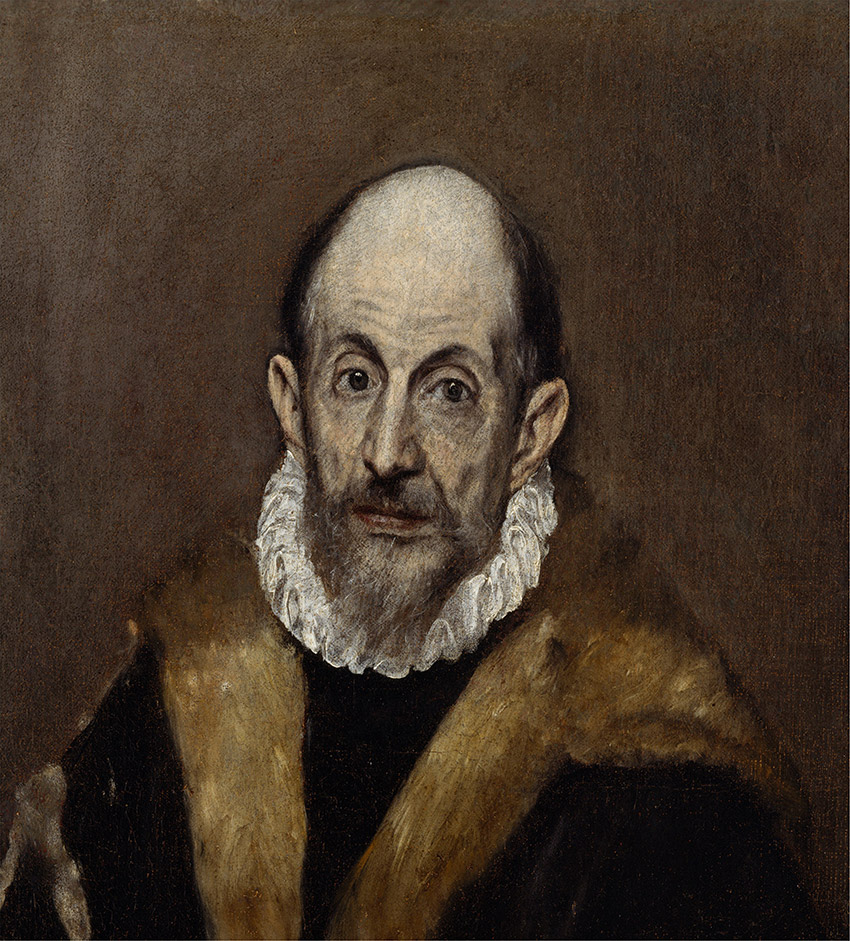
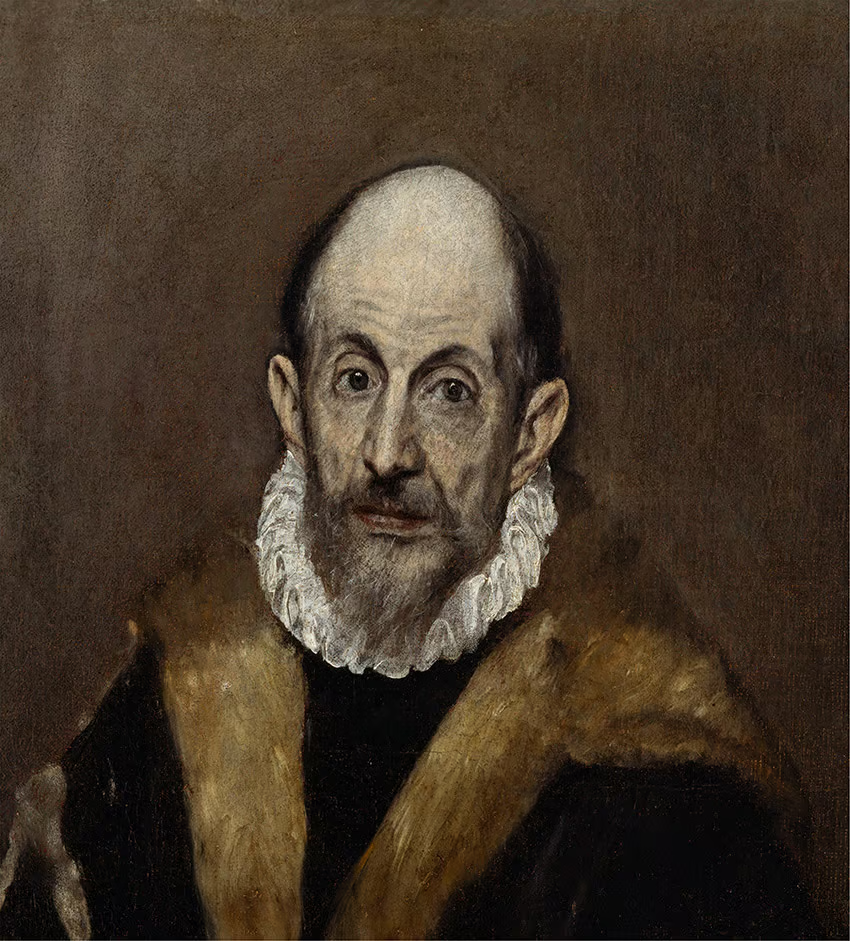
El Greco (2007) was filmed in Heraklion (including the Koules Fortress) and Spain, telling the story of Cretan painter Doménikos Theotokópoulos’s rise during the Renaissance.
El Greco (2007) is a biographical film about the life of the renowned artist Doménikos Theotokópoulos, known as El Greco. Directed by Yannis Smaragdis, the film portrays Theotokópoulos’s pursuit of artistic freedom as he moves from Crete to Venice and Toledo, facing the challenges of the Spanish Inquisition.
Filming took place in Crete – particularly in Heraklion and at the Koules Fortress – and in Spain to depict his later years. Released in 2007, the biographical drama explores art, faith, and freedom. Nick Ashdon stars as El Greco, joined by Juan Diego Botto, Laia Marull, Lakis Lazopoulos, and Sotiris Moustakas. The film holds 6.5/10 on IMDb and has won multiple Greek and international awards.
13. The Inbetweeners Movie (2011)
The Inbetweeners Movie (2011) is set in Malia, Crete, but principal photography took place in Magaluf, Majorca (Spain) – a production logistics decision common in the industry.
The Inbetweeners Movie is a British coming-of-age comedy based on the E4 sitcom The Inbetweeners. It follows four friends – Will, Simon, Jay, and Neil – on a chaotic post-graduation holiday in Malia, Crete. Their misadventures include partying, romance, and embarrassing antics that capture the humour and awkwardness of adolescence.
The film is set in Malia, Crete (the TV series famously featured Crete’s resort strip), but production logistics meant principal photography took place in Magaluf, Majorca (Spain), which offered similar Mediterranean resort aesthetics at lower cost. A limited number of establishing scenes were filmed on location in Crete itself. Filming began in May 2011 during Crete’s peak tourist season, with additional work completed off-season for logistical needs.
Director Ben Palmer brought back the original cast – Simon Bird, James Buckley, Blake Harrison, and Joe Thomas – from the TV series. IMDb gives the film 6.7/10; Rotten Tomatoes rates it 54% from critics and 72% from audiences.
Recent and upcoming films in Crete (2023–2025)
Since 2022, Crete has hosted a new wave of international productions – including Amazon Studios’ Killer Heat, the Nicolas Cage feature The Carpenter’s Son, and the Greek production Kapetan Michalis – driven by the EKOME 40% cash rebate and growing film tourism in Crete.
| Film | Year | Director / Studio | Stars | Crete locations |
|---|---|---|---|---|
| Killer Heat | 2023 | Amazon Studios (Philippe Lacôte) | Shailene Woodley, Richard Madden, Joseph Gordon-Levitt | Heraklion, Agios Nikolaos |
| The Carpenter’s Son | 2023–2024 | Lotfy Nathan | Nicolas Cage | Sfakian Madares mountains (1,900 m altitude) |
| Kapetan Michalis | 2023 | Greek production | Greek ensemble cast | Lasithi, Heraklion, Rethymno, Chania |
The Carpenter’s Son is notable for filming at 1,900 metres in the Sfakian Madares mountains – scenes described by producers as “an otherworldly, lunar landscape captured on camera for the very first time.” These newer productions confirm Crete’s accelerating role in international cinema, supported by EKOME’s incentive scheme and the Crete Film Office.
Why is Crete a popular filming destination?
Crete attracts international productions through Greece’s EKOME cash rebate scheme (up to 40% of qualifying expenses), combined with a mild Mediterranean climate, diverse landscapes, and experienced local crews available year-round.
The island offers a wide variety of settings – beaches, mountains, historical villages, Venetian fortresses, and ancient Minoan ruins – supporting genres from historical epics to modern thrillers and romantic dramas. Year-round filming is supported by Crete’s mild climate and long daylight hours, ideal for outdoor shoots.
EKOME 40% cash rebate. Greece’s EKOME (National Center of Audiovisual Media and Communication) offers a cash rebate of up to 40% on qualifying production expenses – one of Europe’s most competitive film incentive programs. For a €5 ($5.74, £4.24) million production, this rebate represents up to €2 ($2.30, £1.70) million returned directly to the producer, making Crete cost-competitive with major European filming destinations such as Malta, Spain, and Croatia.
Logistical advantages add to the appeal. Crete is served by international airports in Heraklion and Chania and three ferry ports (Heraklion, Souda, Rethymno). Local production companies and the Crete Film Office assist with location scouting and permits. Skilled crews, English fluency, and decades of accumulated experience working with international productions make collaboration smooth.
What is the importance of Crete’s geography for movies?
Crete’s geography combines rugged mountains, fertile valleys, gorges, and beaches, providing natural backdrops without artificial set construction. Iconic sites like Samaria Gorge, the White Mountains, and the ruins of Knossos serve as ready-made settings for historical epics, adventure films, and dramas. The Mediterranean climate, with year-round sunlight and mild weather, supports filming in any month. Crete’s location at the crossroads of Europe, Africa, and Asia adds layered cultural influences from Minoan, Venetian, and Ottoman civilizations – a depth few European islands offer.
What genres of movies were shot in Crete?
Crete’s history and landscapes make it an exceptional setting for films across many genres:
- Historical drama – El Greco (2007), He Who Must Die (1957) draw on Crete’s Venetian and Ottoman heritage and ancient Minoan landmarks.
- War film – The 11th Day: Crete 1941 (2005) and The Last Note (2017) focus on Crete’s role in World War II, particularly the Battle of Crete and the Cretan resistance.
- Mystery & adventure – The Moon-Spinners (1964) and The Two Faces of January (2014) use the island’s gorges, ruins, and old towns for treasure-hunt and intrigue plots.
- Romantic drama – Summer Lovers (1982) and elements of Zorba the Greek (1964) feature Crete’s beaches, villages, and sunsets.
- Comedy – Proti Fora Nonos (2007) and The Inbetweeners Movie (2011) draw on local customs and resort culture.
- Thriller / crime – 22 Bullets (2010) leverages Mediterranean coastline aesthetics.
Most famous filming locations in Crete
Stavros Beach, the ruins of Knossos, the Old Town of Chania, Izzeddin Fortress, and Spinalonga are Crete’s five most-filmed locations – each appearing in multiple productions and accessible to tourists year-round.
Stavros Beach – Zorba the Greek
Stavros Beach, on the Akrotiri Peninsula near Chania, is Crete’s single most cinematic location – Anthony Quinn performed the Zorba the Greek Syrtaki dance here in 1964. Cinematographer Walter Lassally won the Best Cinematography Oscar for that scene and later retired to Stavros, donating his Academy Award statuette to a local taverna; the statuette was destroyed in a fire on New Year’s Day 2012, but the beach remains a place of cinematic pilgrimage.
Knossos ruins – Minoan civilization on film
The ruins of Knossos, near Heraklion, are Crete’s most famous archaeological site and the heart of the Minoan civilization. The Two Faces of January (2014) used Knossos as a visual metaphor for the labyrinthine moral entrapment of its characters, and the site routinely appears in documentary work referencing the myth of the Minotaur.
Old Town Chania and Izzeddin Fortress
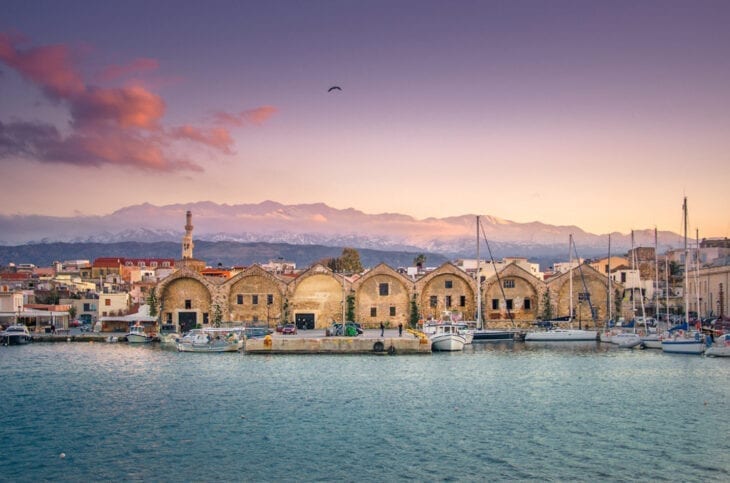
The Old Town of Chania, with its Venetian harbour and narrow streets, served as a setting for The Two Faces of January (2014). The Izzeddin Fortress at Souda – a former Turkish fort used historically to detain political prisoners – appeared in Days of ’36 (1972) and provided the historical backdrop for The Last Note (2017).
Elounda and Spinalonga – The Moon-Spinners and The Island
Elounda and the small island of Spinalonga – Crete’s former leper colony – appear in Disney’s The Moon-Spinners (1964) and the Greek TV drama To Nisi (The Island, 2010). The location is now one of Crete’s top tourist destinations, accessible by boat from Plaka and Elounda harbours.
Malia – The Inbetweeners Movie
Malia’s nightlife strip is the setting of The Inbetweeners Movie (2011). Despite the on-screen Crete setting, principal photography occurred in Magaluf, Majorca – though Malia’s resort culture inspired the film’s tone and the original TV series did film some sequences on location.
Can tourists visit movie sets in Crete?
Yes – most filming locations are open to the public year-round, and several offer guided film-tour itineraries. Stavros Beach (Zorba), the Knossos ruins (Two Faces of January), Chania Old Town (multiple), Spinalonga (The Island), and Kritsa (Moon-Spinners, He Who Must Die) are all accessible without special permits. Guided film-location tours run from Chania and Heraklion, often combining multiple sites with cultural and historical commentary.
A rental car is the most flexible way to combine film locations across the island – Stavros, Knossos, and Kritsa are spread across all four prefectures, and public bus connections between them are limited.
TV shows filmed in Crete
Crete has been the setting for three major BBC productions and Greece’s most expensive domestic TV series – To Nisi (The Island) – all using the island’s Spinalonga and Elounda coastline.
Who Pays the Ferryman? (BBC, 1977)
A BBC drama filmed near Elounda and Agios Nikolaos, Who Pays the Ferryman? follows Alan Haldane, a former British soldier returning to Crete after 30 years to confront his wartime past and find belonging. The series integrated local history, folklore, and scenery, with filming at the Ferryman Taverna and Heraklion Airport.
The Lotus Eaters (BBC, 1972)
Another BBC series filmed in Agios Nikolaos, The Lotus Eaters tells the story of Erik and Ann Shepherd, a British couple managing a taverna while dealing with espionage and psychological drama. The series remains a cult favourite among British viewers of mid-1970s drama.
To Nisi / The Island (Greek drama, 2010)
The Greek TV series To Nisi, based on Victoria Hislop’s bestselling novel The Island, was shot entirely in Crete and features Plaka, Elounda, Agios Nikolaos, and Spinalonga Island, the former leper colony. The show examines love, grief, and resilience among families affected by leprosy. Directed by Thodoris Papadoulakis and starring Stelios Mainas and Katerina Lehou, To Nisi is one of Greece’s most expensive domestic TV productions.
Greek films shot in Crete
Several notable Greek films draw directly on Crete’s cultural heritage, landscapes, and historical significance:
- Zorba the Greek (1964) – Iconic Cacoyannis film based on Kazantzakis’s novel; filmed at Stavros Beach (Akrotiri), Kokkino Chorio, and Chania. IMDb 7.6/10.
- El Greco (2007) – Biographical drama about the Cretan-born Renaissance painter; scenes shot in Heraklion, including the Koules Fortress. IMDb 6.5/10.
- He Who Must Die (1957) – Adapted from Kazantzakis’s Christ Recrucified; filmed in Kritsa village. IMDb 7.5/10.
- The Last Note (2017) – WWII drama on the execution of 200 Greek resistance fighters; filmed at the Izzeddin Fortress near Chania. IMDb 7.6/10.
- Proti Fora Nonos (2007) – Comedy filmed in Chania and surrounding areas; about a young godfather navigating Cretan traditions. IMDb 5.4/10.
Sources and notes
EKOME (National Center of Audiovisual Media and Communication) – official Greek film incentive program details at ekome.media. IMDb ratings sourced from imdb.com. Rotten Tomatoes scores from rottentomatoes.com. Production details verified against published Wikipedia film articles. Film availability on streaming platforms changes frequently and varies by country. IMDb scores and Rotten Tomatoes ratings reflect data as of January 2025. The Inbetweeners Movie (2011) was set in Malia, Crete, but principal photography occurred in Magaluf, Majorca – a production-logistics decision common in the industry. All other films on this list were principally shot in Crete.