





The Labyrinth of the Minotaur is a Greek myth, not a historical record. It tells of a bull-headed monster confined beneath the palace of King Minos on Crete, and two real Cretan sites are most often linked to the legend today. Knossos, the excavated Minoan palace, sits 5 km (3.11 miles) from Heraklion, about a 10-minute drive, close enough for a rental car to cover in a fraction of the time a coach tour needs. Gortyn and the Messara plain, home to the myth’s main rival site, lie 43 km (26.72 miles) south of Heraklion, a 42-minute drive with no direct fast bus route, which is why a car is what turns a Knossos morning into a two-site day.
The Minotaur, in Greek Myth
The Minotaur was a monster of Greek mythology, half man and half bull, born to Queen Pasiphae of Crete after Poseidon punished her husband, King Minos. Minos had asked Poseidon for a bull as a sign of his right to the throne, promising to sacrifice it in the god’s honor. Minos kept the bull instead, and Poseidon retaliated by making Pasiphae fall in love with it. Their union produced Asterion, the Minotaur’s other name, meaning “the starry one.” Ovid’s Metamorphoses and Plutarch’s Life of Theseus preserve the story alongside a longer oral tradition, and no single ancient author claims to have invented it.
This article treats the Minotaur, Theseus, Ariadne and the Labyrinth as Greek mythology, not history. Knossos and the Gortyn cave are real archaeological sites; any link between them and the myth is a scholarly interpretation, not a proven fact, and this article marks that distinction throughout.
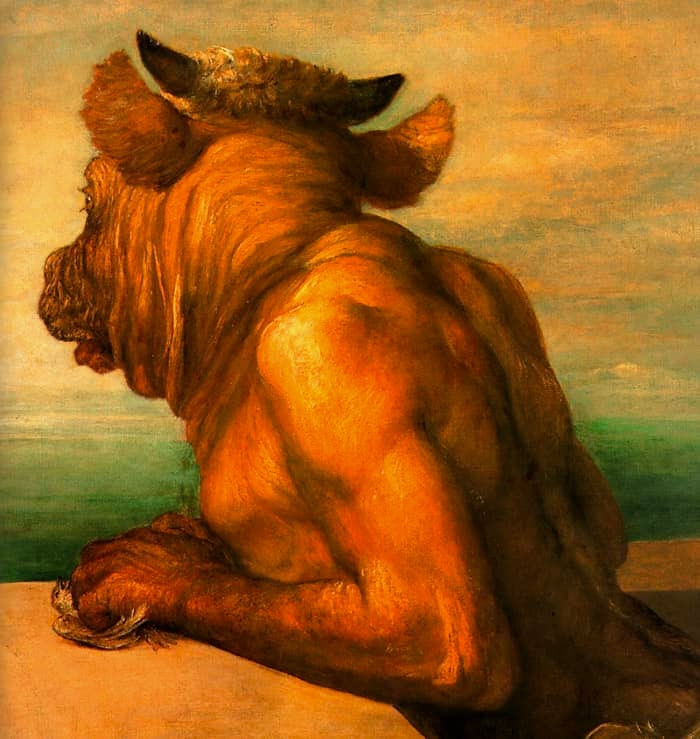
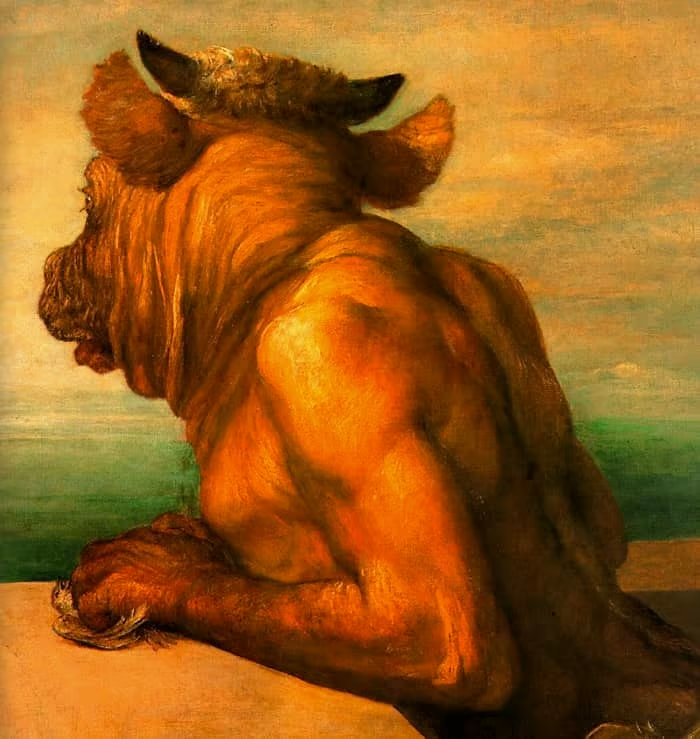
What Did the Minotaur Look Like?
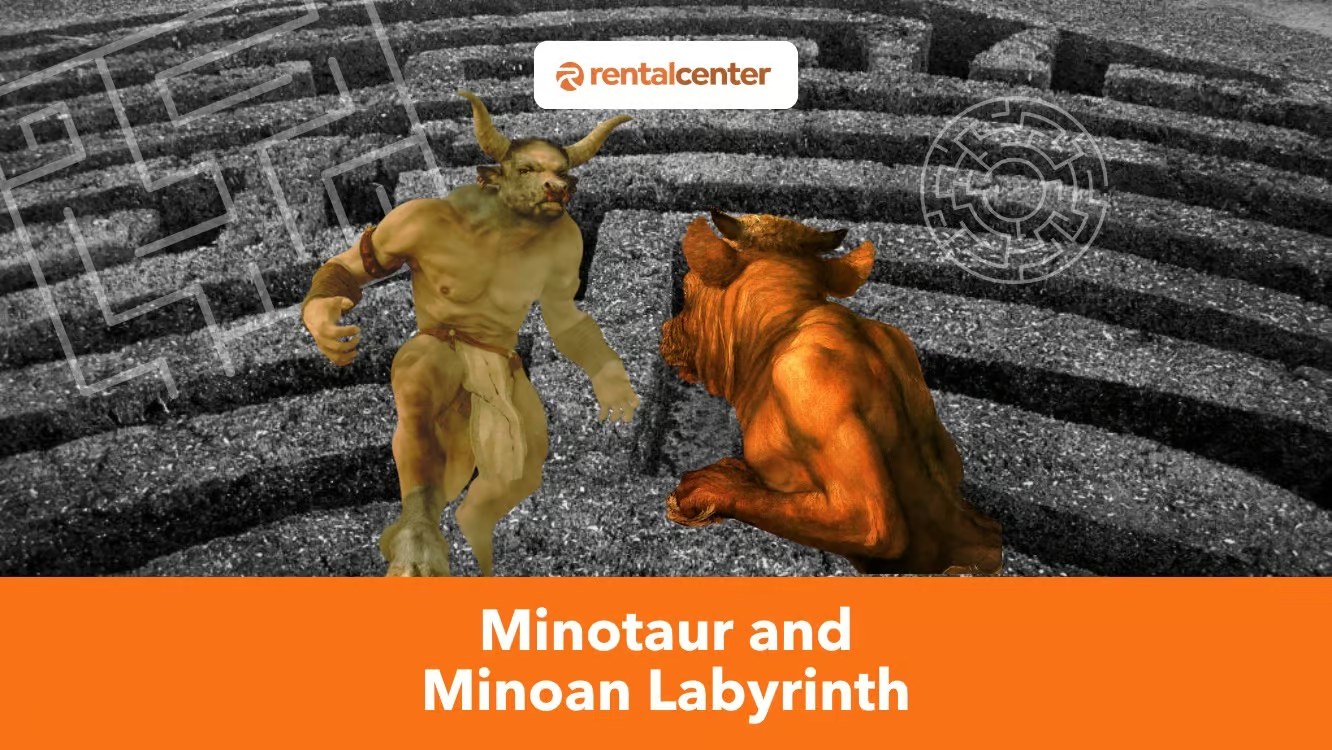
The Minotaur combined human and animal features: a muscular man’s body with broad shoulders and a bull’s head. Large, curved horns projected from its skull, and its face carried a bull’s flat snout and wide nostrils. Coarse fur covered its head and neck in most depictions, and some ancient artists gave it a bull’s hooves or tail below an otherwise human torso.

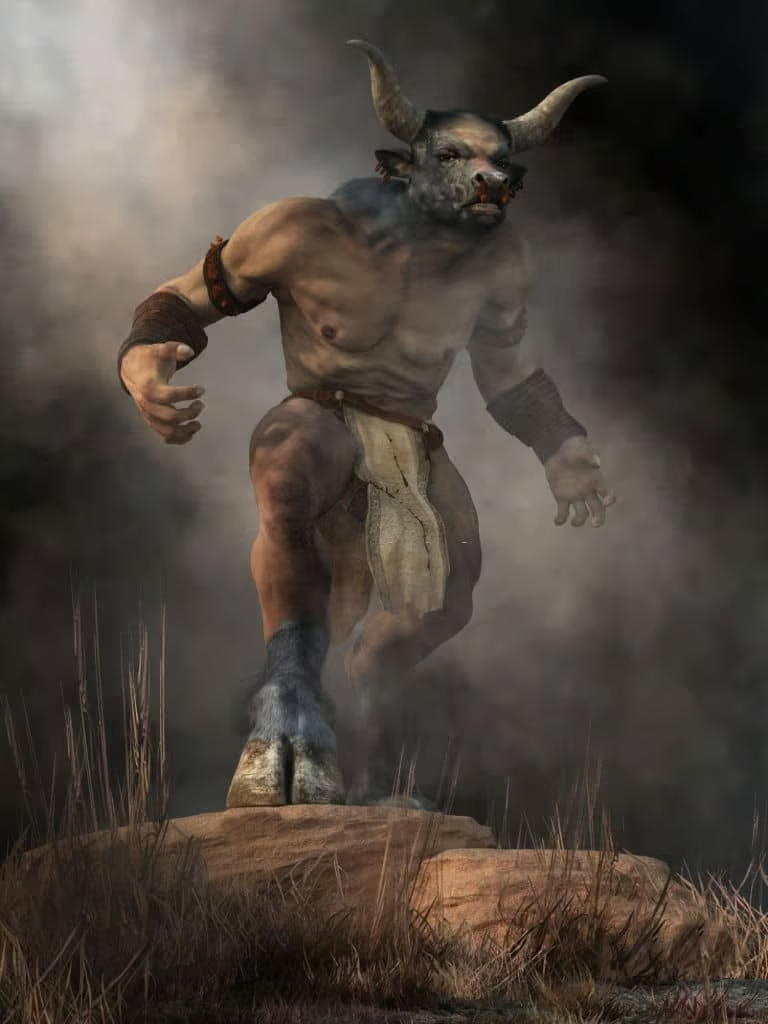
The Labyrinth: Daedalus’s Maze in Myth
Daedalus built the Labyrinth, a maze so intricate that no one held inside could find the way out, on King Minos’s orders. Minos hid the Minotaur inside it once the creature developed a hunger for human flesh, and the maze served two purposes at once: concealing the Minotaur’s existence and preventing its escape. Minos later used it to punish Athens, sending each round of tribute victims into the maze to wander until the Minotaur hunted them down.
Where Does the Word “Labyrinth” Come From?
The word “labyrinth” comes from Bronze Age Crete: it is already written on Linear B clay tablets from Knossos, though its deeper origin is still disputed. The clearest of these tablets, KN Gg 702, records one jar of honey “to the Lady of the Labyrinth” and the same amount “to all the gods”. The tablet is usually dated to around 1375-1350 BC, and some scholars place it later, in the 13th century BC. The term appears on 3 Knossos tablets in all (Gg 702, Oa 745 and Xd 140), and linguists still debate how one of its signs should be read. A tablet from Pylos on the Greek mainland, Cn 1287, carries a scribe’s drawing of a maze on its back, dated to the 13th century BC.
Linear B tablets survive in large numbers. Scholars now know more than 5,000 of them, and the Ashmolean Museum in Oxford, which holds Arthur Evans’s archive, says Evans alone found more than 4,000 at Knossos.
The word’s etymology remains unsettled. In 1892, one scholar first proposed linking Greek labyrinthos to labrys, a Lydian word for a double-headed axe, and Sir Arthur Evans developed the idea further after finding double-axe carvings on the walls at Knossos, arguing that “labyrinth” originally meant “house of the double axe.” Linear B specialist A. P. Judson, in a 2017 study of the tablets, calls that double-axe origin “highly doubtful” and notes that no secure etymology has been established. Philologist R.S.P. Beekes proposes instead a link to the Greek word laura, “narrow street.” Neither theory is settled.
Herodotus, writing in the 5th century BC, is the earliest surviving Greek author to describe a labyrinth as a building of confusing passages, roughly 1,000 years after the Minoan palaces fell. Pliny the Elder later listed 4 famous labyrinths in his Natural History (36.19): Hawara in Egypt, Lemnos, the tomb of Lars Porsena at Clusium in Italy, and Crete. Modern English collapses a useful ancient distinction: a maze offers multiple paths and dead ends, while a labyrinth, in the stricter sense, has a single winding path to the center.
Did Knossos Put the Labyrinth on Its Coins?
Yes, Knossos struck the labyrinth on its coins from the 5th century BC until its mint closed in 67 BC. Studies date the first labyrinth coins to between about 470 and 425 BC. Most Knossian coin labyrinths are square or meander designs, while a round labyrinth appears only on one short issue in the late 2nd century BC. Numismatists M. I. Stefanakis and N. P. M. Konstantinidi, writing in the journal Fortunatae in 2020, found that the mint’s engravers “did not maintain a specific image of the Labyrinth.” A silver stater of Knossos dated 425-360 BC, held at Harvard Art Museums, shows the running Minotaur on one side and a meander-pattern labyrinth on the other.
Who Killed the Minotaur?
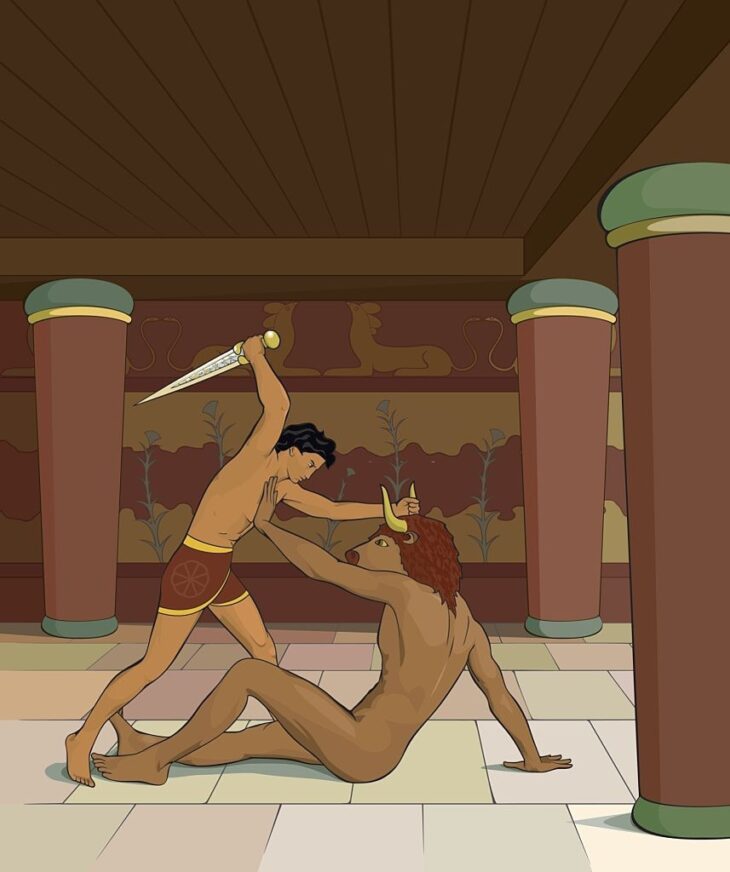
Theseus, the prince of Athens, killed the Minotaur inside the Labyrinth. He had volunteered as one of the tribute victims specifically to end Athens’s obligation to Crete. Ariadne, King Minos’s daughter, fell in love with him on his arrival and gave him a sword and a ball of thread. Theseus tied one end of the thread at the entrance, unwound it as he went deeper into the maze, found and killed the sleeping Minotaur at its center, then followed the thread back out and escaped Crete with Ariadne and the freed Athenian youths.
The Death of Androgeos and the Tribute
Androgeos, King Minos’s son, was killed in Athens, and his death is why Athens owed Crete a blood tribute. Ancient sources disagree on how he died: some blame jealous rivals who killed him after he won every event at the Panathenaic Games, others say King Aegeus sent him to face the Marathonian Bull, which killed him instead. Minos went to war over his son’s death and won, then demanded that Athens send seven young men and seven young women every nine years to be fed to the Minotaur, a term some later sources give as an annual tribute instead.
Can You Visit the Labyrinth of the Minotaur Today?
No single Labyrinth survives to visit, since it exists only in myth, but 3 real Crete sites are linked to it: Knossos Palace is open with timed tickets, the main Gortyn cave is sealed, and Skotino Cave is unstaffed. The table below compares the 3 candidate sites by their real remains, who linked them to the myth, access today and driving distance from Heraklion.
| Site | Real remains | Linked to the myth by | Open to visitors today | Distance from Heraklion |
|---|---|---|---|---|
| Knossos Palace | Minoan palace of about 22,000 m², excavated from 1900 | Sir Arthur Evans’s excavations (interpretation, debated) | Yes, timed tickets, €20 ($22.96, £16.95) full, €10 ($11.48, £8.48) reduced | 5 km (3.11 miles), about 10 min by car |
| Labyrinth Cave, Gortyn | Roman-era quarry tunnels, at least 3 caves | 15th-19th century travelers (Buondelmonti, Tournefort, Spratt) | Main cave sealed since WWII; the 120 m Little Labyrinth can be entered | 43 km (26.72 miles), about 42 min by car |
| Skotino Cave | Natural cave descending 4 levels, chapel of Agia Paraskevi at the entrance | Paul Faure (second half of the 20th century) | Unstaffed and free, enter at your own risk | 27 km (16.78 miles), about 35 min by car |
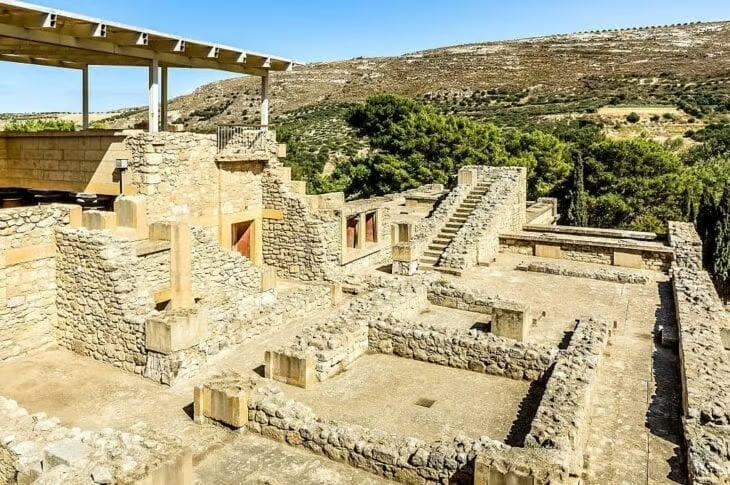
Knossos: the Palace Popularly Linked to the Myth
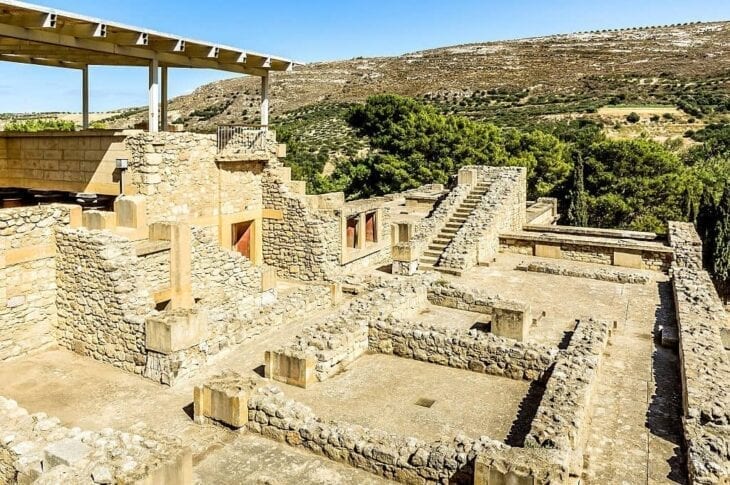
Knossos is the Minoan palace most often named as the myth’s real-world source, and it welcomes visitors today. Minos Kalokairinos, a Cretan merchant and antiquarian, made the first excavations on the Kephala hill in 1878 after Heinrich Schliemann’s discoveries at Troy and Mycenae persuaded him a palace might really be buried on the site; Ottoman authorities stopped his excavation soon after. Sir Arthur Evans visited in 1894, bought the land once Crete gained independence, and excavated the palace from 1900 in campaigns that ran until 1931, naming the civilization he uncovered “Minoan” after King Minos. Evans found double-axe carvings and a multi-storey complex of about 22,000 m², with 4 wings of rooms, corridors and stairways around a central court.
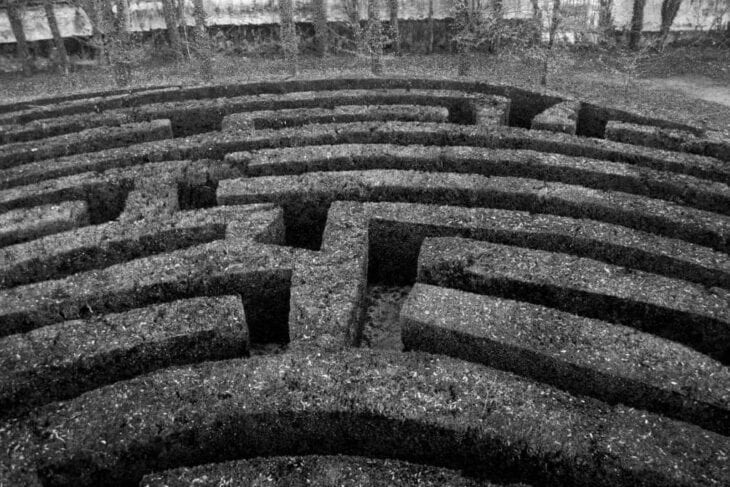
Evans also rebuilt parts of the palace. In the 1920s his team used reinforced concrete to reconstruct the Stepped Portico, the Throne Room and the North Entrance, and ICOMOS, UNESCO’s advisory body on heritage sites, calls these “widely known but much-debated reconstructions” that are now part of the palace’s history.
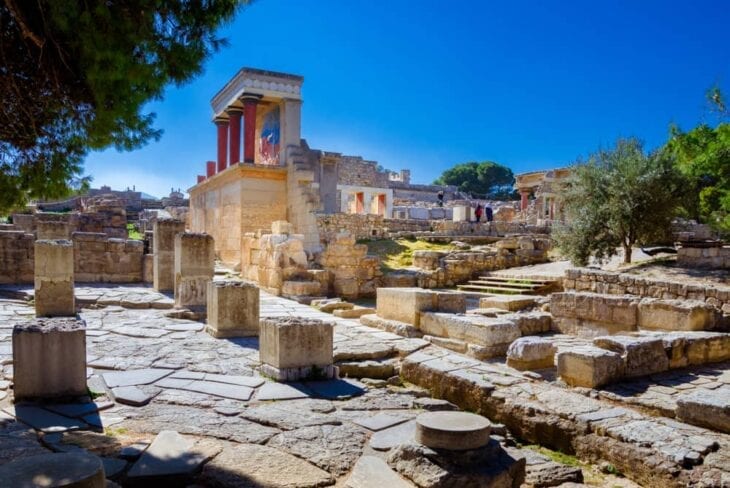
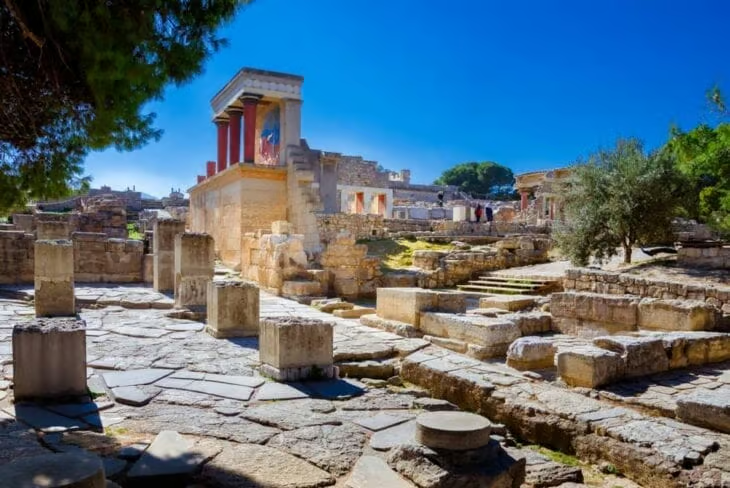
Evans rebuilt the North Entrance in reinforced concrete in the 1920s; UNESCO’s advisers list it among Knossos’s much-debated reconstructions.
Andrew Shapland, the Ashmolean Museum’s curator of Bronze Age and Classical Greece, describes the palace’s maze-like floor plan as the reason many historians link the palace to the Labyrinth myth, while treating that link as Evans’s interpretation rather than an established fact. Classicists Otto Kern and Penelope Reed Doob, whose studies of the Labyrinth motif remain standard references on the subject, go further: the specific claim that the palace itself IS the physical Labyrinth is now largely discounted in scholarship, and no maze structure has ever been found at the site. Since 12 July 2025, Knossos has held UNESCO World Heritage status, inscribed together with five other Minoan Palatial Centres: Phaistos, Malia, Zakros, Zominthos and Kydonia. Entry costs €20 ($22.96, £16.95) for an adult ticket, or €10 ($11.48, £8.48) reduced, with timed entry slots.
UNESCO and its own advisers disagreed about the Minotaur. ICOMOS, in its March 2025 evaluation of the Minoan Palatial Centres, judged that the myth’s link to the palaces “remains weak” and is “not demonstrated”, and that the stories may reflect “later Greek or Mycenaean reinterpretations rather than authentic Minoan traditions.” ICOMOS recommended referring the nomination back to Greece, although it accepted the palaces’ “labyrinthine planning” as an architectural value under criterion (iv). The World Heritage Committee inscribed the site in July 2025 on criteria (ii), (iii), (iv) and (vi). Its final Statement of Outstanding Universal Value, adopted in July 2026 in decision 48 COM 8B.51, says under criterion (vi) that the legend “is directly associated with the palatial centres.”
The Labyrinth Cave near Gortyn: a Rival Candidate, Now Sealed
A quarry cave near Gortyn is the myth’s main rival candidate, and its main cave is sealed to visitors today. Rome made Gortyn, about 43 km (26.72 miles) south of Heraklion, its provincial capital after conquering Crete in 69 BCE, and the stone for its new buildings came from a nearby hillside, leaving behind a network of underground passages. Byzantine writer Ioannes Malalas later described this cave as the Labyrinth. Cristoforo Buondelmonti, a Florentine priest who visited Crete in 1415 and found little left standing at Knossos, mapped the Gortyn cave as the true Labyrinth instead.
Visitors kept coming for centuries. When the French botanist Joseph Pitton de Tournefort explored the cave in 1700, he recorded dates carved by earlier visitors, the oldest from 1444, according to A. M. Woodward’s 1949 study in the Annual of the British School at Athens. Franz Sieber mapped the tunnels in 1821. Later, 19th-century British Admiralty surveyor Captain Thomas Spratt called it “unquestionably a real labyrinth” after exploring it, while fellow traveler Robert Pashley dismissed the whole idea as “a work of the imagination” and argued for Knossos instead. The debate ran for several hundred years before archaeology settled, imperfectly, on Knossos as the more popular candidate.
The Gortyn complex has at least 3 caves, and the 120-metre Little Labyrinth is the one visitors can enter today. German forces stored ammunition in the main cave during the Second World War, and an explosion at the end of the war (1944) destroyed its main entrance; access is now through a narrow grate into a concrete tunnel. The main Labyrinth cave is sealed and entry is forbidden for safety reasons, with no reopening announced as of 2026. The Little Labyrinth (Lavyrinthaki) lies on the north side of the hill and is unmanaged, so bring a torch. A third small cave, hidden on the same hillside, was rediscovered in 2009.
Case study: the 2009 Oxford Labyrinth Expedition. From 29 June to 14 July 2009, an 11-person Greek and Oxford-based team led by geographer Nicholas Howarth surveyed the sealed Gortyn cave. The team included Brigadier Dimitri Hadjiliades as speleologist and ammunitions expert, and Thomas M. Waldmann, an expert on the Gortyn Labyrinth. Inside, the team found dozens of threads laid by visitors re-enacting Theseus’s escape, strung among corroded ammunition left by German forces. The expedition also exposed an illegal treasure-hunting excavation and a possible plan to blow up part of the cave, and the archaeological police confiscated the diggers’ tools. On the hillside nearby, the team rediscovered a third small labyrinth cave hidden beneath a giant fig tree. The survey built on earlier mapping: a Hellenic Speleological Society team explored and mapped the cave in 1985, with the survey map drawn by Anna Petrocheilou. The details come from the expedition’s media fact sheet (PDF).
Is Skotino Cave a Third Labyrinth Candidate?
Yes, Skotino Cave is a third, lesser-known Labyrinth candidate, proposed by the French scholar Paul Faure in the second half of the 20th century. Faure argued that the Labyrinth was a natural cavern rather than a palace, and he pointed to Skotino, which lies about 12 km from Knossos in a straight line. By road, the cave is about 27 km (16.78 miles) and a 35-minute drive from central Heraklion, on a hill near Skotino village. The cave descends 4 levels to its most sacred grotto. Arthur Evans and John Pendlebury excavated it in 1933, Faure dug there in 1953, and Davaras followed in 1962. Faure is said to have abandoned the theory before his death, though the Oxford expedition’s fact sheet reports this only as hearsay.
Skotino is still a place of worship, with a chapel of Agia Paraskevi at the entrance. The cave is unstaffed and unticketed: there is no fee and no guard, so you enter at your own risk. Bring a headlamp and sturdy shoes, and stay in the upper chamber.
What Does the Minotaur Symbolize?
The Minotaur symbolizes the monstrous and the unnatural: chaos, irrational appetite, and desire that overruns its bounds. Its hybrid body, neither fully human nor fully animal, is read as a picture of the darker, more primal side of human nature. The Labyrinth that holds it symbolizes confusion and entrapment, and the myth as a whole works as a cautionary tale about hubris: Minos’s refusal to honor his promise to Poseidon is what brings the curse down on his family and his kingdom.
The Minotaur’s Significance in Greek Mythology
The Minotaur’s story connects to five other well-known episodes in Greek mythology, each one adding a different layer to the legend.
- Knossos and the Labyrinth. The Minotaur was imprisoned in a maze beneath the Palace of Knossos, and the myth ties the creature directly to Minoan Crete through that setting.
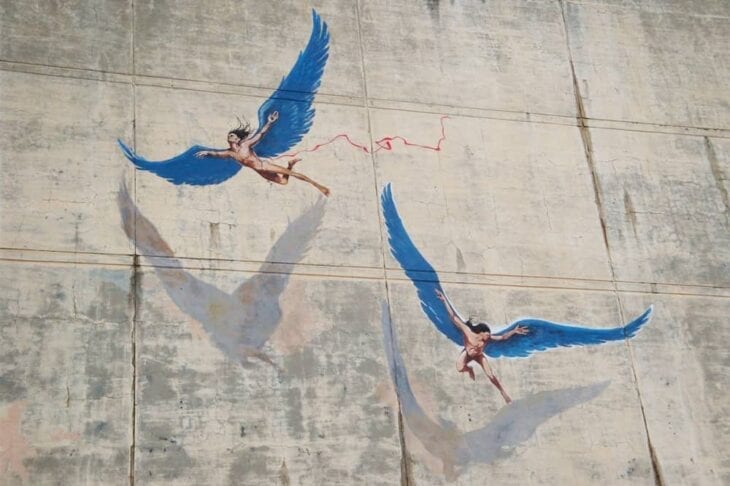
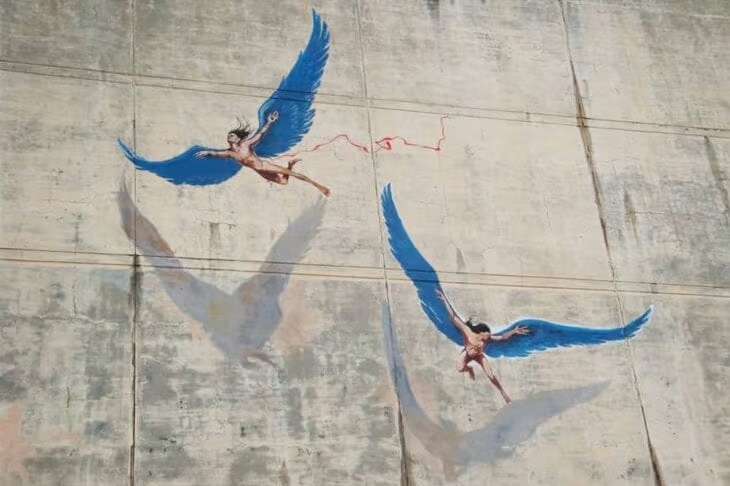
- Daedalus and Icarus. Daedalus, the Labyrinth’s architect, was later imprisoned by Minos to stop him revealing its secrets, so he built wings from feathers and wax for himself and his son Icarus; Icarus flew too close to the sun, the wax melted, and he fell to his death.
- Theseus and Ariadne. Theseus ended Athens’s tribute of human sacrifices by killing the Minotaur, using Ariadne’s thread to navigate the Labyrinth and find his way back out.
- Androgeos and the war with Athens. Minos went to war against Athens after his son Androgeos died there, and the peace terms he imposed created the recurring tribute of Athenian youths that fed the Minotaur.
- The symbolism of Asterion. The Minotaur’s original name, Asterion (“starry one”), links it to older Cretan religious practices built around celestial worship and bull symbolism, and reinforces the myth’s warning against hubris.
The Minotaur in Modern Culture
Writers, artists and game designers have kept reworking the Minotaur for more than a century, each retelling shifting the emphasis of the original myth.
- Mary Renault’s The King Must Die (1958) retells Theseus’s journey as historical fiction grounded in the Knossos excavations.
- Jorge Luis Borges’s “The House of Asterion” (1947) narrates the myth from the Minotaur’s own point of view.
- Pablo Picasso’s Vollard Suite etchings (1930s) returned to the Minotaur repeatedly as a figure of struggle and primal instinct, drawing partly on Spanish bullfighting imagery.
- “The Lightning Thief” (2010), the first Percy Jackson film, opens with the young hero fighting a Minotaur, and the creature recurs through Rick Riordan’s Camp Half-Blood book series.
- “Immortals” (2011) casts the Minotaur as the strongest warrior serving the villain Hyperion.
- “Assassin’s Creed Odyssey” (2018) puts players against the Minotaur as a boss fight, with side missions that reference Theseus and Ariadne’s thread directly.
- Stephen Sherrill’s novel The Minotaur Takes a Cigarette Break (2000) places the creature in the modern American South, using him to explore isolation and identity.
Why Greek Mythology Matters for Tourism on Crete
Greek mythology draws visitors to Crete by tying its ancient sites to stories they already know. Knossos is the clearest example: the Minotaur legend gives an otherwise technical Bronze Age excavation an immediate, memorable hook, and that hook is a large part of why the site draws visitors year-round rather than only archaeology specialists. The myth’s main stop has also moved over time. A century ago, tourists were pointed to Gortyn’s cave rather than Knossos: a 1920s map of Crete, held at the Royal Geographical Society, highlighted the Gortyn Labyrinth as the island’s main tourist feature. Today Knossos draws close to 1 million visitors a year, while the Gortyn cave is sealed.
The same pattern repeats across Greece at the Acropolis and Delphi, where myth and monument reinforce each other and sustain the cultural tourism that funds ongoing preservation work. Travelers who follow the myth beyond Knossos can choose among the other archaeological sites of Crete, from palaces to sacred caves.
Should You Visit Knossos Palace?
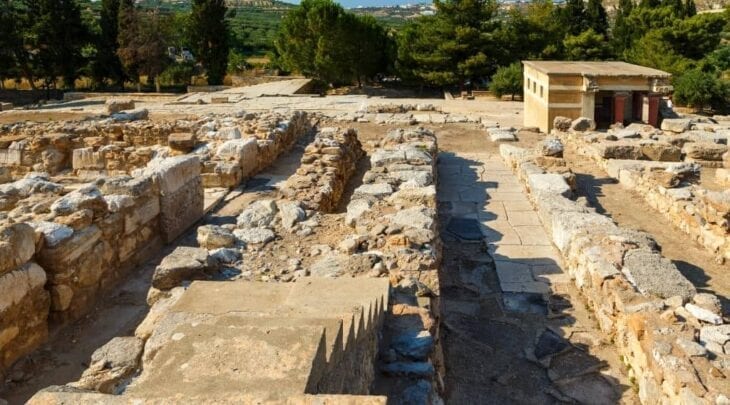
Yes, Knossos is worth visiting for anyone interested in Greek mythology or Minoan history, since it is the site most closely tied to the Minotaur legend and one of Crete’s most complete Bronze Age excavations. A quick, guided visit covers the reconstructed ceremonial spaces, royal apartments and storage rooms in about 90 minutes. Visitors who want to study the architecture and frescoes in more depth should plan for 3-4 hours, and pairing the palace with the Heraklion Archaeological Museum afterward fills in the objects, frescoes and everyday artifacts the site itself no longer holds.
How Much Does a Knossos Ticket Cost?
A full Knossos ticket costs €20 ($22.96, £16.95) and a reduced ticket costs €10 ($11.48, £8.48), at the same price all year. Knossos tickets cost €15 ($17.22, £12.71) (reduced €8 ($9.18, £6.78)) before April 2025, when Greece raised the price. The April 2025 change also ended the cheaper winter fare and the combined ticket for Knossos and the Heraklion Archaeological Museum. Entry works by timed slots, introduced in 2024 to spread out cruise-ship crowds, so book ahead in summer on the official store, tickets.hh.gr, run by the Hellenic Organization of Cultural Resources Development (ODAP). Tickets are non-refundable, and the store allows up to 2 changes per ticket until 2 hours before the visit.
How Many People Visit Knossos?
Knossos drew 977,299 visitors in 2025, down 3.2% from 1,010,006 in 2024, according to the Hellenic Statistical Authority (ELSTAT). The yearly totals rose by about 180,000 between 2022 and 2024. The table below shows annual visitor numbers at Knossos and Phaistos from 2022 to 2025, taken from ELSTAT’s survey of museum and archaeological site attendance.
| Year | Knossos visitors | Change at Knossos | Phaistos visitors |
|---|---|---|---|
| 2022 | 831,320 | n/a | 74,817 |
| 2023 | 959,110 | +15.4% | 79,934 |
| 2024 | 1,010,006 | +5.3% | 84,637 |
| 2025 | 977,299 | -3.2% | 65,431 |
Knossos crowds are strongly seasonal. In 2024, August brought 181,677 visitors, about 18% of the year and roughly 21 times December’s 8,576. The table below compares Knossos visitor numbers for February, August and December 2024, using ELSTAT’s monthly releases.
| Month (2024) | Knossos visitors | Share of the 2024 total |
|---|---|---|
| February | 8,220 | 0.8% |
| August | 181,677 | 18.0% |
| December | 8,576 | 0.8% |
February 2025 was quieter still, at 7,447 visitors. For a calmer visit, winter is the clear choice: February and December 2024 each saw fewer than 9,000 visitors. The Heraklion Archaeological Museum drew about 4 visitors for every 10 at Knossos in 2025 (387,682 against 977,299), so the museum is the quieter half of a Knossos day.
What Other Crete Sites Show Minoan Civilization?
Three other Minoan palaces, alongside Knossos, show the range of Europe’s first advanced culture. The Palace of Phaistos is known for its well-preserved layout and the still-undeciphered Phaistos Disc. The Palace of Malia shows grand stonework and formal architecture from the same period. The Palace of Zakros, on Crete’s eastern coast, survives in unusually intact condition because looters never returned to it after its final destruction. All four palaces, together with the palatial centre at Zominthos and the town of Kydonia (modern Chania), were inscribed as UNESCO World Heritage Sites on 12 July 2025. The Heraklion Archaeological Museum ties them together with pottery, jewelry and frescoes recovered from Knossos and beyond.
The UNESCO property has 6 component parts, and the table below lists each one with the palace area that ICOMOS gives in its evaluation.
| Palatial centre | Palace area | Location |
|---|---|---|
| Knossos | about 22,000 m² | 5 km (3.11 miles) from Heraklion |
| Phaistos | about 8,000 m² | Messara plain, south-central Crete |
| Malia | about 7,500 m² | North coast, east of Heraklion |
| Zakros | about 3,500 m² | East coast of Crete |
| Zominthos | about 2,150 m² | Mountains above Anogeia, about 1,200 m altitude |
| Kydonia | No palace area given | Within the modern town of Chania |
Knossos draws far more visitors than its sister palaces. ELSTAT’s figures show Knossos with about 12 times as many visitors as Phaistos in 2023 (959,110 against 79,934) and about 15 times as many in 2025 (977,299 against 65,431).
Can You Visit Zominthos?
Yes, Zominthos opened to visitors in 2025 with free admission, but it closes often in bad weather, so phone ahead before you drive up. The Minoan palatial centre sits at about 1,200 m on the mountain road above Anogeia. Greece’s Ministry of Culture lists it as open seasonally, roughly April to October, and closed on Tuesdays. On 5 October 2026 the Ministry listed the site as closed until further notice because of adverse weather. The Hellenic Heritage website (hh.gr) says visits are by appointment on +30 28310 23653 or +30 28310 58842.
Zominthos is a road-trip site rather than a coach-tour stop. Drivers starting from the city can pick up a Heraklion car hire and combine the palace with a stop in Anogeia village on the way.