







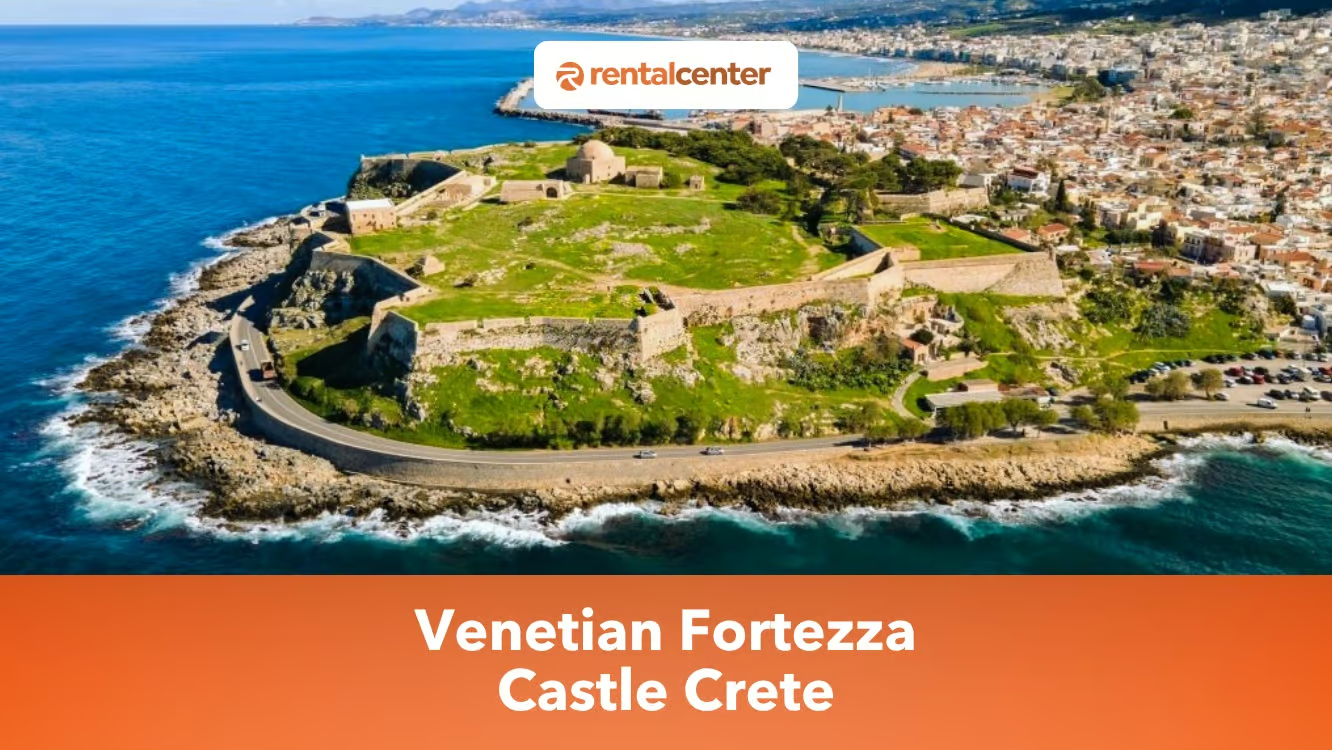
The Venetian Fortezza Castle is the fortress that the Republic of Venice built on the Paleokastro hill in Rethymno, Crete, to defend the town against pirate raids and Ottoman invasion. “Fortezza” is the Italian word for “fortress”, and the Venetians applied that name to the citadel they raised above the harbour town then known as “Castrum Rethemi”. The Fortezza guards the northwest edge of Rethymno’s Old Town, and its walls run 1,307 metres around an irregular plan, according to Wikipedia’s entry on the Fortezza of Rethymno. Greek heritage authorities have partially restored the monument and opened its walls, bastions, and interior buildings to visitors. The fortress hosts cultural events inside its grounds, including music performances, theatre productions, and exhibitions.
Opening hours, admission prices, and car rental rates in this guide change with the season. Verify the current figures with the official ticket office and with your rental supplier before you travel.
Fortezza quick facts
| Attribute | Value |
|---|---|
| Location | Paleokastro hill, Rethymno, Crete (74100) |
| Coordinates | 35.372000° N, 24.471000° E (per en.wikipedia) |
| Built | Begun 1573, completed between 1580 and 1590 (per en.wikipedia / de.wikipedia) |
| Built by | Republic of Venice |
| Wall length | 1,307 m, irregular plan (per en.wikipedia) |
| Managed by | Hellenic Ministry of Culture and Sports (per en.wikipedia) |
| Standard hours | Daily 08:00-19:15 (verify before visiting) |
| Admission | Charged per person – confirm the current price with the ticket office (see the FAQ below) |
| Distance from Chania Airport (CHQ) | 67 kilometers (41.63 miles), per visitourgreece.com |
| Distance from Heraklion Airport (HER) | 89 kilometers (55.30 miles), per visitourgreece.com |
The site of the Fortezza first emerged as a small island separated from Crete. The island resembled the landscape of the Greek leper island of Spinalonga and connected to Crete only through a narrow strip of land. That strip silted up over the centuries and formed the hill that stands today. The hill carried the citadel of ancient Rithymna and a sanctuary of Artemis, the Greek goddess of the hunt. A small community named “Castrum Rethemi” occupied the east side of the hill before the Venetians built the Fortezza.
Venice fortified the hill between 1573 and 1590 as a barrier against pirate intrusions and Ottoman attack. The fortress served Crete as a refuge and as an intermediate stronghold between the neighbouring towns of Heraklion and Chania. More than 100,000 Cretans performed forced labour on the walls, and thousands of pack animals hauled the stone; English Wikipedia puts the figures at 107,142 Cretans and 40,205 animals.
The fortification of the Fortezza drove the growth of Rethymno into a city. The castle rewards visitors with a wide view over the town and its west coast from the top of the hill. A small road circles the fortress and gives a full perspective of the structure from the outside. Rethymno offers convenient options for Crete Car Rental, and a small vehicle suits the visit best, because Greek roads are usually narrow and curvy.
What is the history of the Venetian Fortezza Castle?
The history of the Fortezza hill begins in the 13th century AD, during the Second Byzantine period, when the fortification called “Castrum Rethemi” or Paleokastro (“Old Castle”) stood on the site. The Castrum Rethemi was an earlier, separate fortification, and the Venetian Fortezza replaced it three centuries later. Enrico Pescatore, a Genoese corsair, destroyed that old castle in the early 13th century. Venice later made Rethymno an administrative seat between Heraklion and Chania.
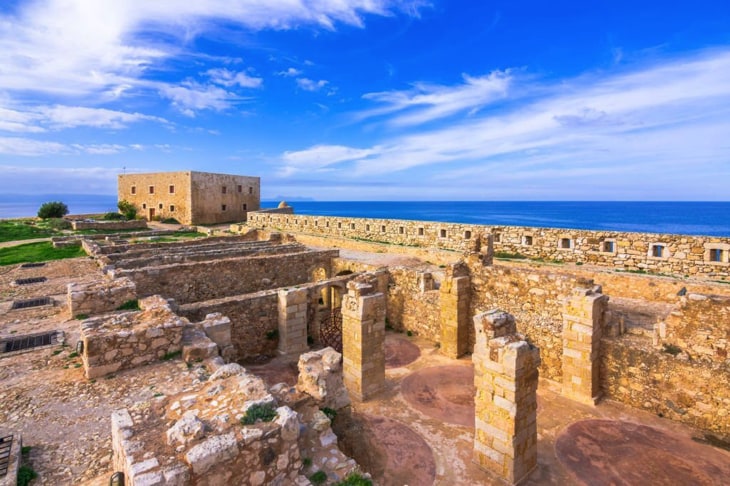
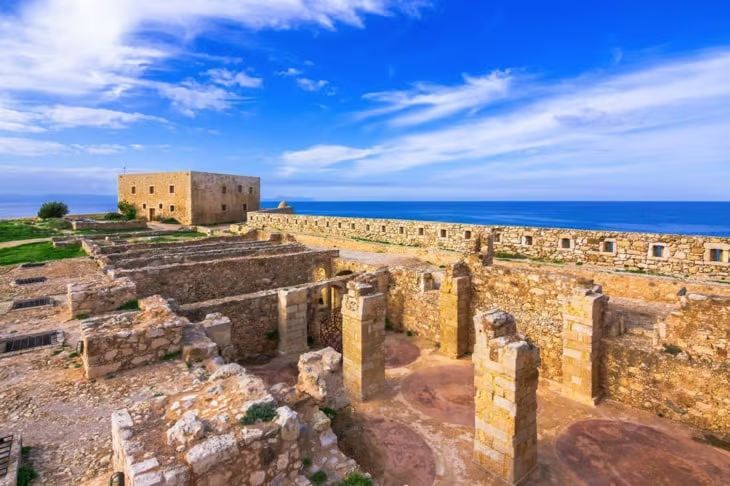
Venice needed a Fortezza in Rethymno by the middle of the 16th century. Ottoman pressure was rising across the eastern Mediterranean, and artillery was advancing everywhere, which left the town’s earlier walls obsolete. An Ottoman fleet under the corsair Uluç Ali (Ulu Ali) sacked Rethymno in 1571 and burned the town; German Wikipedia records that the townspeople afterwards rebuilt their houses with stone taken from the destroyed city wall. Venice and the Cretan administration then resolved to build a proper citadel on Paleokastro hill as a refuge for the whole population of Rethymno.
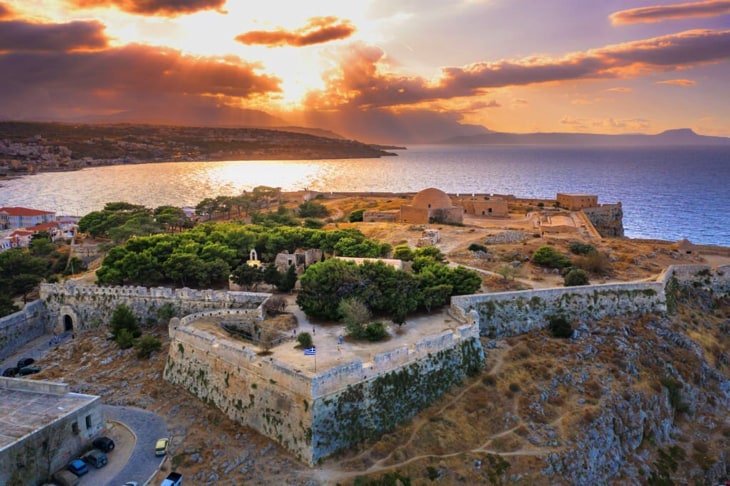
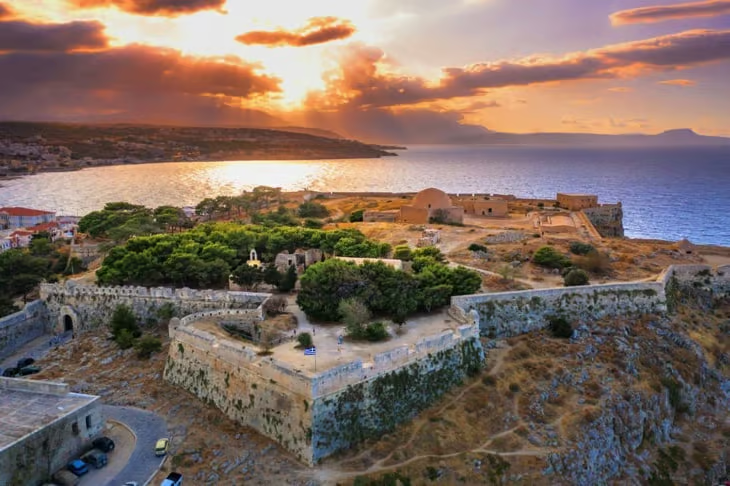
Construction of the Fortezza began in 1573, and the fortress was finished between 1580 and 1590. Sforza Pallavicini designed the fortification, the engineer Gian Paolo Ferrari led the work on the outer wall, and the master builder Giannis Skordilis supervised construction, according to the German and English Wikipedia entries on the Fortezza. Over a hundred thousand Cretans were conscripted into the labour, and tens of thousands of pack animals worked on the site. The citadel nevertheless fell in 1646: an Ottoman force besieged Rethymno on 29 September 1646, the population took refuge inside the walls, and the Venetians surrendered on 13 November after disease, hunger, and a lack of ammunition wore down the defence.
The Ottomans changed little in the design of the fortress. They converted the Venetian cathedral of San Nicolò into the Mosque of Sultan Ibrahim, built houses for the garrison and the administration inside the walls, and raised a five-sided ravelin in front of the main gate. Residents occupied the whole fortress area until the early 20th century.
German forces used the Fortezza as a base during the occupation of Crete between 1941 and 1945, and they converted several buildings into barracks and prisons, according to German Wikipedia. The settlers inside the fortress moved to other districts of Rethymno after World War II, the city demolished its landward fortifications, and the outer walls of the Fortezza survived intact. The Hellenic Ministry of Culture and Sports manages the monument today and has run large-scale restoration work since the early 1990s.
Why was the Venetian Fortezza Castle built on a hill?
The Venetian military engineers chose the Paleokastro hill deliberately, because its height let defenders spot pirate ships and Ottoman forces early and fire down on attackers. The hill gives an overlooking view of Rethymno, its port, and the coast on either side. The sea in front of the Fortezza opens the horizon, so lookouts could see sails long before they reached the harbour. The elevation also made the walls hard to storm, since attackers had to climb under fire.
The Venetians combined defence and administration on the same high ground. The fortress guarded the town, sheltered its people during a siege, and housed the Venetian governor, the Latin bishop, and the army command. That combination of a natural vantage point and a strong artillery fortification is what makes the Fortezza the landmark of Rethymno today.
What is the layout of the Fortezza: bastions and buildings?
The Fortezza has an irregular plan, and its 1,307-metre wall carries four demi-bastions, according to English Wikipedia. The four demi-bastions and the main structures inside the fortress are listed below.
- St Nicolas Bastion: St Nicolas Bastion stands at the east end of the fortress and holds a Venetian-era building, probably a storehouse or laboratory. The bastion offers a wide view over the city and the old harbour.
- St Paul Bastion: St Paul Bastion stands at the southeast end of the fortress and also carries the name Santa Maria Bastion.
- St Elias Bastion: St Elias Bastion stands at the south end of the fortress and contains the Erofili open-air theatre, which hosts the summer performances of the Renaissance Festival of Rethymno.
- St Lucas Bastion: St Lucas Bastion stands at the southwest end of the fortress and carries an L-shaped outwork that once mounted cannon against the opposite hills.
- The main gate and the Ottoman ravelin: The main gate sits on the east side, between St Nicolas and St Paul Bastions, and an Ottoman-era ravelin protects it. That pentagonal ravelin served as the city prison into the 1960s and now houses the Archaeological Museum of Rethymno.
- The Mosque of Sultan Ibrahim: The Mosque of Sultan Ibrahim occupies the central square of the fortress and was originally the Cathedral of St Nicolas.
- The House of the Rector and the Council Building: The House of the Rector was the residence of the Venetian governor of the province of Rethymno, and the Council Building housed part of the Venetian administration. Only the prisons of the Rector’s house survive.
- The churches, armoury, magazines, and cisterns: The churches of St Theodore and St Catherine date from the late 19th century, and the fortress also contains an armoury, two gunpowder magazines, storage rooms, and several cisterns. The armoury beside the main gate hosts exhibitions and cultural events today.
When is the Venetian Fortress open?
The Venetian Fortress opens daily, from Monday to Sunday, with standard hours of 08:00 to 19:15. Opening hours often extend during the summer, and listings vary slightly – one travel guide, visitourgreece.com, publishes 08:00 to 19:30 – so confirm the schedule on the day of your visit. A well-built pavement runs around the hill and gives a full perspective of the fortress from the outside.
The fortress keeps its longest hours during the peak season, which runs from April through October. Special events and exhibitions inside the walls change the schedule on individual days.
When is the best time to visit the Venetian Castle?
The best time to visit the Fortezza is the shoulder season – April to May or September to October – when the weather stays warm but the crowds and prices drop below their July and August peak. Peak season runs from May to October, brings the warmest weather, and pushes accommodation and rental prices up. July and August are the busiest months of the year at the fortress.
Off-season visitors travel between November and March. The fortress is quieter and prices are lower in those months, but the weather is cooler and some attractions and businesses close for the winter. Check the weather forecast before you set out, pack accordingly, and book tickets and accommodation in advance during the peak months, because the castle fills up quickly in summer.
What are the tourist attractions near the Venetian Castle?
The tourist attractions near the Venetian Fortezza Castle are listed below.
What is the best transportation to the Venetian Castle?
The fastest way to reach the Venetian Fortezza Castle is by rental car, because the castle has its own parking at the rear, beside the Old Town. There are 4 ways to get to the Fortezza in Rethymno: by car, by taxi, by bus, and on foot.
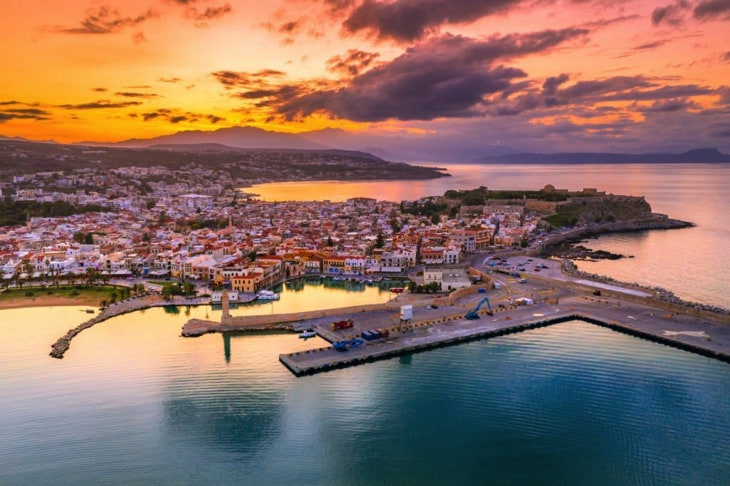
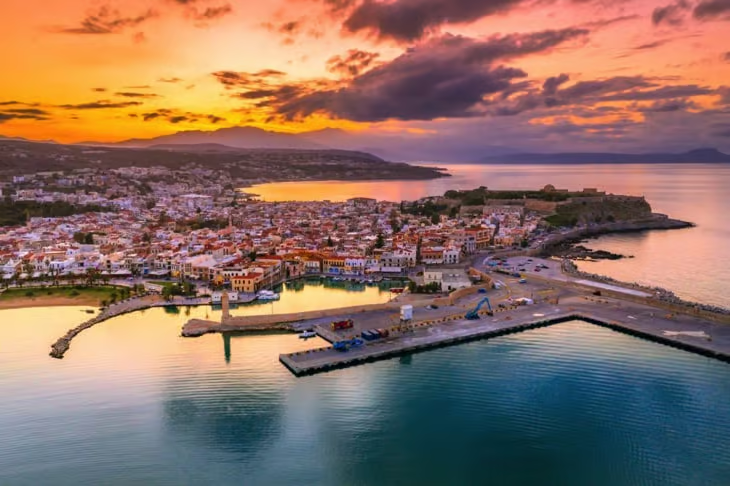
- By car. Drive to the Fortezza and park in the designated visitor parking at the rear of the castle, next to the old town. Stop briefly along the coastal road that circles the fortress for photographs. The Fortezza lies 67 kilometers (41.63 miles) from Chania Airport (CHQ) and 89 kilometers (55.30 miles) from Heraklion Airport (HER), according to visitourgreece.com, so a rental car collected at either airport reaches Rethymno directly.
- By taxi. Hire a taxi from your accommodation to the Venetian Castle. Rethymno has a large taxi fleet, and drivers know the fortress entrance on Odos Katehaki.
- By bus. Ride a local bus toward the Old Town and walk the final stretch uphill. Ask at the Rethymno bus station for current routes, or check the website of the local bus company to book ahead.
- On foot. Walk up the Old Town road of Chimaras from the harbour and the old quarter. The Fortezza is easy to locate because of its size and its elevated position, and the local roads run straight.
What is the importance of the Venetian Castle to the history of Crete?
The Fortezza is the largest fortress Venice built on Crete and the historic seat of Rethymno’s defence against Ottoman invasion. The hill first served as a sanctuary of Artemis, the ancient Greek goddess of the hunt, and as the citadel of ancient Rithymna. The Venetians then turned it into the main line of defence for the town, and the Ottomans held it for more than two centuries after 1646. Pottery, coins, and weaponry recovered on the site document each of those periods.
The Fortezza sheltered the people of Rethymno through sieges, occupations, and a world war. Its walls record the rise and fall of the city, and the monument now carries that history to visitors from around the world. The Fortezza stands as a testament to the strategic weight of Crete during the Venetian and Ottoman periods. Readers planning a wider itinerary can browse our separate guide to Crete’s most significant historical sites and cultural landmarks.
What are the factors to consider before renting a car in Crete?
The factors to consider before renting a car in Crete are listed below.
Two documents are essential for renting a car in Crete: a driver’s licence and a credit or debit card. No tourist rents a car in Crete without a valid driver’s licence in hand, in the same way that no driver operates a car without one. A driver’s licence is the document that permits a person to drive a motor vehicle, and an international licence, such as a valid US licence, qualifies for a rental in Crete. The licence needs to be written in English or in Greek, so both parties understand it.
Most car rental companies in Crete require tourists without an English licence or a prepared translation to have held their licence for at least a year in their home country, and a passport supports the booking. That requirement gives the rental company confidence in the safety of the driver and the vehicle. A travel credit card is the second essential document, because payment for car rentals in cash is not possible in Crete. A credit card is a plastic card issued by a bank that lets its holder acquire goods or services on credit. Most credit cards from the US and equivalent countries carry car insurance coverage by default, which means they already include Collision Damage Waiver (CDW) insurance for car rental coverage. Credit cards also hold the excess charge during the rental period and serve as a guarantee for the rental company if the car is stolen or if a driver declines to pay for damage after an accident.
Car insurance is the second factor to weigh before renting a car in Crete, because it covers repair costs when an accident or collision damages the rented car. Most international credit cards from the US already include a Collision Damage Waiver (CDW) in their car rental insurance coverage in Crete, so some rental offices in Crete add no insurance fee to the rental cost. Other rental offices still recommend adding insurance on top of the coverage on the credit card, for peace of mind while travelling. Many rental companies leave the choice to the client.
The driver’s age is a decisive factor before renting a car in Crete, because rental companies set a minimum age for licence holders. The licence holder must be 21 years old or older to rent a car, and some companies raise the minimum to 23 years old. Drivers under 25 pay an additional young-driver charge on top of the rental cost. Ask the rental company about its age requirement before you book.
The pick-up location shapes the whole rental in Crete. The airport is the best place to rent a car for tourists arriving straight into Crete, because collecting the car at the terminal saves the trip into the city and spares you from carrying luggage between vehicles.
Crete has 2 major airports with car rental services: HER (Heraklion Airport) and CHQ (Chania Airport). Most tourists prefer HER for airport car rentals. Other rental locations sit in Chania, Rethymno, and Plakias. Rental cars must be returned to the exact location where they were picked up, which makes an airport pick-up more practical than a city office, since you can walk straight into the terminal after the drop-off.
The specification of the car is the fifth factor to consider, and it covers size, power, transmission type, and rental cost. Smaller cars suit Crete best, because highways and village lanes are narrow and some stretches narrow further into a single lane. Drivers on those curves have to agree who passes first to avoid a collision. Pack light so your luggage fits a small car.
Bigger cars are available for rent in Crete, and they carry more people and luggage, but they are harder to handle on narrow roads and in tight turns. Choose the car class that matches your itinerary.
Power is the second specification to weigh. Crete is mountainous, roads climb and descend constantly, and a stronger engine handles those gradients with fewer gear changes and more comfort.
The transmission type is the third specification. Most rental cars in Crete are manual, and manual cars are cheaper than automatic ones. Automatic cars are fewer and cost more, so book an automatic as early as possible – that is where online booking becomes essential.
The rental cost is the fourth specification. Cheaper cars carry lower specifications, and higher-priced cars carry better equipment and more comfort. Rental prices in Crete vary through the year and drop in January and February. The average rental cost of a car in Crete ranges from 15 to 50 US dollars per day. Choose the specification that fits your budget without trading away comfort, safety, and time.
Online booking lets you reserve a car in advance, at your own convenience, and pay from home. Car rental agencies in Crete run web-based booking systems, and some offices still take bookings over the phone. Booking online saves time and money, because online promotions and discounts do not appear at the counter. Online bookings also open a direct line to the agency, so the car is ready at pick-up, the paperwork is prepared in advance, and you wait less.
How much does a car rental in Crete cost?
The average cost of renting a car in Crete for a week is €184 ($211.25, £155.94), according to rental-center-crete.com. The cost depends on the pick-up location, the type of car, the number of rental days, and the number of passengers. A day trip costs around €11 ($12.63, £9.32) to €26 ($29.85, £22.04), depending on the car type. A night rental in Crete runs higher, from €24 ($27.55, £20.34) to €97 ($111.37, £82.21), because it falls outside regular office hours.

The pick-up location changes the price. Heraklion Airport (HER) is one of the leading car rental locations in Crete, and its average rental cost is around €16 ($18.37, £13.56) per day. Chania Airport is the second popular location, at around €17 ($19.52, £14.41) a day. Rethymno Hotel is the third prominent location, and its rental price reaches €31 ($35.59, £26.27) a day.
The itinerary changes the price as well, because a longer route needs more days and raises the total. Elafonisi Beach is one of the top itineraries in Crete, with an average car rental cost from €18 ($20.67, £15.26) to €145 ($166.47, £122.89) depending on the car type, with a pick-up location in Chania, Greece. The rental cost from a Crete-and-Chania pick-up runs from €43 ($49.37, £36.44) to €158 ($181.40, £133.91), according to rental-center-crete.com. Balos Beach is another famous destination in Crete, and the car rental cost to Balos ranges from €18 ($20.67, £15.26) to €29 ($33.29, £24.58) depending on the car type, with pick-up available in Chania, Crete. Samaria Gorge is a further go-to destination, with pick-up in Crete and Chania and a rental cost from €18 ($20.67, £15.26) to €175 ($200.92, £148.31) depending on the car type.

Other factors affect car rental costs in Crete, and the ones above are the most relevant. Knowing them in advance is one of the elements that make a trip across the island work.
Frequently asked questions about the Venetian Fortezza Castle
How much is the entrance fee to the Fortezza?
The Fortezza charges a per-person admission fee at the gate. The travel guide visitourgreece.com lists €4 ($4.59, £3.39) per person and €10 ($11.48, £8.48) for a family ticket in its 2025 Fortezza listing, and TripAdvisor reviewers report a combined ticket with the Museum of Contemporary Art of Crete. Confirm the current price with the ticket office or the Municipality of Rethymno before your visit, because admission prices and combined-ticket offers change between seasons.
What is the book about the Venetian Castle?
The book about the Venetian Fortezza Castle is titled “FORTEZZA | The History of the Venetian Fortress at Rethymnon”. The book covers the invasions and the sieges that the town of Rethymno withstood, and it describes the walls, towers, and gates of the fortress and their defensive role. It also documents the daily life of the soldiers, artisans, and convicts who lived and worked inside the castle. The local government of Rethymno published the volume, and MW Books Ltd of Galway, Ireland, is the store partner that stocks it; the book also sells online through Amazon.
“FORTEZZA” contains drawings, maps, and images of the castle and its surroundings, which together work as a visual tour of the site. A further reference work on the monument is Stella Kalogeraki’s “Fortezza – The Castle of Rethymno” (Mediterraneo Editions, Rethymno, 2000), which Wikipedia’s German entry cites throughout its account of the fortress.
Is the Venetian Castle a UNESCO World Heritage Site?
No, the Venetian Fortezza Castle is not a UNESCO World Heritage Site. The Fortezza is a historical landmark in Rethymno and a protected archaeological site, but UNESCO has not placed it on the World Heritage list. UNESCO, the United Nations Educational, Scientific, and Cultural Organization, decides which sites enter the list, and it bases the assessment on the site’s value to the world and on the need to preserve it for future generations.
The Fortezza remains a recognised historical and cultural monument of Crete, and heritage authorities have preserved and restored it over the years. Other Cretan sites carry greater international recognition, among them the historic Old Town of Chania and the archaeological sites of Knossos and Phaistos. Greece’s inscribed World Heritage Sites include the Acropolis of Athens in Attica, the archaeological site of Delphi in Central Greece, the Temple of Apollo Epicurius in the Peloponnese, and Mount Athos. Our separate guide covers the UNESCO World Heritage Sites in Crete for travellers planning a heritage itinerary across the island.
Why is the Venetian Castle considered an archaeological site?
The Venetian Castle counts as an archaeological site because it preserves Venetian and Ottoman structures and artefacts on its grounds. The Venetians built the Fortezza in the 16th century, between 1573 and 1590, as a military stronghold to protect Rethymno and its port, according to the English and German Wikipedia entries. The earlier 13th-century Byzantine fortification on the same hill, Castrum Rethemi, predates the Fortezza and was a separate structure. The castle then served as a military outpost through the Ottoman era, and part of it worked as a prison into the 20th century.
Excavation at the site has uncovered the Venetian architecture of the fortress, including its bastions, towers, and walls. The grounds have yielded pottery, coins, weaponry, ceramics, columns, and arches. Those finds document the Venetian and Ottoman occupations of Crete and open a window on the island’s past. The walls, towers, and buildings of the Fortezza count as archaeological features in their own right, and they show how the fortress developed and how each era used it. Visitors comparing monuments across the island can read our guide to the archaeological site of Crete.
Is it worth visiting the Venetian Castle?
Yes, visiting the Venetian Castle is worth the trip, whether or not you have a specific interest in history, architecture, or antiquities. The Fortezza is one of the most significant structures on Crete, and its grounds and walls are open to exploration, with views over the town, the countryside, and the Cretan Sea. Displays inside the castle present artefacts, armour, and weapons that set out the cultural history of the island and the origins of the fortress.
The defended walls, towers, and gates make the Fortezza a remarkable example of Venetian military architecture. TripAdvisor rates the Venetian Fortezza 4.1 out of 5 from 3,468 reviews and ranks it No. 6 of 69 things to do in Rethymno at the time of writing. Lonely Planet recommends the Fortezza in its Crete guidebook, citing the architecture, the views, and the historical significance of the site, and it advises a guided tour to understand the history and cultural heritage of the fortress.
Reviewers praise the architecture, the panoramic views, and the cultural value of the castle. Some reviewers note that the climb to the castle takes effort, and they judge the views over the city and sea worth it. Visitors with mobility challenges should plan for uneven ground and a steady uphill approach, and several reviewers suggest visiting in the cooler months to avoid the summer heat.